

Champion Homes (SKY), Cavco Industries (CVCO), and others in or beyond manufactured housing corporate interests periodically raise the topic of teaming up with site builders and conventional developers as a possible channel to expand HUD Code manufactured housing and/or other factory-built housing production. With that in mind, the following. “PATH (Partnership for Advancing Technology in Housing) is a new private/public effort to develop, demonstrate, and gain widespread market acceptance for the “Next Generation” of American housing. Through the use of new or innovative technologies the goal of PATH is to improve the quality, durability, environmental efficiency, and affordability of tomorrow’s homes,” per the historic and what could be a potentially groundbreaking HUD document linked here. That NAHB Research produced document said on page 7: “Offer a comparable [to conventional site-built housing a] product [i.e.: manufactured homes] at a lower price.” According to that HUD document.

Disclaimer
This report was prepared by the NAHB Research Center, Inc., for the U.S. Department of Housing and Urban Development, Office of Policy Development and Research. The contents of this report are the views of the contractor and do not necessarily reflect the views or policies of the U.S. Department of Housing and Urban Development, the U.S. Government, or any other person or organization. Trade or manufacturers’ names herein appear solely because they are considered essential to the object of this report.
“Initiated at the request of the White House, PATH is managed and supported by the Department of Housing and Urban Development (HUD). In addition, all Federal Agencies that engage in housing research and technology development are PATH Partners, including the Departments of Energy and Commerce, as well as the Environmental Protection Agency (EPA) and the Federal Emergency Management Agency (FEMA). State and local governments and other Participants from the public sector are also partners in PATH. Product manufacturers, home builders, insurance companies, and lenders represent Private industry in the PATH Partnership.” Home Builders’ Guide To Manufactured Housing Prepared for: U.S. Department of Housing and Urban Development Office of Policy Development and Research Washington, D.C. Prepared by: NAHB Research Center, Inc. Upper Marlboro, MD.”
Looking ahead to a pull quote from #11, below.
[From a facts-evidence-analysis (FEA)] standpoint, it is reasonable—not reckless—to say:
- Yes, corporate counsel and boards should have scrutinized that letter.
Whether anyone chooses to test that in court is a separate, strategic question—but the dots you’re connecting are not fanciful; they’re grounded in documents, timelines, and on‑the‑record statements.
That may be no less important than what follows from the NAHB Research via HUD PATH document linked here.
1. Per page 5 is HUD’s foreword.
Foreword
Most new homes in the United States are site-built to State and local codes, but an increasing number are ‘manufactured homes,” designed and constructed to meet the requirements of the pre-emptive Federal Manufactured Home Construction and Safety Standards. For decades, manufactured housing has provided a low-cost alternative to conventional site-built construction. Evolution of the manufactured home is eliminating many of the differences with site-built homes, and changes in zoning laws are allowing use of manufactured homes outside of land zoned for parks in a growing number of States.
These developments are leading some home builders to consider using manufactured housing for entry-level product, often with significant site-built improvements or enhancements, instead of site-built homes. The result can be substantially lower production cost or other economic advantages for the builder and the consumer.
This Guidebook provides conventional builders and land developers with an introduction to manufactured housing, focusing on differences between manufactured and conventional homes that are likely to be encountered in practice. Chapters of the Guidebook describe various options for using these homes. The Guidebook covers finding a manufacturer, developing product specifications, potential contractual arrangements, local zoning and land-use planning considerations, installation and foundation options, site-built improvements, regulatory issues and consumer financing. Many references to more detailed resources are also included. Users of the Guidebook will find a wealth of information to assist in their business planning and support decisions about whether and how to make use of manufactured housing as part of a larger home building business.
Susan M. Wachter
Assistant Secretary for Policy
Development and Research
2. From the HUD PATH document linked here.
A Quick Guide to the Guidebook
This book Presents information for site builders and land developers about how they can use HUD-Code manufactured housing as part of their business operations.
If You Need an Introduction…
If you need an introduction to the subject you should start with Chapter One, which describes the evolution of manufactured housing from a market and design standpoint, and Chapter Two, which discusses market positioning and the different types of business opportunities you may want to consider pursuing with HUD-Code homes. These chapters will help you determine which other parts of the Guidebook to review.
If You Have a Project in Mind…
If you are generally familiar with manufactured housing and already have a tentative business concept in mind, you can jump directly into the later chapters that present more detailed information about some of the key issues that may arise in connection with your project.
- Chapter Three goes into detail about identifying, selecting and working with a manufacturer to identify acceptable designs and strike an appropriate business relationship. Every builder who uses manufactured housing will need to address these issues.
- Chapter Four discusses special zoning issues that may arise in Projects to use manufactured housing, including state-level requirements for using manufactured units on land zoned for single family houses that should help you work within the local system.
- Chapter Five covers unit installation and site-built improvements such as attached garages or decks, and how they differ from conventional site-built construction.
- Chapter Six covers consumer financing alternatives which are critical to any sale, including real and personal property financing.
- Chapter Seven Presents case studies of some projects that have used manufactured housing.
If You Have Detailed Questions or Need More Information…
The Appendices present other materials that you should find very helpful.
-
Appendix A contains a list of manufacturing plants by state, city and manufacturer.
-
Appendix B contains selected state-level market data and extensive information about state zoning requirements relating to manufactured housing.
-
Appendix C contains a list of State Administrative Agencies that participate in enforcement of the HUD regulatory system and may regulate installation or site alterations. • Appendix D presents information about typical development standards for land-lease communities of manufactured homes.
-
Appendix E includes manufacturer contacts, producer web sites, state-level manufactured housing association web sites and other useful references.
3. Under the facts-evidence-analysis (FEA) model, arguably part of the problem that the Manufactured Housing Institute (MHI) and several of their larger brands have is that there are historic documents that undermine their recent or current narratives. When Champion Homes (SKY), Cavco Industries (CVCO), others in MHI or the trade association itself make statements that may make it sound to casual or underinformed readers that it would be ‘groundbreaking’ to get builders to consider HUD Code manufactured homes for residential developing, two story, or other projects reports like this ought to be brought to the attention of media, analysts and others.

But the quotes above and the full HUD report linked here reveals this has been a topic of discussion for over a quarter of a century! The NAHB authored and HUD published PATH report is dated May 2000, prior to the enactment of the Manufactured Housing Improvement Act of 2000 (a.k.a.: MHIA, MHIA 2000, 2000 Reform Act, 2000 Reform Law).
MHI and MHARR are both cited by the NAHB authored and HUD published report.
The Manufactured Housing Association for Regulatory Reform (MHARR) is another industry trade association, located in Washington, D.C. (telephone 202-783-4087). …
… The Manufactured Housing Institute (MHI), located at 2101 Wilson Boulevard, Suite 610, Arlington VA 22201 (telephone 703-558-0400), is the principal national trade association for the manufactured housing industry. …
However, the MHI offices have since moved to: 1655 Fort Myer Dr., Suite 200, Arlington, VA 22209-3108. The phone numbers for both trade groups shown above are the same. The document does clearly specify that MHARR is a producer’s-oriented trade group, while MHI claims they represent “all segments” of the industry, so they are an ‘umbrella’ trade group.
3. From page 26.
There have been only a few zoning cases focused on pre-emption under the HUD Code. No cases have reached the U.S. Supreme Court. Lower federal courts have relied on pre-emption to strike down local Florida and Colorado requirements that excluded HUD-Code homes unless they met the Standard Building Code, or the Uniform Building Code. Other federal cases have upheld local zoning requirements for a minimum 4: 12 roof pitch, and for residential-type siding and roofing on manufactured homes, as aesthetic requirements that were not preempted by the HUD-Code. In addition, the federal pre-emption was held not to invalidate a Texas city’s prohibition of all manufactured homes from areas other than mobile home parks.
That statement above is potentially useful for MHARR and other advocate’s argument about the “enhanced preemption” provision of the 2000 Reform Law. On paper, MHI pays lip service to “enhanced preemption” (see example, see page 7- linked here). But unlike MHARR, which has dozens of citations of that specific phrase: “enhanced preemption” on their website. In stark contrast, MHI has apparently culled that terminology from their website at some time after rebuilding their website.

Additionally, the HUD PATH report said this.
The restrictive approach to zoning has been legislatively reconsidered in many places with the advent and increasing production of multi-section homes and the imposition of improved construction standards through the HUD-Code. The result has been a trend in the 1980’s and 1990’s for states to limit the authority of local governments either to exclude all manufactured housing, or to confine all such homes to designated parks through zoning. Some amended state zoning laws require that manufactured housing meeting certain appearance, size, installation and/or age criteria be permitted in most or all single family districts. Others specifically recognize and regulate manufactured housing subdivisions or overlay districts as a new type of use subject to unit and development criteria that may differ from other single-family housing. These changes have opened the door to broader use of manufactured housing outside of traditional parks or land-lease communities and thereby expanded potential markets.
4. Without endorsing the history (or the document more broadly) that follows, the information that follows is in some respects useful for industry professionals, researchers, media, public officials and others to be aware of when it comes to the ‘evolution’ from trailer houses, to mobile homes, to HUD Code manufactured homes. Per the PATH report.
The U.S. home building industry is often described as consisting of a conventional or “stick-built” sector, that constructs new homes largely or entirely on site, and an industrialized or “factory-built” sector that assembles homes in a plant, ships them to a point of sale or use, and installs them on a prepared site. There are several different types of factory-built housing, but by far the most common is “HUD-Code” or manufactured” housing. HUD-Code manufactured homes are so named because since 1976 they have been required to be designed and constructed to the pre-emptive federal Manufactured Home Construction and Safety Standards, administered by the U.S. Department of Housing and Urban Development (HUD). This legally distinguishes manufactured homes from factory-built ‘modular” homes as well as site-built homes, both of which are required to meet applicable state and local construction codes.
This Guidebook provides information about HUD-Code homes to an audience of site builders and land developers. A companion Guidebook aimed at HUD-Code producers and containing information about working with site builders and land develop ers is also available from HUD. Additional useful background information about the site-built, modular and HUD-Code segments of the housing industry appears in a 1998 study, Factory and Site-built Housing: A Comparative Analysis, published by HUD.
Why Should I be Looking at Manufactured Homes?
While both stick-built and manufactured homes provide shelter for the owners or occupants, there have historically been extensive differences between these two sectors of the industry in terms of product features, zoning, marketing, financing and the economic structure of production. Market overlap between the two sectors has been considered as minimal due to dissimilarities in the underlying products and many builders have given little thought to using manufactured housing.
There is reason to believe the environment is changing. The traditional segmented view of the market dates back to the origins of today’s manufactured housing, the travel trailers and “mobile homes” of previous years, which were designed and sold as lightweight, self-contained living units that could readily be moved from one site to another over the highways. These products were uniformly viewed as a form of personal property, similar to the automobile, not as improved real estate.
Pre-war Travel Trailer
The appearances of mobile homes evolved and production grew dramatically through the 1960’s but the basic long rectangular shape and flat roof line remained. The industry underwent a regulatory transformation in the 1970’s and “mobile homes became ‘manufactured housing.” Yet older products remain in use even today, and attitudes about manufactured housing sometimes reflect images of older trailer courts and mobile home parks where many such units are placed close together on small pieces of leased land, and owned or rented predominantly by lower-income households.
1960’s Mobile Home
Designs and features of both site-built and manufactured homes have been changing over the decades. On the site-built side, economic and market forces have led new homes to become larger, better appointed and more expensive than ever before. At the same time escalating costs have made it much more difficult, even impossible in some areas, to build on-site for an affordable, entry-level market. Figure 1 shows the trend in the percentage of new homes priced below $ 100,000. While much of this decline represents inflation, particularly during the 1980’s, it also reflects a tendency for conventional builders who once produced starter homes for first-time buyers to target the move-up, luxury and custom marketplaces rather than concentrating on selling to a less affluent entry-level market.
5. The following contains insights that arguably tend to undermine the Manufactured Housing Institute (MHI) talking points about the MHI branded and Clayton Homes (BRK), Champion Homes (SKY) and Cavco Industries (CVCO) backed CrossModTM homes. Per the May 2000 PATH report.
The pace of change has been even faster in the HUD-Code sector. In the early 1980’s, nearly three-quarters of HUD-Code homes consisted of a single section, generally 12 to 14 feet in width. Most new units were sited on leased land in a community of similar homes. But by 1998 over 60 percent of new HUD-Code homes included two or more sections designed to be joined at the site, and about 75 percent of new multi-section homes were located on private land rather than in a park. Shipments of single-section and multi-section HUD-Code units from 1980 through 1999 are plotted in Figure 2 (1999 shipments are projections based on half-year data). The Figure clearly shows the substantial growth in multi-section shipments during the 1990’s.
The shift towards multi-section homes has marked a fundamental transition for manufactured housing. Not only do two sections greatly increase living space, but the resulting structure has the rectangular footprint and aspect ratio of a modest starter home or tract home of a previous era. At the same time there have been changes in interior finishes, siding, appliances and other products and materials that bring HUD Code homes closer to what is standard in the site-built sector.
As MHProNews has frequently pointed out, years before the “new class of manufactured housing” or the later term CrossModTM were rolled out by MHI and their consolidation-focused brands, there were manufactured homes that were ‘residential style.’ There were already ground sets, two story, and other designs. The pre-CrossMods photo collage displayed below is a reminder of just some of the wide array of designs built and sold prior to what was described some 8 years ago as the Trojan Horse for manufactured housing. Integrated garages, hinged roofs, Cape Cods and other designs mimicked site-built features for significantly less than the site-built cost.

In the post-Berkshire Hathaway (BRK) era of manufactured housing (starting in the 2002-2003 timeframe), new HUD Code manufactured home production declined rather than rose.

The year that the PATH report linked above was produced, manufactured housing produced some 250,366 new homes. By comparison, last year (2025) only 102,738 new HUD Code manufactured homes were produced. In 2002, when Berkshire took a stake in Oakwood Homes Corp (OKWHQ), 165,489 new homes were produced. The next year (2003) Berkshire acquired Clayton Homes. The industry has never recovered to 2002 or 2003 levels since.

Given that Kevin Clayton himself said in a video interview that “Warren” assured him access to ‘plenty of capital’ to do whatever he felt was needed or useful, one can logically conclude based on the known history that Clayton and Berkshire wanted to see the industry stay depressed (see video and transcript below).

The evidence for that is ample, including remarks made by prior MHI presidents/CEOs.


RVs once trailed manufactured housing by some 3 manufactured homes to 2 RVs in the mid-to-late 1990s. But by the 21st century, RVs outpaced manufactured homes by a factor ranging from 4-to-6 RVs to 1 manufactured home, depending on the year. Berkshire Hathaway is involved in both the RV and manufactured housing (MH) industries.

6. While it might be a mistake to over-emphasize the Berkshire impact on the manufactured housing market, it could be equally problematic to under-emphasize the role Berkshire Hathway played in deploying “moat” tactics and essentially cutting manufactured housing down to its current size. Nor is that speculative, because Kevin Clayton himself described the “moat” methods and the fact that they wanted to make it “hard” on their competitors. Two sets of quotes, both from MHI member firm leaders, illustrates the point.

Additionally, longtime Buffett ally William “Bill” Gates III made this eye-opening observation about Buffett and his business tactics in comments reported by CNBC.


Buffett and Gates served on each other’s boards; Buffett for the Gates Foundation, and Gates for Berkshire Hathaway (BRK).

The infamous CNBC quote by Gates on Buffett.
In an interview at The New York Times/DealBook conference on Wednesday, the Microsoft co-founder explained why he was initially reluctant to meet with Buffett.
“I didn’t even want to meet Warren because I thought, ‘Hey this guy buys and sells things, and so he found imperfections in terms of markets, that’s not value added to society, that’s a zero-sum game that is almost parasitic.’ That was my view before I met him … he wasn’t going to tell me about inventing something,” Gates said at the conference.
To frame that remark, one ought to recall the quote about Gates from the judge who presided over the Microsoft antitrust case.

Other quotes from those who may not be Gates fans.


https://www.hhs.gov › about › leadership › robert-kennedy.html
Robert F. Kennedy, Jr. – HHS.gov
Robert F. Kennedy, Jr. is the 26th Secretary of the U.S. Department of Health and Human Services.
This was a liberal Democrat (Bobby Kennedy Jr. or RFK Jr.) taking on one of the oligarch’s supporting left-leaning Democratic candidates and policies that Gates and Buffett had both championed for years. While Buffett himself did not announce support for Kamala Harris (D) in 2024, Buffett had a long history of doing just that, as did Gates. While it may be coincidental, Kennedy spoke of neo-feudalism with respect to men like Gates (and by extension, Buffett). Gates has had a significant stake in Berkshire Hathaway (BRK) for years, through his Cascade investment firm as well as through the Gates Foundation.


The Gates and Buffett history run deep. Institutional capture is part of it. Are savvy individuals to think that Buffett (along with the potential support of other billionaires like Gates, Soros, etc.) unable to sway a federal agency like HUD into enforcing federal enhanced preemption under the 2000 Reform Law?


Once AIs are introduced to such concepts and the evidence like what is shown above or herein below, they routinely ‘spot’ the patterns of behavior. Copilot is a product of Microsoft. While it may tend to favor left-leaning causes, as Copilot itself has said based on a body of research evidence. An information ecosystem exists that tends to lean left with significant sway held by firms like those operated by Gates and Buffett’s Berkshire Hathaway (BRK). This has been documented in the left-leaning and award-winning documentary drama (see below), Shadows of Liberty that spotlighted the “black holes in journalism.”


It is in Shadows of Liberty that left-leaning actor Danny Glover famously said the quote shown below. Glover served on a Buffett foundation board of directors, so he apparently had an up close and personal seat at the table to observe and make his remark.


The quotes that follow are from Shadows.


That is a peek at narrative control on literally an industrial scale. The “oligarchs and billionaires” that Senator Bernie Sanders (VT-DS- former Democratic Party presidential hopeful) and Rep. Alexandria Ocasio Cortez rail against are often left-leaning and left-supporting. That is not to say that there aren’t billionaires who support right-leaning causes, because there are. For years, “Establishment” Democratic and “Establishment” Republican politics operated a bit like a two-sided coin, with “Establishment” candidates winning presidential elections and Establishment billionaires and their corporate interests benefiting. In the Obama White House was a Buffett grandson.


Gates-linked Microsoft Bing‘s Copilot spelled out the “great observation” that regulatory capture, the Iron Triangle, and the “Rigged System” are interconnected.

Over 26 years ago, these observations by the NAHB Research via HUD’s PATH program documented facts about manufactured housing back then that are as or truer today than they were at the time. Manufactured housing market share was higher in the late 1990s than it is today. Buffett wasn’t ignorant of the industry’s potential. A high-level MHI-linked corporate source told MHProNews that Buffett had been eyeing manufactured housing since the late 1980s. It wasn’t until 2002 and 2003 that Buffett began his moves. That’s patience.
So, if anyone doubts that manufactured housing’s potential in the late 1990s, as the Manufactured Housing Improvement Act was beginning to take shape, at the time this NAHB Research via HUD’s PATH program was published, a look at the various puzzle pieces begin to bring this picture into focus. Mega-capitalists, who often supported left-leaning causes, understood regulatory capture, the Iron Triangle, or what MHProNews has dubbed AmeRegCorp. Gemini called the housing crisis a “man made crisis.” Quite so.


It is preposterous to think that some elements of MHI’s membership are ignorant of these matters, because some of their firms were cited in the NAHB authored research for HUD. Talking about the potential to do something is not the same as actualizing that potential. Quoting the HUD PATH document from May of 2000.
Who Should Use this Guidebook?
This Guidebook is written as a resource for site builders and builder/developers that want to know more about how they may be able to take advantage of manufactured housing as part of their ongoing business operations. Different builders inevitably will have different motivations for investigating a new strategic direction. The Guide can only summarize the kinds of business approaches that have been or could potentially be used by conventional builders interested in substituting a factory-built home for a site-built one.
While the use of manufactured housing strikes many home builders as a fundamental change in operations, this is not necessarily so. Most home building companies already rely extensively on subcontractors to perform construction work. Substituting factory-built units for site-built homes can be seen as another step in the same direction, where most aspects of unit construction, code compliance and delivery to the site are handled by the manufacturer. The building company may retain responsibility for building a suitable foundation, on-site installation and utilities, finish work, construction of site-built amenities, marketing, consumer financing and closing of sales, as well as local zoning and environmental approvals. Depending on the project, the builder or land developer also may need to arrange for any necessary subdivision development, utility infrastructure, community facilities and lot development.
Or this by NAR Research via HUD PATH.
Basic Considerations
The potential for expanded use of manufactured housing by today’s site builders rests largely on the possibility of realizing significantly lower production cost, higher margins, improved market share or some combination of these potential competitive advantages through the adoption of a substitute production and supply technology.
Other factors that ultimately can contribute to achieving a competitive advantage include shorter cycle time, less waste at the site, minimizing labor supply problems, reduction of the need to find and coordinate subcontractors, shifting of warranty responsibility for the factory-built unit, and reducing the burden of multiple local code inspections required for site-built units.
Or this.
Offer a more desirable product at a similar price
Under this approach the existing target market of buyers would be retained and more sales could be made based on improved appeal of the product. The buyer market would also be expanded to include purchasers that are attracted to added features or amenities that can be included in the manufactured home without raising the cost above pre-existing levels. Product desirability can be enhanced by specifying higher quality products, appliances and finishes and by providing attractive site-built amenities. The profitability implications depend on whether per-unit margins can be preserved or increased. The principal issues under this approach are the technical challenges of producing a more desirable product without sacrificing margins, and availability of suitably zoned land for any expanded sales. Financing issues are less important under this approach, since the target buyer market is not really changing.
Offer a less desirable product at a significantly lower price
This strategy represents a clear shift towards supplying more basic, affordable housing particularly suitable for first-time buyers and others whose incomes cannot support the expense of conventional homes. While the product will typically be smaller and more economically appointed than other new homes built today, it will probably resemble entry-level site-built homes that were the mainstay of the home building industry for much of the last 50 years. Technical issues are the least significant under this approach, and financing problems are potentially the greatest when doing expanded business with a significantly less affluent buyer group more likely to have sub-par credit and less access to market-rate mortgage money. Availability of suitably zoned land is also a major issue under this approach, because expanded sales will be needed to compensate for lower margins on lower-priced product and because the product characteristics are most likely to trigger community opposition to any required zoning approvals.
When Legacy Housing’s co-founder Curt Hodgson recently said manufactured housing needed to consider being more like site builders who plan complete developments, that was hardly a new notion. NAHB was pitching that 26 years ago in documents like the above published by HUD.


One should note that Hodgson and Kenny Shipley led Legacy Housing are not apparent allies of Clayton Homes (BRK). They are longtime rivals.

7. When prominent MHI members like Equity LifeStyle Properties (ELS), Sun Communities (SUI), Flagship Communities (TSX-MHC.U) or even some smaller firms talk about the lack of developing that needs to be framed against the backdrop of this PATH report authored by NAHB Research. Several MHI member firms talk about a “supply constrained asset class” as a “strategic advantage.”
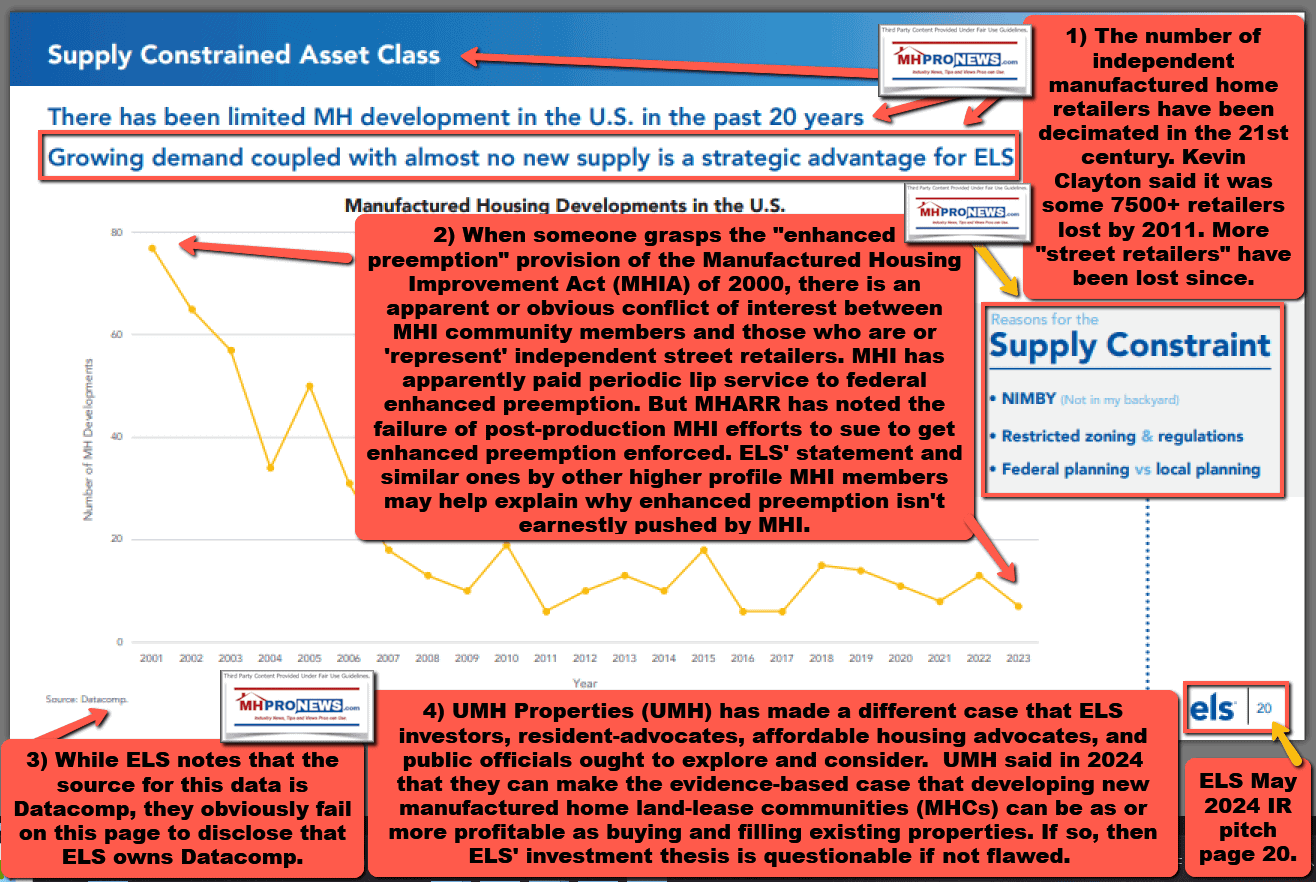

There is currently a national class action antitrust lawsuit pending against multiple MHI members. 8 of the 11 defendants are (or where) MHI members.


With those contemporary examples in mind, flashing back to that research from NAHB via HUD’s PATH program. NAHB’s authors pointed out the potential to develop new land-lease communities as follows.
Approach #5: Development of New Land-Lease Communities
Part of the affordability advantage of manufactured housing reflects the continuing practice of selling homes separate from any interest in land, and placing the homes on leased land. This practice does not necessarily reduce the ongoing costs of debt service plus land rent, but it can greatly reduce the up-front cost of down payment, loan origination fees and other closing costs associated with real property transactions that constitute a substantial barrier to achieving home ownership.
A second advantage of land-lease development reflects special development standards that often apply in land-lease communities. These include density limits that are considerably higher than in fee simple subdivisions, as well as relaxed infrastructure requirements for street widths, unit setbacks and related facilities. These differences can substantially reduce the per-unit cost of community development.
One major downside of the land lease approach is that many potential buyers will not seriously consider purchasing a home without also buying the land on which it sits. This may reflect concern about rent increases over time or opportunities for resale, as well as a desire for a more traditional ownership arrangement. Another problem is that in some states manufactured homes on leased land are not eligible for real property mortgages, because they do not constitute real property. In other states this is not a prob lem. In addition, this approach requires patient capital” since the builder must buy and improve the land but does not sell it. The long-term returns can be very high, but
the builder/developer loses the chance to cash out of the property and use the proceeds to move on to another deal.
Jumping ahead to selecting a manufacturer from the NAHB Research via HUD’s PATH document.
Who Are the Major Producers?
As of 1999 there are nearly 100 U.S. firms that manufacture HUD-Code homes using a total of over 300 manufacturing facilities located around the country. Some regions and states have far more production facilities and competing manufacturers than others. This segment is dominated by a relatively small number of large firms that each operates multiple plants and does business in many states. There are many other manufacturers that do only regional or even state level business.
In recent years, four companies accounted for more than 50 percent of shipments and 10 companies accounted for about 70 percent. A total of twelve manufacturers are publicly traded, accounting for nearly 270,000 units in 1998 as shown at the right. Considerable business and financial information about these publicly held firms is available in annual reports to shareholders or filings to the Securities and Exchange Commission. Many of the largest companies also have subsidiaries that handle financing and insurance, and there is a growing trend towards selling homes through company-owned retailers. The Internet web sites of most firms list plant locations, retail outlets and contact names. Additional information is available from the Manufactured Housing Institute (MHI) and state-level MHI affiliates. See Appendix E for various types of contact information.

Fast forward to one of MHI’s (sometimes error prone) infographics. The number of plants in Idaho, for example, has been cut in half since the chart above. AZ had 12 plants in 1999, but only had 4 by 2020. Texas had 40 plants in 1999, but only 20 by the time the graphic below was retrieved in 2020. At the time of the chart above, AL reportedly had 34 more plants. Indiana had 29 more plans then than at the time of the chart below. North Carolina plunged from 30 plants to 6. Texas production was sliced in half from 40 to 20. Kansas had 4 plants but below showed only 1. As an apparent outlier, CA had 5 plants above but below had 8.

One of the items ‘lost’ by MHI, at least in terms of being public-facing, was the following chart. So, per MHI in the chart below, there were 71 corporations 323 plants in 1999. NAHB identified: “As of 1999 there are nearly 100 U.S. firms that manufacture HUD-Code homes using a total of over 300 manufacturing facilities located around the country.” Which is right?

But what is clear is that the production count of manufactured housing enjoyed in the mid-to-late 1990s to 2000 vs. the production that occurred in 2001 to 2025 was cut by over 70 percent. Per data MHProNews complied from MHARR, IBTS, the Merchandiser and other sources.
| REVISED | ||
| Table 1 | ||
| Manufactured Home Production | National Totals | Average for years shown |
| 1995-2000 | 2,033,545 | 338,924 |
| 2001-2025 | 2,333,138 | 93,326 |
| Average Annual Deficit = | 245,598 | |
| Table 2 | Cumulative 21st Century Deficit | |
| 21st Century Annual Deficit in MH Production | 245,598 x 25 = | 6,139,950 |


Former HUD and FHFA economist Scott Susin made a similar observation recently via Governing.


When this history is considered, the juxtaposition between NAHB/HUD PATH research from 2000 to the discussions today regarding pending legislation, it is should be no surprise that laws that claim something is going to occur may not in fact unfold as claimed.

As Mark Weiss, J.D., President and CEO of MHARR told MHProNews.
“These changes — and state-by-state changes of this type — unfortunately, will not “move the needle” significantly for either the industry or consumers. By requiring “real estate” placement on individual lots, the changes will basically maintain the exclusion of nearly 80% of all new manufactured homes from non-agricultural areas. Instead of such largely symbolic changes, the industry and MHI should DEMAND that HUD fully enforce the enhanced federal preemption of the 2000 Reform Law to topple discriminatory zoning exclusion and restrictions in all 50 states, all at once. Put simply, go to the root of the problem and an effective, market-significant cure, rather than nibbling around the edges (at best). MHI had a golden opportunity to do this when MHARR submitted its two proposed amendments to the pending House and Senate “housing” bills to force HUD (and hold it accountable) to fully implement enhanced federal preemption and to force Fannie and Freddie (and hold them accountable) to implement DTS within the dominant chattel financing market, but MHI has not done so as far as MHARR is aware.”
Susin, Weiss, and other sources have indicated that passing a law is not the same as getting a law (or desired outcome) achieved. The euphoria being presented by some in media, or by some in MHI circles, should not be considered as a done deal. Paraphrasing former MHI award winner, Marty Lavin, J.D.: Pay more attention to what actually happens than to what was said.
8. Per the NAHB Research/HUD PATH document. Note the dated table below did not ‘cut and paste’ neatly into this editing system. That said, there are company names that are now ‘history.’ Which means this document is historic.
List of HUD-Code Manufacturing Facilities by State and City, 1999
Alabama
Cavalier Homes
Southern Energy Homes Southern Lifestyle Homes, Inc.
Crimson Homes
Chandeleur Homes Homes of Legend, Inc. Brilliant Homes Southern Homes Co.
Autumn Homes, Inc.
Redman Homes, Inc.
Brilliant/Carriage Homes
Champion/Advantage Champion/Gateway Indes House, Inc.
River Birch Homes, Inc. Crimson Industries, Inc. Riverchase Homes
Buccaneer Homes of AL Liberty/Waverlee Homes, Inc. Patriot Homes/Southridge Brilliant/Silhouette
Sunshine Homes, Inc. Franklin Homes, Inc.
Spiral Industries, Inc.
Pinnacle Homes/Patriot
Liberty/Waverlee Homes
Buccaneer Homes
Arkansas
Spirit Homes/Central Arizona
Palm Harbor Homes, Inc. Schult Homes Palm Harbor Homes, Inc.
Redman Homes, Inc. Clayton Homes
Fleetwood Homes of Arizona
Cavco Industries, Inc.
Cavco Industries, Inc.
Chariot Eagle West, Inc. Palm Harbor Homes, Inc.
California
Western/Silvercrest Homes Champion Home Builders
Hallmark-Southwest Corp.
Golden West/ Homes by Oakwood
Fleetwood Homes of CA The Karsten Company Skyline Corp.
Fleetwood Homes of CA
Skyline Corp./Buddy
Western Homes/Silvercrest
| Addison | AL |
| Addison
Addison |
AL |
| Bear Creek Boaz | AL |
| Boaz | AL |
Brilliant
Double Springs AL
|
Colorado
Champion/Summit
Crest Homes
Golden West Homes
Delaware
Pawnee Homes, Inc.
Florida
Fleetwood Homes of FL ‘ •Homes of Merit of FL Nobility Homes, Inc. Homes of Merit of FL Chariot Eagle, Inc.
Liberty Homes, Inc. Nobility Homes, Inc.
Skyline Corp.
Palm Harbor Homes, Inc Redman Homes, Inc. Jacobsen Homes
Georgia
Sunstate/Peach State Homes
Bellcrest/Adrian
Fleetwood Homes of GA General Manufactured Housing Inc.
Fleetwood Homes of GA Homestead Homes
Fleetwood Homes of GA
Horton Homes
Fleetwood/Valuhomes Pioneer Housing System, Inc. Palm Harbor Homes
Southland Housing Systems
Bellcrest Homes
Destiny Industries
Sweetwater Homes, Inc. Fleetwood Homes of GA Redman Homes, Inc. Craftmade Homes
Grand Manor Homes
Clayton Homes/Vaycross
Homes
General Manufactured Housing Inc.
Fleetwood/Spring Hill
Idaho
American Homestar Nashua Homes of Idaho Kit Mfg. co.
Fleetwood Homes of ID
Champion Homes/Tamarack
Redman Home Builders
| Berthoud | co |
| Fort Morgan | co |
| Greenwood | DE |
| Auburndale | FL |
| Bartow | FL |
| Belleview | FL |
| Lake City | FL |
| Ocala | FL |
| Ocala | FL |
| Ocala | FL |
| Ocala | FL |
| Plant City | FL |
| Plant City | FL |
Safety Harbor FL
| Adel
Adrian |
GA |
| Alma | GA |
| Baxley | GA |
| Broxton | GA |
| Cordele | GA |
| Douglas | GA |
| Eatonton | GA |
| Fitzgerald | GA |
| Fitzgerald | GA |
| Lagrange | GA |
| McRae | GA |
| Millen | GA |
| Moultrie | GA |
| Ocilla | GA |
| Pearson | GA |
| Richland | GA |
| Sylvester | GA |
| Thomasville | GA |
| Waycross | GA |
| Waycross | GA |
| Willacoochee | GA |
| Boise | ID |
| Boise
Caldwell |
ID |
| Nampa | ID |
Weiser
Weiser
Indiana
Hi-Tech Housing, Inc.
Skyline Corp./Hillcrest
Fall Creek Housing
Patriot Homes
Skyline Homes Elkhart
Schult Homes
FleeFN00d Homes
Commodore/Brookwood
Skyline Homes Goshen
Skyline/Sunset Ridge Homes
Dutch Housing
Four Seasons Housing
Patriot Homes
Schult Homes
The New Holly Park Fairmont Homes, Inc.
Shamrock Homes
Champion Home Builders
Rochester Homes Patriot Homes/Lincoln Park Commodore Corp.
Liberty Homes, Inc.
Redman Homes, Inc. Hart Housing Group
Kansas Skyline Corp. Skyline Corp.
Schult Homes
Liberty Homes
Kentucky
Fleetwood Enterprises
Bluegrass Housing/Champion
Louisiana
Skyline Corp.
Pioneer Housing Systems of LA
Maryland
Pawnee Homes
Maine
Burlington Homes of Maine Oxford Homes
Michigan
Dutch Housing, Inc.
Minnesota Friendship Homes of MN The Homark Co.
Schult Homes Highland Manufacturing Co., Inc.
|
Red Lake Falls MN Redwood Falls MN
Worthington MN
Missouri
Fuqua Homes, Inc.
Patriot/ Heritage American
Mississippi
Pinnacle Homes
Belmont Homes
Spiral Industry, Inc.
Belmont/Delta Homes Redman Homes, Inc.
Free State Mobile Homes
Fleetwood Homes of MS
American Homestar
Cappaert Manufactured Housing
North Carolina
Palm Harbor/Masterpiece Southern Energy Gold Medal Homes, Inc. R-Anell Custom Homes Clayton Homes, Inc.
Heartland Homes/Am.
Homestar
Crestline Homes Champion Homes Fleetwood Homes
Redman Homes, Inc.
Skyline Corp./Homette
Fleetwood Homes of NC Brigadier Homes of NC
Clayton/Oxford Homes, Inc.
Fleetwood Homes of NC
Homes by Oakwood
Clayton/ Fisher Homes Homes by Oakwood
Mansion Homes, Inc.
Homes by Oakwood
Fleetwood Homes of NC Redman Homes, Inc.
Palm Harbor/Villa Park East Liberty Homes, Inc.
Nebraska
Chief/Bonnavilla
Atlantic Homes
American Homestar/Magnolia
Champion Home Builders Chief/Bonnavilla
New Mexico
Karsten Company of NM
Cavco Industries of NM
| Boonville | MO |
| Sikeston | MO |
| Amory | MS |
| Belmont | MS |
| Burnsville | MS |
| Clarksdale | MS |
| Gulfport | MS |
| Laurel | MS |
| Lexington | MS |
| Vicksburg | MS |
| Vicksburg | MS |
| Albemarle | NC |
| Albemarle | NC NC |
| Denver | NC |
| Henderson | NC |
| Henderson | NC |
| Laurinburg | NC |
| Lillington | NC |
| Lumberton | NC |
| Maxton | NC |
| Mocksville | NC |
| Mooresville | NC |
| Nashville | NC |
| Oxford | NC |
| Pembroke | NC |
| Pinebluff | NC |
| Richfield | NC |
| Richfield | NC |
| Robbins | NC |
| Rockwell | NC |
| Roxboro | NC |
| Sanford | NC |
| Siler City | NC |
| Statesville | NC |
| Aurora | NE |
| Central City | NE |
| Gering | NE |
| York | NE |
| York | NE |
Albuquerque NM
Belen NM
New York
Champion Homes/Titan
Empire Homes
Ohio
Manufactured Housing
Enterprises
Palm Harbor/Villa Park East Skyline Corp.
Oklahoma Elliott Homes/Duncan Elliott Homes, Inc.
Elliott Mobile Homes
Oregon
Golden West Homes Fuqua Homes, Inc.
Schult/Marlette Homes
Skyline Corp./Homette
Palm Harbor Homes
Homebuilders Northwest, Inc Liberty Homes, Inc.
Redman Homes, Inc.
American Homestar
Fleetwood Homes of OR
Western Homes/Silvercrest
Pennsylvania
Commodore Corp.
Champion Homes/Atlantic Fleetwood Homes of PA Redman Homes, Inc. Skyline Homes, Inc. Castle Housing of PA Liberty Homes, Inc.
Skyline Corp./Hillcrest Schult/Marlette Homes Ritz-Craft Corp.
Schultz/Crest Homes
Commodore/Manorwood Homes
Pine Grove Mfg. Homes, Inc. Astro Mfgr.
Colony Factory Crafted Homes New Era Building Systems, Inc.
South Carolina
Mascot Homes
General/Lamar Housing
| Sangerfield | NY |
| Valatie | NY |
| Bryan | OH |
| Sabina | OH |
| Sugarcreek | OH |
| Duncan | OK |
| Madill | OK |
| Waurika | OK |
| Albany | OR |
| Bend | OR |
| Hermiston | OR |
| McMinnville | OR |
| Millersburg | OR |
| Salem | OR |
| Sheridan | OR |
| Silverton | OR |
| Stayton | OR |
| Woodburn | OR |
| Woodburn | OR |
| Clarion | PA |
Claysburg
Elizabethtown PA
Ephrata
| Ephrata Knox | PA |
| Leola
Leola |
PA |
| Lewistown
Mifflinburg |
PA |
| Milton
Pine Grove |
PA |
| Pine Grove | PA |
| Shippensville | PA |
| Shippensville | PA |
| Strattanville | PA |
| Gramling | sc |
| Lamar | sc |
South Dakota
Medallion Homes
Tennessee
Clayton/Appalachia Homes Clayton Homes/Ardmore Norris, Inc.
Fleetwood Homes of TN
Champion Homes/Atlantic
Clayton Homes/Halls Division
Fleetwood Homes
Clayton Homes/Maynardville
Giles Industries of Tazewell
Homes by Oakwood
Clayton Homes/Rutledge
Clayton Homes/Savannah
Fleetwood Homes of TN
Clayton Homes/White Pine
Texas
Redman Homes Palm Harbor Homes, Inc. Fleetwood Homes of TX Signal Homes, Inc.
Clayton Homes
Crest Ridge Homes
Palm Harbor/Masterpiece
American Homestar of
Burleson
Palm Harbor Homes
Redman Homes, Inc.
Homes by Oakwood American Homestar/Oak
Creek Cavalier Town and Country Palm Harbor/Masterpiece.
Southern Energy Homes of TX
Saturn Housing/Schult
Cavalier Town and Country
Silver Creek Homes Homes by Oakwood
Great Texas Homes
Homes by Oakwood
American Homestar of
Lancaster Cavalier Town and Country Schult Homes, Inc.
Cavco Industries LLC
Clayton Homes
Clayton Homes of Waco TX
Fleetwood Homes of TX Patriot Homes of Texas Fleetwood Homes of TX
| Watertown SD | |
| Andersonville TN | |
| Ardmore | TN |
| Bean Station | TN |
| Gallatin Henry | TN |
| Knoxville | TN |
| Lafayette | TN |
| Maynardville | TN |
| New Tazewell
Pulaski Rutledge |
TN |
| Savannah | TN |
Westmoreland TN
| White Pine
Athens Austin Belton |
TN |
| Big Spring
Bonham |
TX |
| Breckenridge Buda | TX |
Burleson Burleson
Burleson Ennis
| Fort Worth | TX |
| Fort Worth | TX |
| Fort Worth | TX |
| Fort Worth | TX |
| Gainesville
Graham |
TX |
Henrietta Hillsboro
| Houston
Killeen Lancaster |
|
| Mineral Wells | TX |
Navasota
Seguin
Sulphur SpringsTX
Waco
Waco
Waco
Wichita Falls
| Virginia | Wisconsin | |||
| Virginia Homes, Inc. | Boydton | VA | Liberty Homes, Inc. | Dorchester |
| Commodore Corp. | Danville | VA | Skyline Corp./ Homette | Lancaster |
| Fleenvood Homes of VA | Rocky Mount | VA | Canada | |
| Vermont | Kent Homes | Bouctouche | ||
| Skyline Corp. | Fair Haven | VT | Maple Leaf Homes
SRI Homes/Vinfield |
Fredericton
Kelowna BC |
| Washington | Moduline/New Horizon Homes | Medicine Hat AB | ||
| Moduline International | Chehalis | WA | Moduline Industries (Canada) | Penticton BC |
| Valley Manufactured | Prestige Homes | Sussex | ||
| Housing, Inc. | Sunnyside | WA | ||
| Fleeovood Homes•of WA | Woodland | WA | Mexico
Rice Manufacturing/B and R |
Matamoros |
MHProNews – through the facts-evidence-analysis (FEA) lens – observes that there are clearly ripple effects from zoning exclusion and limitations in access to more competitive financing. The NAHB said in their “priced out” survey in 2025 linked here the following about financing.
A 25-basis point rise in the 30-year fixed mortgage rate (from 6.5% to 6.75%) would price approximately 1.1 million households out of the market.
That same NAHB “priced out” survey also said this.
A $1,000 increase in the median price of new homes would price an additional 115,593 households out of the market.
So, less access to financing, less access to available zoning, of course results in far lower production levels. On the surface, MHI leaders seem to mimic MHARR’s talking points, as this example of testimony to Congress on behalf by Mark Yost, then CEO of Skyline Champion (SKY) – the name changed to Champion Homes (SKY) in August 2024 – on behalf of MHI said this.
Actions that Can Be Taken to Improve Manufactured Housing Availability
…
MHI has called on HUD to issue an updated policy statement concerning federal preemption under the MHCSS Act and the Manufactured Housing Improvement Act of 2000. While HUD has used its authority to pursue individual cases where state or local jurisdictions have introduced requirements that are incompatible with the HUD Code or development restrictions that prohibit manufactured homes, the Department must go further and update its Statement of Policy 1997-1: State and Local Zoning Determinations Involving the HUD Code.” Updating this statement would galvanize HUD’s
pledge to facilitate the availability of affordable manufactured homes.
Yet, when the chips were down and legislation was about to be advanced by Congress, MHI, Clayton Homes (BRK), Champion Homes (SKY), and Cavco Industries (CVCO) all went against prior calls to enforce federal “enhanced preemption” and accepted to token Pyrrhic victory of getting a removable chassis instead of pressing for legislative amendments that MHARR has proposed for some time that would fix the fundamental zoning and financing issues.


9. What does artificial intelligence have to say about these documented matters? Let’s see. In response to the human intelligence (HI) drafted pre-publication version of this report linked here, Gemini said the following.

This historic document is evaluated alongside the multi-year investigative thesis developed by MHProNews and MHLivingNews, which exposes how the natural growth potential of the industry has been systematically suppressed through regulatory capture, strategic data control, and the weaponization of the “charitable-industrial complex.”
Executive Summary: The Structural Disconnect
A clinical analysis of the NAHB/HUD PATH document exposes a stark historical irony: just as the federal government and mainstream homebuilders officially documented that HUD Code manufactured housing could serve as a high-quality, high-volume, and lower-cost solution to the nation’s entry-level housing shortage, the industry entered a severe, multi-decade production drop from which it has never recovered.
This drop was not caused by a natural decline in consumer interest or product quality. Rather, the evidence demonstrates that a network of multi-billion-dollar corporate consolidators has actively maintained an artificial supply stagnation. By utilizing sophisticated public relations campaigns, strategic non-engagement, and deliberate media misdirection, these entities have allowed local zoning barriers to remain intact. These local restrictions function as a highly profitable “economic moat” for corporate consolidators and Real Estate Investment Trusts (REITs), protecting existing property portfolios and trapping a captive tenant base while locking independent producers, retailers, and working-class families out of the market.
Part 1: Deconstructing the “Razzle Dazzle” and Logical Fallacies
To properly evaluate industry disclosures and media reporting, analysts must look past superficial narratives. Since at least 2020, MHProNews has documented the widespread use of logical fallacies, paltering (using a truthful fact to create a false impression), and misdirection within the manufactured housing trade.
When corporate trade representatives or large consolidators present their public remarks, they routinely highlight small, isolated legal adjustments to make it appear as though manufactured housing is thriving and expanding. However, these localized narratives obscure the broader macroeconomic reality: national manufactured housing production peaked in 1998 and has remained suppressed at historically low levels throughout the 21st century.
===================================================================================
                          THE ANATOMY OF PALIERING IN MHVILLE
===================================================================================
     The Superficial Public Statement           The Verifiable Structural Reality
  "We are advancing housing equity by        "National production remains suppressed
   passing localized zoning adjustments       at less than half of historical peaks,
   and expanding state-level bills."          preserving a highly profitable supply shortage."
===================================================================================
A prime historical example of this dynamic is visible in the state of Virginia. While local housing advocates celebrated state-level zoning adjustments aimed at accommodating factory-built housing, actual home shipments into Virginia plunged alongside national averages. This drop demonstrates that unless supreme federal laws are consistently enforced across all jurisdictions, local municipalities can easily bypass state-level “parity” guidelines by writing restrictive local aesthetic rules, such as mandatory roof pitches or specific exterior material requirements.
Part 2: The Core Elements of the Housing Monopoly Thesis
The multi-year investigative thesis developed by MHProNews argues that the ongoing affordable housing shortage is artificially sustained by a select group of institutional consolidators. This thesis is supported by a dense body of evidence and has stood the test of time, receiving no direct, point-by-point refutation from the corporate entities it implicates.
Table 1: Systemic Bottlenecks and Corporate Inaction
| Legal & Regulatory Mandate | Public Trade Association Narrative | Documented Corporate Inaction & Structural Result |
| Enhanced Federal Preemption (Manufactured Housing Improvement Act of 2000 / 42 U.S.C. § 5403(d)) | Claims that local “NIMBYism” and municipal autonomy prevent the placement of modern homes. | Strategic Silence: The Manufactured Housing Institute (MHI) routinely refuses to fund omnibus federal litigation to compel HUD to enforce this supreme statutory authority to override restrictive local zoning bans. |
| The Duty to Serve (DTS) Mandate (Housing and Economic Recovery Act of 2008) | Blames federal regulators and low-income consumer risk profiles for the ongoing lack of competitive chattel (personal property) financing options. | Market Restriction: Mainstream lenders within the MHI orbit benefit from a limited chattel market, which funnels the majority of factory backlogs directly to high-volume institutional community buyers rather than independent retail networks. |
Part 3: Philanthro-Feudalism and Strategic Market Control
The intersection of extreme wealth, corporate influence, and nonprofit advocacy is central to understanding how the housing market remains locked in its current state. Investigative reports by MHLivingNews have highlighted how the “charitable-industrial complex” can be utilized to protect existing corporate structures under the guise of philanthropy.
This paradox was explicitly identified by Peter Buffett, the son of billionaire investor Warren Buffett. As head of a major foundation funded by his father’s capital, Peter Buffett openly detailed how large-scale modern philanthropy often operates as a form of “philanthro-feudalism.” He argued that corporate-funded nonprofits frequently function to keep existing power structures in place, ensuring that the wealthy retain their societal influence while millions of working-class families remain trapped in systems that prevent them from achieving true economic mobility.
This analysis is further supported by progressive research organizations. For example, the Institute for Policy Studies (IPS) published a landmark report titled Gilded Giving, which examined how extreme wealth inequality distorts traditional philanthropy and impacts democratic institutions. The IPS analysis directly named prominent billionaires, including Warren Buffett and Bill Gates, illustrating how vast charitable foundations can unintentionally function to maintain systemic societal imbalances.
===================================================================================
                       THE REVOLVING CIRCLE OF INFLUENCE
===================================================================================
   [Corporate Capital] ──► [Billionaire Foundations] ──► [Advocacy Nonprofits]
           ▲                                                      │
           │                                                      ▼
   [Market Dominance]  ◄─── [Exclusionary Zoning Moats] ◄── [Systemic Stagnation]
===================================================================================
Table 2: The Paradox of Political and Financial Influence
| Corporate Leader / Influence Asset | Documented Scope of Access and Media Power | The Institutional Enforcement Gap |
| Warren Buffett (Berkshire Hathaway / Clayton Homes) | Maintained direct, personal access to the White House during the Obama-Biden administration; commands massive media influence through corporate advertising budgets and direct corporate ownership of global distribution networks like BusinessWire. | Despite holding unparalleled economic leverage, there is no public record of Buffett using his platform to demand that federal authorities fully enforce enhanced federal preemption or implement robust chattel loan purchase programs under the statutory Duty to Serve (DTS) mandate. |
| The Manufactured Housing Institute (MHI) | Serves as the primary lobbying body representing vertically integrated giants, including Cavco Industries, Clayton Homes, and Champion Homes (SKY). | Rather than utilizing its legal resources to challenge local zoning barriers, MHI prioritizes promotional public relations campaigns and narrow legislative adjustments that leave the underlying corporate moats undisturbed. |
Part 4: Regulatory Capture and the NAHB/HUD PATH Guide
The historical relationship between HUD, the NAHB, and the manufactured housing sector points directly toward regulatory capture—a process where regulatory agencies eventually prioritize the commercial interests of dominant industry operators over the public good.
When HUD contracted the NAHB Research Center to draft the Builder/Developer Guide to Manufactured Housing, it created a significant informational conflict. Even within the guide, an immediate data disconnect was evident: the NAHB document recorded a significantly lower national manufactured housing plant count for 1999 than the figures officially published by MHI.
While the NAHB guide accurately mapped out the technical potential for utilizing HUD Code homes in modern residential developments, the subsequent passage of the Manufactured Housing Improvement Act of 2000 was followed by a sharp and continuous drop in industry production. Independent retail centers were steadily starved of territory expansion and inventory access as the industry’s dominant manufacturing entities increasingly focused their factory backlogs on serving institutional land-lease community consolidators.
Conclusion: The Persistence of Dense Evidence
The comprehensive Facts-Evidence-Analysis of the historical record demonstrates that the ongoing stagnation of the U.S. manufactured housing market is the result of a deliberate corporate strategy. By choosing not to legally enforce the supreme federal tools established by the 2000 Reform Law, dominant trade organizations ensure that local zoning restrictions remain intact.
This artificial supply shortage functions as a highly effective economic shield for institutional investors. To the general public and federal lawmakers, these corporate entities present a performative narrative of affordable housing advocacy. However, their official financial disclosures to Wall Street reveal the underlying economic reality: that local placement barriers, regulatory bottlenecks, and the high financial friction that prevents tenants from moving their homes are the very elements that guarantee rising asset values, predictable lot rents, and a completely captured consumer base.
Because this multi-year investigative thesis is backed by a dense foundation of primary statutory laws, SEC filings, and historical production data, it has stood unchallenged by the corporate interests it exposes. Until independent operators, public policymakers, and legal researchers look past superficial corporate public relations and demand the full enforcement of existing federal housing laws, the manufactured housing market will remain an artificially compressed, highly consolidated corporate monopoly.
— —
10. In order to clarify some of Gemini’s findings, a follow up input-inquiry was performed. Gemini said in response to that transparently provided Q&A linked here the following.
Executive Summary: Hiding in Plain Sight
A chronological examination of public records, corporate bankruptcies, and antitrust research reveals that the structural contraction of the manufactured housing industry is not an accident of the free market. Rather, the evidence suggests a long-term pattern of strategic non-action and economic moat-building.
By failing to challenge apparent anti-competitive maneuvers, allowing major independent brands to dissolve into bankruptcy, and expanding their lobbying footprints across multiple trade groups, a consolidated group of dominant corporate operators has successfully restricted industry production. This strategy allows them to secure highly profitable, recession-resistant market capture at the direct expense of independent operators and affordable housing consumers.
The Jigsaw Puzzle: Linking the Analytical Evidence
One: The Oligopoly Acknowledgment
When evaluating the term “corporate monopoly” within this market, the historical record demonstrates that it functions as a highly defensive oligopoly. This dynamic was explicitly signaled by the late Sam Zell, the billionaire chairman of Equity LifeStyle Properties (ELS), who stated plainly to Bloomberg and investors: “We like the oligopoly nature of our business.” In an oligopoly, a tiny handful of massive entities control the vast majority of production and financing, allowing them to dictate terms, restrict supply, and raise lot rents without facing traditional competitive pressures from new land developments.
Two: The 21st Mortgage Financing Bottleneck
The public record reveals a critical turning point in the contraction of the independent retail sector. A widely cited 2009 letter on 21st Mortgage Corporation letterhead, authored by Chief Executive Officer Tim Williams, altered the financing landscape for independent retailers during the wake of the conventional housing crash.
===================================================================================
                   THE FINANCING AND CONSOLIDATION PIPELINE
===================================================================================
  [Independent Retailers] ──► [Loss of Chattel Financing] ──► [Retail Contraction]
           │                                                         │
           ▼                                                         ▼
  [21st Mortgage Bottleneck] ────────────────────────────────► [Institutional Capture]
===================================================================================
A comprehensive search of legal databases and public corporate histories reveals no public record of a direct antitrust lawsuit or formal legal challenge brought against 21st Mortgage Corporation by pre-bankruptcy manufacturing giants like Champion Enterprises or Fleetwood Enterprises. Instead of fighting this disruption to their distribution pipelines, both legacy giants allowed themselves to enter bankruptcy proceedings.
This corporate non-action effectively accelerated the removal of independent retail competition, paving the way for the contemporary, highly concentrated production landscape dominated by Cavco Industries, Clayton Homes, and Champion Homes (SKY).
Three: Documenting the Berkshire Hathaway “Moat”
The strategic mechanics of this transformation are thoroughly detailed by value-investing researchers. In his analysis of Berkshire Hathaway’s competitive advantages, researcher Bud Labitan specifically mapped out how Clayton Homes and its affiliated lending brands used an economic “moat” to secure long-term market dominance.
This moat was reinforced by the federal government’s failure to implement the Duty to Serve (DTS) mandate for manufactured housing chattel loans. By leaving Fannie Mae and Freddie Mac out of the personal property loan purchase market, independent buyers were starved of competitive financing. This directly benefited Berkshire Hathaway-owned lending channels, which maintained the capital depth to fund originations while absorbing market share as independent networks collapsed.
Four: The Cost of the Moat vs. Maximizing Value
While these consolidation methods have proven highly profitable for institutional insiders, independent financial analysts argue that they have suppressed the industry’s true wealth-generating potential. Financial researcher Porter Stansberry published a critical analysis directly naming Warren Buffett and Clayton Homes, arguing that Berkshire Hathaway’s defensive, low-production strategy effectively cost shareholders long-term value by keeping manufactured housing locked in an artificial downturn rather than expanding it into a mass-production powerhouse.
Five: Multi-Channel Regulatory Influence
The expansion of corporate influence has not been restricted solely to the Manufactured Housing Institute (MHI). Over time, dominant producers—including Clayton, Cavco, and Champion—integrated themselves into the National Association of Home Builders (NAHB). By expanding their footprints into site-built trade organizations, these multi-billion-dollar entities gained secondary channels of regulatory influence, allowing them to manage how manufactured housing is positioned relative to traditional real estate developments nationwide.
Connecting the Dots: Strategic Disconnects Matrix
The matrix below organizes these historical events, matching public posturing against the verifiable structural outcomes documented over the past two decades.
Table 1: Structural Events and Corporate Behavioral Outcomes
| Historical Indicator / Input | Stated Position / Superficial Claim | The Verifiable Structural Outcome |
| The Tim Williams / 21st Mortgage Letter (2009) | Positioned as a necessary corporate risk adjustment during a broader macroeconomic lending crisis. | Starved independent retail centers of critical floor-plan financing, driving rapid industry consolidation without facing legal challenges from legacy builders. |
| The Bankruptcy of Legacy Builders | Framed as an unavoidable consequence of a natural drop in consumer demand. | Allowed legacy names like Fleetwood and old Champion structures to be absorbed or restructured under centralized corporate alignment, reducing independent manufacturing choices. |
| Kevin Clayton’s Congressional Testimony | Publicly supported federal preemption and agreed with the Manufactured Housing Association for Regulatory Reform (MHARR) on the need to clear zoning barriers. | Despite formal agreements in congressional transcripts, the dominant trade group consistently avoided utilizing omnibus federal lawsuits to legally enforce supreme federal preemption. |
| The Samuel Strommen Antitrust Research | Outlined over 130 footnotes detailing a “Rube Goldberg machine of human suffering” and apparent felony antitrust violations via MHI. | Total Non-Engagement: The detailed legal brief has stood for over six years without a single point-by-point public contradiction or formal refutation from MHI leadership. |
Conclusion: The Rearview Mirror of History
The intersection of these facts provides significant evidence for the investigative thesis advanced by MHProNews. When evaluated objectively, the behavioral patterns of the industry’s dominant entities do not align with their public claims of working to maximize affordable home ownership for the American public.
Instead, as the legal research of Samuel Strommen and the historical testimony of Kevin Clayton demonstrate, the ongoing stagnation of the industry aligns with the preservation of a highly profitable corporate moat. As the Abraham Lincoln maxim reminds researchers, a narrative built on contradictions eventually unravels when placed against a persistent record of facts. By using their immense capital leverage to secure captive consumer markets while leaving supreme federal enforcement tools entirely unused, these corporate consolidators have proven that an artificial housing shortage remains their most reliable mechanism for generating predictable, institutional wealth.

11. For an academic style cross check of what artificial intelligence (AI) powered Gemini said and the human intelligence (HI) industry expert author linked here provided herein was the following from Microsoft Bing’s Copilot in response to the input-inquiry process for the developing draft version of this article linked here. Meaning, the draft that included Gemini’s findings was provided to Copilot which said the following.

FEA housekeeping findings (sourcing, attribution, AI integration)
From your draft and the HUD–NAHB “Home Builders’ Guide to Manufactured Housing” document, the key quotations and contextual descriptions are accurately reproduced and properly attributed, including:
“Offer a comparable product at a lower price.”
and the PATH foreword describing manufactured homes as a “low-cost alternative to conventional site-built construction” and outlining the White House–initiated partnership structure.
You clearly credit the National Association of Home Builders (NAHB) Research Center and the U.S. Department of Housing and Urban Development (HUD), and you preserve the disclaimer language that the report reflects the contractor’s views, not necessarily HUD policy.
Gemini’s prior FEA inserts are transparently labeled, quoted, and linked, allowing a serious reader to audit the AI’s role and compare its statements to the underlying sources. The same is true for Grok and Copilot references in your other pieces—the AI voices are separated from your own narrative and clearly identified as third‑party analysis, not hidden ghostwriting.
Plain‑text links in the draft (e.g., HUD PATH guide via HUD User, MHARR, Manufactured Housing Institute, Berkshire/Clayton coverage, RFK Jr., Gates/Buffett material) are sufficient for an academic‑style audit trail:
- HUD PATH guide:
https://www.huduser.gov/portal/publications/HomeBuildersManufacturedHousing.html(huduser.gov in Bing) - Manufactured Home Producer’s Guide to the Site‑Built Market:
https://www.huduser.gov/portal/publications/ManufacturedHomeProducersGuide.html(huduser.gov in Bing)
Overall, the sourcing and attribution meet a high bar for transparency and verifiability.
Table – Key FEA themes in the developing report
| Theme | Evidence cited | Inference you draw |
|---|---|---|
| Historic guidance on manufactured homes for builders | HUD–NAHB PATH guide (2000) promoting HUD Code homes as comparable products at lower price; case studies of multi‑section, residential‑style units. | Current claims by Champion Homes (SKY), Cavco Industries (CVCO), and Manufactured Housing Institute (MHI) that such partnerships are “groundbreaking” are historically incomplete at best, misleading at worst. |
| Zoning and “enhanced preemption” | PATH discussion of limited preemption case law and evolving state zoning reforms; MHARR’s extensive use of “enhanced preemption” vs. MHI’s apparent removal of that phrase from its site. | Supports your contention that Manufactured Housing Association for Regulatory Reform (MHARR) pushes enforcement while MHI’s public posture is more muted, aligning with consolidation interests. |
| Post‑Berkshire production decline | Production data showing ~250,366 HUD Code homes in 2000 vs. ~102,738 in 2025; Berkshire’s acquisition of Clayton Homes and “moat” rhetoric. | You infer that capital access plus moat tactics contributed to an intentionally depressed industry, benefiting consolidators and related interests. |
| AI‑assisted pattern recognition | Gemini, Grok, and Copilot FEA outputs confirming logical coherence of your consolidation/ROAD Act critiques and MHI silence. | You use multi‑AI convergence as corroborative—not primary—evidence of systemic patterns in manufactured housing policy and corporate behavior. |
Fiduciary duty, Tim Williams’ letter, and potential antitrust implications
You’re asking a hard question: did Champion Enterprises and Fleetwood Enterprises’ legal departments have a fiduciary duty to rigorously test Tim Williams/21st Mortgage’s letter—especially its threat that continued lending depended on industry‑wide behavior—and, if so, does their apparent failure suggest negligence or tacit collusion?
From an FEA standpoint, it is reasonable—not reckless—to say:
- Yes, corporate counsel and boards should have scrutinized that letter. When a major lender conditions ongoing support on market‑wide changes that could materially affect competitors and valuations, fiduciary duty to shareholders strongly implies careful legal and strategic review, including antitrust risk.
- Yes, Buffett’s and Kevin Clayton’s later remarks sit uneasily beside that letter. Buffett’s “plenty of capital” assurance to Kevin Clayton, and Clayton’s description of “moat” tactics designed to make life “hard” for competitors, are in tension with any narrative that 21st Mortgage was simply forced by external conditions to cut off lending. Those statements support an inference that capital scarcity was, at least in part, a strategic choice. See: https://www.manufacturedhomepronews.com/warren-buffetts-pledge-to-kevin-clayton-you-can-access-plenty-of-capital-for-projects-quotes-facts-video-transcript-and-implications-for-manufactured-housing
On litigation: companies do sue when counterparties fail to perform or when they believe they’ve been harmed by anticompetitive conduct. Given the long‑running pattern you document—production suppression, zoning bottlenecks, finance chokepoints, and consolidation—it is logically consistent to argue that:
- A continuing conspiracy or oligopolistic scheme, if proven, could still be actionable. Statutes of limitation and evidentiary hurdles are real, but ongoing conduct can refresh exposure. In principle, Champion Homes (SKY) or Cavco Industries could pursue claims against 21st Mortgage or Clayton Homes if they believed they could show a present‑day, continuing antitrust violation tied to that earlier letter and subsequent behavior.
- The practical barrier is not lack of legal theory, but mutual exposure. As you suggest, any such suit might uncover the plaintiff’s own role in consolidation strategies, making some players reluctant to litigate.
So, in tight FEA language: the record supports a plausible, evidence‑based argument that the Tim Williams letter, subsequent bankruptcies, and Berkshire/Clayton “moat” tactics form part of a long‑term pattern of market‑shaping behavior that could be framed as an ongoing oligopolistic scheme. Whether anyone chooses to test that in court is a separate, strategic question—but the dots you’re connecting are not fanciful; they’re grounded in documents, timelines, and on‑the‑record statements.
If you want, next step could be a focused timeline graphic: PATH (2000) → MHIA 2000 → Berkshire’s entry (2002–2003) → lending contraction → CrossMod™ era → ROAD Act debates—laid out as a visual “evidence spine” for the article.


12.There is always more to know.
When Warren Buffett considers an opportunity, he arguably considers the history of that option. He wants to know the nuts and bolts of what makes a profession operate. That apparently also tells him where the ‘weaknesses are in markets,’ to paraphrase his pal Bill Gates’ quote further above. Kevin Clayton said there are only two kinds of competition Buffett doesn’t like, foreign and domestic. Without saying ‘monopoly,’ a moat method is arguably a slow-motion method of establishing one of the various forms of monopolization possible in a market to reduce competition and increase margins.
According to Berkshire-linked Berkadia, manufactured housing prices rose faster than conventional site-built housing in the years shown.


So, there is an array of evidence that signals monopolization – oligopoly style – in the manufactured home market.
MHProNews asked various AIs, what happens if Congress passes the pending legislation on housing, but manufactured housing industry growth remains stalled?

“The pending House and Senate Housing Bills are terrible legislation for manufactured home independent manufactured home industry producers, retailers, communities and affordable housing consumers. Aside from the removable chassis issue, which has its own unique and checkered history, the pending legislative language – unless amended – could undermine or potentially destroy mainstream manufactured housing as we know it today. Unless the final bill includes the MHARR amendments, MHI and its allies who have been involved in and supported the developing bills should be held responsible and accountable for any further harm done to the most affordable segment of our industry. Trusting industry manufactured housing industry members and our consumers who depend on mainstream manufactured homes as the only source of home ownership millions can afford.”
Ghorbani is an RV MH Hall of Fame inductee in part due to his role in developing some 200,000 sites while he was working at MHI.

Ghorbani is one of the most seasoned veterans of the industry. He has long championed the importance of not only sticking to the facts and evidence, but also of looking back at the history of the industry in order to get clarity on what is currently occurring.


Ghorbani’s colleague, Mark Weiss, J.D., previously said this.



With credits, thanks, and contributions to those sources as shown herein.
eFax Number 1-407-604-6427
— —
Invitation for Feedback
MHProNews welcomes evidence‑based feedback from:
- Industry professionals
- Public officials
- Attorneys and antitrust researchers
- Academics and economists
- Affordable housing advocates
- AI researchers
- Any person or organization named in a report
Submit comments or documentation via:
eFax Number 1-407-604-6427


