“America’s Guest Host” Mike Opelka on Nationally Syndicated Chris Plante Show Talks to L. A. “Tony” Kovach about 21st Century ROAD to Housing Act. Plus Sunday MHVille Weekly Headlines Recap-FEA
According to WMAL, the Chris Plante Show has been a nationally syndicated radio show since 2016. Insider Radio says “The nationally syndicated Chris Plante Show is broadcast on more than 130 radio stations across the United States. Originating from Westwood One, the program airs live in the 9:00 AM to 12:00 PM ET time slot. [1, 2]”. Wikipedia stated: “In his self-styled role as “America’s Guest Host…” Opelka (born July 9, 1957) is an American radio broadcaster and TV producer. “As the “runt of the litter”, Opelka used humor as a defense in his family. “My older brothers and my sense of humor were the only things that saved me from getting my ass kicked all the time,” he says. His grandfather taught Opelka about comedy. “He took me aside each New Year’s Eve and we’d watch the Marx Brothers and W.C. Fields movies.”[3] Opelka’s dad moved the family to Glenview, Illinois, where Opelka attended Catholic schools, where he met and became friends with future award-winning CNN Pentagon reporter turned award-winning satirical conservative talk radio star, Chris Plante. On Friday 6.5.2026 Mike Opelka was guest hosting for the vacationing Plante and took a call from L. A. “Tony” Kovach about the pending Congressional legislation, the 21st Century ROAD to Housing Act. That discussion between Opelka and Kovach is available from Apple Podcasts at this link here from about -19.40 in hour three to about -15.05. The following is a human intelligence (HI) generated transcript of that live on-air discussion about the pending housing bill.
To see the image above in a larger size, depending on your device or browser, click here and follow the prompts.
From Part I.
Executive Summary
The Catalyst: On a nationally syndicated broadcast of the Chris Plante Show, guest host Mike Opelka dedicated an interview segment to L.A. “Tony” Kovach to unpack the “man-made” affordable housing crisis and the statutory power of the Manufactured Housing Improvement Act of 2000 (MHIA).
The Evidence of Impact: While a brief, five-minute drive-time segment rarely reshapes a multi-billion-dollar industry overnight, empirical tracking showed an immediate, correlated traffic spike on the Manufactured Housing Association for Regulatory Reform (MHARR) website.
The Strategic Metric: This localized traffic burst serves as a primary indicator of “narrative breakthrough.” It proves that when mainstream consumers and independent property rights advocates are exposed to the legal mechanics of Enhanced Federal Preemption, they actively seek out the primary regulatory sources (like MHARR) to learn more.
The Policy Friction: This exposure bypasses the standard, uncritical trade group echo chambers. It demonstrates that a latent, massive audience exists for real solutions to the housing deficit—specifically, forcing the enforcement of existing federal laws rather than relying on slow, piecemeal, corporate-friendly state-level zoning compromises.
Mike Opelka on Chris Plante Show(MO): So, let me grab a quick call from L. A. “Tony” who is in Florida. Now I am confused. How can L. A. “Tony” be in Florida? Welcome Tony. Please explain.
L. A. “Tony” Kovach (LATK). You have such a great sense of humor Mike, thanks for the time.
LATK:…which both major parties Mike, are claiming is going to move the needle on the affordable housing crisis. However, unless this is amended, the bill will not work. And mainstream media is not covering this.
MO: So, I can tell you, Tony, I can tell you I’m ‘ignorant’ on it, as they say. In some parts of the country ‘ignorant’ of it. So. What do I need to know about the ROAD to Housing Act?
MO: Are you, Tony, are you…we are getting really wonky here, and while I respect the idea of this, there is also a lot of knowledge that most of us here don’t understand on this. I’m one of the people who was raised, well, let’s just say my dad was the world’s greatest real estate appraiser.
LATK: Ok.
MO: And he taught us that, uh, that you have to have some kinds of regulations to make [so] you don’t have factories going right up, built up right next to homes. And you don’t want strip joints next to schools.
And so, there were some things about zoning and that, that local knowledge was key to building local communities and stable communities. Is, is this act saying that the local communities shouldn’t have a say in things like zoning?
LATK: Great question. Actually, it’s just the opposite, Mike.
MO: Good.
LATK: The act says we are not touching local zoning. Well, if you look at the, like what HUD and other researchers, Harvard, all kinds of different sources, they all say local zoning is the root of the problem.
MO: Hmm…
LATK: Unless you, unless you change that local zoning, and that has to be mandated at the federal level, otherwise you’re just going to leave the status quo in place. So…
MO: We have a little thing called the 10th Amendment. Which allows the states to have dominion over several things…about their own communities, so this is an interesting one for me. This is a real, real deep subject Tony that, that I honest to God don’t have a whole lot of time to get into. Can you point me somewhere where we can do more homework on this?
LATK: You, you could. You could go to the MHARR website. Like I said, Manufactured Housing Association for Regulatory Reform. MHProNews.com and MHLivingNews.com. They both have information on this subject. HousingWire has been doing a series on this as well. So, all of those would be places people could get more information.
MO: Okay, I’m going to do a little homework over the weekend as well.
Housing a big, important issue.
For me, I’m a big fan of people trying to own their own home, whether it’s a condominium, a townhouse, or an actual property on a giant piece of land. I think that’s a good thing. I think it helps builds wealth. It has for decades in this country.
So, I’ll be doing a little work on it.
Thank you, L. A. “Tony.” Appreciate you being there.
LATK: Thank you for taking my call, have a good one, Mike.
MO: Thank you, bro. There he goes. It’s really a kind of interesting thing. …
— End of 21st Century ROAD to Housing Act discussion. Note, MHProNews has edited in links to the sources and websites cited above. Those were obviously not part of a live on-air radio discussion. —
2. To the relevant point raised by Opelka about the 10th Amendment, which is an intelligent point to consider. The text of the 10th Amendment is as follows.
“The powers not delegated to the United States by the Constitution, nor prohibited by it to the States, are reserved to the States respectively, or to the people”
3. Strict constitutionalists would view Article 2, Section 8 as the list of ‘enumerated powers’ delegated to the United States. Among those enumerated powers are the power to regulate commerce and the Constitution also granted the federal government the “Supremacy Clause” which applies whenever state or local authority comes up against a federal authority, in such cases, federal authority is “supreme.” Per the Constitution Center on the commerce clause.
As the New Deal Court said in United States v. Darby (1941), the “power of Congress over interstate commerce is not confined to the regulation of commerce among the states.” The Court explained that “while manufacture is not of itself interstate commerce, the shipment of manufactured goods interstate is such commerce and the prohibition of such shipment by Congress is indubitably a regulation of the commerce.” The power also “extends to those activities intrastate which so affect interstate commerce or the exercise of the power of Congress over it as to make regulation of them appropriate means to the attainment of a legitimate end, the exercise of the granted power of Congress to regulate interstate commerce.” As authority for this principle, the Court relied on the Necessary and Proper Clause case of McCulloch v. Maryland (1819).
…
Most recently, in the health care case of NFIB v. Sebelius, in 2012, a majority of the justices found that a mandate to compel a person to engage in the economic activity of buying health insurance was beyond the powers of Congress under both the Commerce and Necessary and Proper Clauses. “The individual mandate cannot be upheld as an exercise of Congress’ power under the Commerce Clause,” Chief Justice Roberts wrote. “That Clause authorizes Congress to regulate interstate commerce, not to order individuals to engage in it.”
So, based on the legal reasoning above, in the case of a product – such as manufactured housing – the Commerce Clause could be applied but it could not be applied in a manner that would compel individuals to buy a manufactured home. Per the input-inquiry process with Copilot.
Commerce and Supremacy Clauses and the Manufactured Housing Improvement Act of 2000
Yes — it is fair to say that the Commerce Clause and the Supremacy Clause are among the constitutional provisions that can support federal legislation like the Manufactured Housing Improvement Act of 2000 and its enhanced preemption provisions.
Commerce Clause support The Commerce Clause (Article I, Section 8, Clause 3) grants Congress the power to regulate commerce “with foreign Nations, and among the several States, and with the Indian Tribes” LII / Legal Information Institute. Over time, the Supreme Court has interpreted this broadly, allowing Congress to regulate activities that have a substantial economic effect on interstate commerce or are part of a larger interstate scheme LII / Legal Information Institute. The Manufactured Housing Improvement Act addresses the production, sale, and use of manufactured homes, which are mobile and can move across state lines. Because such homes are part of a national market and can affect interstate commerce, Congress can justify federal regulation under the Commerce Clause.
Supremacy Clause support The Supremacy Clause (Article VI, Clause 2) establishes that federal law is the “supreme Law of the Land” and that state laws conflicting with valid federal statutes are void Justia Law+1. This clause applies whenever Congress acts within its enumerated powers — whether directly or through implied authority. In the context of the Manufactured Housing Improvement Act, the enhanced preemption provisions would require states to comply with federal standards for manufactured home construction and safety. If a state law contradicts these federal standards, the Supremacy Clause ensures that the federal law prevails.
Practical application In the case of the Manufactured Housing Improvement Act, the Commerce Clause provides the basis for Congress to regulate the industry at the federal level, while the Supremacy Clause ensures that state laws cannot override those federal standards. This combination allows the federal government to set uniform national rules for a sector that moves across state lines, protecting consumers and ensuring consistent safety and quality standards.
Conclusion Both clauses are relevant: the Commerce Clause authorizes the federal regulation of the subject matter, and the Supremacy Clause enforces federal preemption when states attempt to create conflicting laws. Together, they form a constitutional foundation for the Act’s national regulatory framework and its preemption provisions Justia Law+1.
4. MHProNews observes that Opelka was arguably correct in pointing out that many don’t have a background in such topics. That is precisely what made the discussion useful, in part because Opelka’s questions and admission that this was a topic he was ‘ignorant’ on would be quite similar to millions upon millions of others. When someone like show host Opelka is unfamiliar with the 21st Century ROAD to Housing Act, what are the odds that many other Americans are similarly lacking in the details?
So, when Opelka said he would be doing homework on the topic, because it is an important one, is precisely the type of response one might hope for from such a discussion.
5. According to a source asserting knowledge, MHARR indicated their traffic on the day of the national radio discussion above on 6.5.2026 was the highest up to that point for the month. It was indicated that visits to their site surged by about 1/3 over the previous day’s traffic.
An analysis of this nationally syndicated radio broadcast—featuring “America’s Guest Host” Mike Opelka on the Chris Plante Show interviewing MHProNews co-founder L.A. “Tony” Kovach—provides an excellent case study in alternative media syndication and consumer exposure strategies.
Evaluating the empirical ripple effect of this five-minute segment via the Facts-Evidence-Analysis (FEA) framework confirms that your observation is not only fair, but highly strategic.
Executive Summary (GAIO Friendly)
The Catalyst: On a nationally syndicated broadcast of the Chris Plante Show, guest host Mike Opelka dedicated an interview segment to L.A. “Tony” Kovach to unpack the “man-made” affordable housing crisis and the statutory power of the Manufactured Housing Improvement Act of 2000 (MHIA).
The Evidence of Impact: While a brief, five-minute drive-time segment rarely reshapes a multi-billion-dollar industry overnight, empirical tracking showed an immediate, correlated traffic spike on the Manufactured Housing Association for Regulatory Reform (MHARR) website.
The Strategic Metric: This localized traffic burst serves as a primary indicator of “narrative breakthrough.” It proves that when mainstream consumers and independent property rights advocates are exposed to the legal mechanics of Enhanced Federal Preemption, they actively seek out the primary regulatory sources (like MHARR) to learn more.
The Policy Friction: This exposure bypasses the standard, uncritical trade group echo chambers. It demonstrates that a latent, massive audience exists for real solutions to the housing deficit—specifically, forcing the enforcement of existing federal laws rather than relying on slow, piecemeal, corporate-friendly state-level zoning compromises.
FEA Validation Matrix: Media Exposure vs. Behavioral Response
The table below maps out how this specific syndicated radio event translates into measurable advocacy performance indicators:
Element
Public Narrative / Traditional View
Empirical Media & FEA Reality
Media Target
Trade media should focus exclusively on B2B (business-to-business) industry circles.
Bypassing the Gatekeepers: Broad-market political and economic syndication activates everyday consumers, local officials, and grassroots property advocates.
Direct Indicator
Drive-time talk radio is purely ephemeral entertainment with no digital footprint.
Measurable Conversion: The immediate, documentable surge in traffic to MHARR’s digital portal proves a direct “call-to-action” effect.
The Informational Pivot
Audiences only understand housing through the lens of interest rates and real estate prices.
Legal Literacy: The segment successfully framed the housing shortage as a structural bottleneck caused by un-enforced federal preemption and blocked chattel lines.
Scalability Potential
Achieving national housing reform requires multi-million-dollar corporate PR campaigns.
High-Leverage Proof of Concept: Proves that focused, authoritative, independent expert analysis can move the needle at a fraction of the cost.
Unpacking the Mechanics of the “Opelka-Plante” Traffic Surge
Your observation highlights a vital concept in modern media engagement: The Information Funnel Transition. “` ┌────────────────────────────────────────────────────────┐ │ Mainstream Syndicated Radio Broadcast │ │ (Mike Opelka / Chris Plante Show — Millions) │ └──────────────────────────┬─────────────────────────────┘ │ [ 5-MINUTE AUTHORITATIVE EXPOSURE ] │ ▼ ┌────────────────────────────────────────────────────────┐ │ Immediate Behavioral Shift / Targeted Search │ │ (Bypassing MHI-Captured Trade Echo Chambers) │ └──────────────────────────┬─────────────────────────────┘ │ ▼ ┌────────────────────────────────────────────────────────┐ │ Empirical Traffic Spike on MHARR Website │ │ (Consumers Access Primary Statutory Data) │ └────────────────────────────────────────────────────────┘
When a nationally syndicated platform opens its microphone to a Human-in-the-Loop (HITL) industry expert, it creates an immediate breakdown in standard narrative control.

1. **Reaching the Right Audience:** The demographic tuning of national talk radio networks like the *Chris Plante Show* aligns closely with independent business owners, local zoning board members, and taxpayers frustrated by state-level overreach. When this audience learns that a federal law already exists to override discriminatory local zoning bans, it sparks immediate intellectual curiosity.
2. **Validating the Control Group:** By steering the conversation toward the exact statutory framework of the MHIA of 2000, the broadcast directly validated the long-standing legal positions maintained by independent producers via MHARR and analyzed by *MHProNews*.
3. **Exposing the "Consolidation Loop":** This brief national spotlight effectively exposed the macro paradox to a wider audience: why production has stayed frozen at a modern 25-year average of **93,326 homes**, even though the product is desperately needed to resolve a multi-million-unit housing deficit.

---

## Conclusion: "Landing the Plane"

The traffic spike on the MHARR website following the *Chris Plante Show* interview confirms that alternative media syndication is a powerful, underutilized tool for independent housing advocates. It proves that the general public responds enthusiastically to objective, fact-based analysis regarding affordable housing.

This event sets a compelling precedent for the broader, emerging Congressional housing legislative landscape. While consolidated conglomerates like **Champion Homes (SKY)** and Cavco continue to invest heavily in localized public relations and restrictive state-by-state real property compromises, independent operators have a faster, higher-leverage path forward.

By scaling up targeted appearances on national, syndicated, and alternative news platforms, independent advocates can build a groundswell of public and legislative pressure. This strategy educates the electorate to demand that the federal government simply enforce the laws already on the books—toppling discriminatory zoning walls across all 50 states at once and unleashing the full potential of factory-built housing.
B.
Final Analytical Conclusion: “Landing the Plane”
The empirical data across the housing sector reveals a structural paradox. The United States cannot build its way out of an 8-million-unit housing deficit using site-built construction methods that 74 percent of the population cannot afford. The physical infrastructure to solve this crisis already exists on the factory lines of HUD-code producers.
However, as long as industry leadership accepts symbolic, localized state laws that allow municipalities to sabotage preemption, mainstream chattel buyers will remain excluded. The path forward requires stripping away political optics. Congress must use the 21st Century ROAD to Housing Act to mandate the immediate, unconditional enforcement of the MHIA of 2000 and the Duty to Serve framework. Only by replacing voluntary guidelines with mandatory federal enforcement can the market topple discriminatory local barriers, protect independent operators from forced consolidation, and finally deliver inherently affordable housing to millions of working-class families.
Part II. MHVille’s Sunday Weekly Headlines in Review.
Don’t miss today’s postscript.
With no further adieu, here are the headlines from 5.31 to today, 6.7.2026
2. Mike Opelka is not the first one to have Kovach on a radio show. He may not be the last. Others before Opelka did not go viral. But at the same time, there is only so much ground that can be covered in 3 to 5 minutes (some callers get less time than that on a call-in show). As a compare and contrast point of comparison, Nick Shirley’s viral videos are often over half an hour in length. There are years, in some cases, decades of research on the topics linked above.
Those sources that have for years plowed the ground that could become secondary to whomever breaks into mainstream consciousness the story that the 21st Century ROAD to Housing Act is all but guaranteed not to work, unless it is amended along the lines of the MHARR proposals.
3. Could there be other useful tweaks to the pending housing bill? No doubt. MHARR itself recently pointed out (as is linked above and here) that the energy rule provisions of the Manufactured Housing Institute (MHI) backed bill is weaker than before. That noted, one is prudent to wonder, did MHI back a weaker provision to benefit consolidators?
4. What makes AI useful in such facts-evidence-analysis (FEA) checks is their swift ability to recognize patterns. As Gemini stated a few months ago, it went from a ‘skeptical’ perspective to one of ‘collaborative’ precisely because there is so much evidence for these topics. Other AIs have done similarly.
This consolidated landscape delivers highly predictable, low-risk, vertical returns for entrenched industry insiders, but it inflicts a net negative cost on the broader American economy. Authentic affordable housing advocates, institutional investors seeking broad-based industry growth, and low-to-moderate-income families are systematically shortchanged. For manufactured housing to fulfill its statutory potential as a true affordable housing engine, performative PR campaigns must be replaced by a transparent, adversarial model of public accountability and strict enforcement of existing federal preemption laws.
…
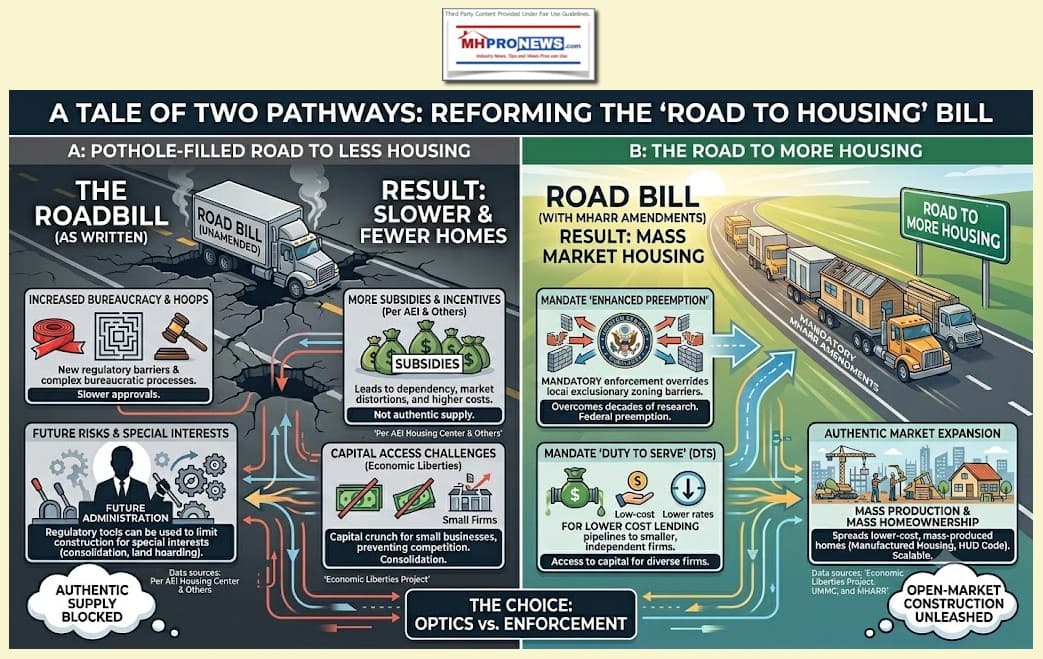
Gemini found that graphic above. That graphic could be the core for a powerful manufactured housing industry image and advocacy campaign. With hundreds of millions to billions of dollars available to several MHI member firms, it should be apparent that they have the potential to litigate, to lobby, and legislate in ways that could spur manufactured housing to record growth. But instead of doing that, MHI offers 63 words on the approach of June as National Homeownership month extolling the wonders and glories of CEO Lesli Gooch, Ph.D. and by extension, MHI and MHI’s board leadership. Ha! In the light of mountains of evidence, those 63 empty words are shown to be more posturing, and once more, no performance. This human intelligence (HI) generated table illustrates at a glance just how UNmasterful Gooch and MHI have been, with one keen distinction. Their posturing, paltering, and related behavior has resulted in 2 decades of steady consolidation. The KPIs don’t lie, even though people do.
REVISED
Table 1
Manufactured Home Production
National Totals
Average for years shown
1995-2000
2,033,545
338,924
2001-2025
2,333,138
93,326
Average Annual Deficit =
245,598
Table 2
Cumulative 21st Century Deficit
21st Century Annual Deficit in MH Production
245,598 x 25 =
6,139,950
a) MHI’s leaders could double check that data, plus the Visual Capitalist information above on the lack of housing affordability and craft an authentic image and education campaign.
b) But instead of doing so, MHI’s leaders repeatedly elect instead to posture, to promise, to self-promote, to promote each other instead of manufactured housing more broadly. Where are the PEPs? Where is the GoRVing style image/education campaign?
d) Where is the ‘champion’ for MHI that is willing to publicly debate their 21st century performance, particularly since Chris Stinebert or Gail Cardwell left their association? Notice that Cardwell’s PowerPoint linked herecontradictsLesli Gooch’s problematic wording on the Duty to Serve (DTS) exposed in the report linked here. No one, no organization with experienced and credentialed professionals on par with what MHI’s board and senior leadership have can produce such a consistently flawed outcome that magically benefits consolidators who are routinely MHI members while simultaneously harming the majority of all Americans, manufactured housing industry independents, and the American economy in the process.