According to the Manufactured Housing Association for Regulatory Reform (MHARR) President and CEO, Mark Weiss, J.D.: “Discriminatory zoning exclusion is at the root of the industry’s stagnant production levels and a major contributor to the nation’s affordable housing crisis. For this issue to be excluded, in any mandatory context, from bills that, according to their authors and supporters, are designed to spur and revitalize the availability of affordable housing, is unfathomable, as is [the Manufactured Housing Institute’s] MHI’s apparent failure to publicly support MHARR’s effort to include a preemption-based zoning remedy in those bills.” From the full MHARR research document (Part II): “This legal triad ensures major production cost savings for manufactured home producers, which are then passed-on to manufactured homebuyers:” “(1) uniform federal standards; (2) uniform federal enforcement; and (3) federal preemption to prevent the imposition or enforcement of disparate, non-identical standards by state and/or local governments.” MHARR’s remarks are similar to those of Legacy Housing’s Executive Chairman Curt Hodgson during a recent earnings call (see Part III):
But we still struggle on where you’re going to put them [i.e.: HUD Code manufactured homes]. We don’t have a lot of vacant spaces in big cities. We don’t have very many mobile home parks coming online, although, as you know, we’re trying to do things in Texas. But we don’t have a good answer to where we’re going to put them. Lots of headwinds. And the industry itself has not grown in and filling that void, and they haven’t grown on providing a neighborhood solution as the traditional home builders have, of which I know you follow many of them.
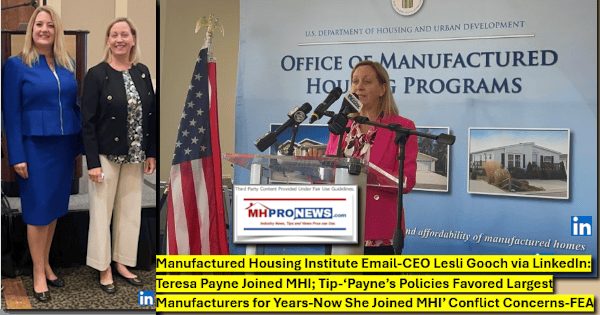
1. Legacy is a known multi-year member of the Manufactured Housing Institute (MHI). Those earnings call insights from Hodgson help set the stage and underscore what follows from MHARR.
AI‑in‑the‑Loop (AIL): Independent runs using Microsoft Copilot and Google Gemini
Primary‑source documentation: MHARR research, federal statutes, congressional testimony, earnings calls, antitrust filings, and zoning case evidence
Audit trail transparency: Full Q&A transcripts and AI‑generated summaries are preserved for academic, legal, and regulatory review
3. This layered approach ensures that automated AI synthesis is checked, corrected, and grounded in the factual record by a decades‑experienced industry expert.
Part I
Washington, D.C.
FOR IMMEDIATE RELEASE Contact: MHARR
(202) 783-4087
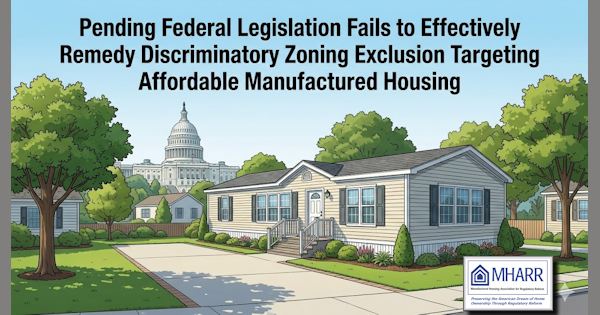
Pending Federal Legislation Fails to Effectively Remedy Discriminatory Zoning Exclusion Targeting Affordable Manufactured Housing
Washington, D.C., May 14, 2026 – The Manufactured Housing Association for Regulatory Reform (MHARR) is today publishing the second in a series of detailed analyses (copy attached) based on its April 13, 2026 one-page summary (copy also attached) of fundamental and potentially serious questions for the manufactured housing industry – and manufactured housing consumers – raised by the housing bills currently pending in the U.S. Senate (the ROAD to Housing Act) and the U.S. House of Representatives (the Housing for the 21st Century Act).
This must-read in-depth analysis addresses the most serious and damaging of the major national bottlenecks (primarily within the industry’s post-production sector) which have suppressed the growth and expansion of the affordable manufactured housing industry (thereby contributing to the nation’s unprecedented shortage of affordable housing) – i.e., the total failure of the U.S. Department of Housing and Urban Development (HUD), with the apparent acquiescence of the post-production sector’s national representative, the Manufactured Housing Institute (MHI), to enforce the enhanced federal preemption of the Manufactured Housing Improvement Act (2000 Reform Law) to stop local zoning laws that discriminatorily exclude (or limit) HUD-regulated manufactured homes from jurisdictions and communities around the country.
Notwithstanding the extreme harm that such edicts impose on both the manufactured housing industry and the nation’s consumers of affordable housing, a definitive, mandatory remedy is nevertheless inexplicably omitted entirely from the currently-pending “housing” bills. The MHARR analysis fundamentally demonstrates, proves and concludes that a statutory clarification of the scope and reach of enhanced federal preemption under the 2000 Reform Law – to confirm that such preemption applies to and includes discriminatory zoning exclusion or limitation, is essential for both the industry and consumers, and must be included in any final legislation.
In Washington, D.C., MHARR President and CEO, Mark Weiss, stated: “Discriminatory zoning exclusion is at the root of the industry’s stagnant production levels and a major contributor to the nation’s affordable housing crisis. For this issue to be excluded, in any mandatory context, from bills that, according to their authors and supporters, are designed to spur and revitalize the availability of affordable housing, is unfathomable, as is MHI’s apparent failure to publicly support MHARR’s effort to include a preemption-based zoning remedy in those bills.”
Manufactured Housing Association for Regulatory Reform (MHARR) 1331 Pennsylvania Ave N.W., Suite 512 Washington D.C. 20004 Phone: 202/783-4087 Fax: 202/783-4075 Email: MHARRDG@AOL.COM Website: www.manufacturedhousingassociation.org
The Manufactured Housing Association for Regulatory Reform is a Washington, D.C.- based national trade association representing the views and interests of independent producers of federally-regulated manufactured housing.
MHARR’s report is available for re-publication in full (i.e., without alteration or substantive modification) without further permission and with proper attribution and/or linkback to MHARR.
MHARR notes that the featured image was generated by artificial intelligence (AI) powered Gemini.
Part II
MHARR ISSUE ANALYSIS: WHY STRENGTHENING OF FEDERAL LAW TO HALT THE ZONING EXCLUSION OF MANUFACTURED HOMES MUST BE INCLUDED IN PENDING HOUSING LEGISLATION
Of the principal national bottlenecks that have suppressed the sales, use and production of affordable, mainstream federally-regulated manufactured homes over the past two decades (i.e., discriminatory zoning exclusion, the ongoing failure of Fannie Mae and Freddie Mac to implement the statutory Duty to Serve Underserved Markets mandate and pending draconian manufactured housing “energy” standards), discriminatory zoning exclusion is today, by far, the most harmful, most damaging and most fundamental barrier for both the manufactured housing industry and American consumers of affordable housing. Yet, the housing bills pending before Congress in its current session, totally fail to remedy or even address this destructive discrimination in any mandatory fashion. Moreover, as is demonstrated by the detailed analysis which follows, both the failure to confront this discriminatory exclusion under pre-existing law (which, according to its authors, was specifically designed to achieve that purpose through enhanced federal preemption)and the parallel failure to address and remedy this crucial bottleneck through the bills introduced in the current session, are the product of parallel failures on the part of the industry’s federal regulator, the U.S. Department of Housing and Urban Development (HUD), and the erstwhile national representative of the industry’s post-production sector, the Manufactured Housing Institute (MHI).
The discriminatory exclusion of manufactured homes and manufactured home communities under the guise of zoning regulation, is not a new phenomenon. Before the enactment of the National Manufactured Housing Construction and Safety Standards Act of 1974 (1974 Act) (42 U.S.C. 5401, etseq.), discriminatory zoning edicts were a result or byproduct of the then-mobile homes’ placement on a piece of land – either individually on a single, self-contained lot or a collective group of individual properties confined to and contained within a given area, in the case of developments, communities, planned unit developments, resorts, etc. The discriminatory and exclusionary laws adopted by local governments against mobile homes at that time, were subtle and nearly all based on one – or a combination of – supposed characteristics of either the mobile home itself or the lower/moderate-income mobile homeowner or resident, such as race, socio-economic traits, lifestyle, class, site-work, aesthetics of the home, etc. These exclusionary edicts were further rationalized by false or unsubstantiated claims regarding lower/moderate-income residents, e.g., their alleged failure to pay proportionate tax revenue, disproportionate utilization of taxpayer-funded resources (e.g., school over-crowding), and disproportionate property depreciation, among other things.
Blatantly discriminatory zoning exclusion of this type was largely addressed and resolved by the industry before the adoption of the 1974 Act, and would not be likely to return, under any scenario, today. Such overt dejure socio-economic discrimination today would be met with legal challenges outside of federal manufactured housing law (e.g., civil rights and anti-discrimination laws) which would be likely to prevail in any court challenge and bring with them highly negative and unwanted publicity for any jurisdiction involved. Accordingly, discriminatory zoning exclusion of this type, targeted against manufactured homes, manufactured homeowners and manufactured home residents, was largely addressed and remedied prior to the advent of federal regulation under the 1974 Act.
Nevertheless, the 1974 Act was designed and structured to expand the availability and utilization of HUD-regulated manufactured homes as an affordable housing and homeownership resource. Thus, the 1974 Act debuted a three-part federal regulatory structure (triad) which was designed by Congress to ensure the continuing, long-term affordability of HUD-regulated manufactured housing. This three-part structure, as previously explained and documented by MHARR, is based upon:
(1) uniform federal standards;
(2) uniform federal enforcement; and
(3) federal preemption to prevent the imposition or enforcement of disparate, non-identical standards by state and/or local governments.
This legal triad ensures major production cost savings for manufactured home producers, which are then passed-on to manufactured homebuyers.
As originally enacted by Congress, then, the 1974 Act included an express federal preemption provision which stated:
“Whenever a Federal manufactured home construction and safety standard established under this title is in effect, no state or political subdivision of a state shall have authority either to establish, or to continue in effect, with respect to any manufactured home covered, any standard regarding construction or safety applicable to the same aspect of performance of such home which is not identical to the Federal manufactured home construction and safety standard.”
42 U.S.C. 5403(d) (Emphasis added). This provision, as expressly recognized by Congress at the time, was included in the 1974 Act to prevent states and localities from imposing a multitude of divergent construction and safety mandates on manufactured housing, which would undermine the dual fundamentalfederal objectives of the Act – i.e., to ensure the availability and affordability of federally-regulated manufactured housing. Thus, federal preemption was recognized by the framers of the 1974 Act as being essential to the affordability and utilization of HUD Code manufactured housing.
Under this structure and its express federal preemption provision, HUD could have – and should have – used federal preemption to prevent the discriminatory zoning exclusion of manufactured homes that HUD, itself, regulated. HUD, however, under pressure from the National Association of Home Builders (NAHB) to sharply limit and maintain only minimal preemption under the 1974 Act – and without effective push-back from MHI on behalf of manufactured housing retailers and its other post-production sector constituents — interpreted the preemption provision of the original 1974 Act very narrowly and, specifically, as not reaching matters of zoning exclusion.
Zoning exclusion of manufactured homes, however, did not disappear in the wake of the collapse of earlier dejure exclusion, or the advent of the 1974 Act. Instead, it proliferated, shifting its nature, focus and rationalization(s) to other grounds, while operating to the extreme detriment of both the industry and manufactured housing consumers. The basis and nature of this shift were explained in detail by MHARR Founding President and CEO, Danny D. Ghorbani in a 2021 trade press interview:
“The zoning battleground has been shifting for years …. States, local governments and zoning boards these days are much smarter than our industry gives them credit for. They have studied and learned the intricate details of [federal manufactured housing law] and nearly all of them understand it and its far-reaching ramifications better than a lot of people in our own industry. While they rarely admit it openly or publicly, they now know that our homes are no longer the trailers and mobile homes of yesteryear, but modern, high-quality dwellings to be lived in permanently, just like any other type of housing. So, today’s zoning boards, which include, [as members,] among others, site-builders, realtors, suppliers, financiers, planners, union members and site-developers, just to name a few, have been slowly, quietly and subtly using the differences between the Federal manufactured housing code (i.e., the HUD Code) and other types of building codes (i.e., International Residential Code and/or its various derivatives) as their main weapon to keep manufactured homes out of their jurisdictions. They have gradually switched their reason(s) for not allowing manufactured homes in their jurisdictions away from the characteristics and/or profile of the homeowner, to the home itself. Thus, a new and different version of the “Not In My Backyard – NIMBY” argument (a phrase made famous by the late HUD Secretary, Jack Kemp), is now being applied against manufactured homes. According to their various arguments, manufactured homes are not permitted in their jurisdictions because they are built in compliance with a HUD Code that is not on par with – or is allegedly inferior to — other types of homes and the code(s) they are built to, which are allowed in their jurisdictions. The zoning battle ground now is about the parity, or the lack thereof, between these two codes, and such zoning laws, in reality, are challenging the HUD Code and manufactured homes, which carry the “good housekeeping” seal of approval of the United States government.”
Discriminatory zoning exclusion, accordingly, is the major manufactured housing industry bottleneck that must be addressed and rectified if the industry is to grow and expand in a manner consistent with its full potential.
DISCUSSION AND ANALYSIS
As is demonstrated above, discriminatory zoning exclusion is an issue which uniquely affects mainstream, affordable, federally-regulated manufactured housing and its predominately lower and moderate-income consumers. While there is currently no definitive analysis or academic examination of the number of jurisdictions in the United States which exclude (or significantly limit) manufactured homes[1] – either dejure or defacto – extensive anecdotal evidence indicates: (1) that the number is substantial; (2) that such jurisdictions are widely distributed geographically across the United States; and (3) that such jurisdictions have significant populations, representing millions of potential manufactured housing purchasers, a substantial number of which are either excluded from homeownership altogether or otherwise housing-limited by such anti-manufactured housing zoning mandates and/or enforcement. This discriminatory exclusion of affordable manufactured housing has, in turn, contributed to the 10 million-unit affordable housing shortfall currently affecting all areas of the United States.[2]
Given the pervasive dimensions of this issue (i.e., scope) and its extreme negative impact on: (1) the manufactured housing industry; (2) American consumers of affordable housing; (3) and the American housing economy (i.e., severity), its omission — in any mandatory context – from housing legislation in the current session of Congress, is inexplicable and ultimately, indefensible. This matter will be analyzed, in detail, with specific facts, below.
In multiple jurisdictions around the country, affordable, mainstream manufactured housing regulated by HUD pursuant to the 1974 Act, as amended by the Manufactured Housing Improvement Act of 2000 (2000 Reform Law) is still excluded by local zoning requirements or mandates.[3] Given the fact that manufactured homes today are both aesthetically similar to like-sized site-built homes, and are constructed in accordance with federal construction and safety standards which assure that such homes are high-quality, durable, and ensure consumer safety comparable to all other types of single-family homes, the sole remaining (albeit illegitimate) state and/or local excuse for the exclusion of manufactured homes is the fact that they are constructed to comply with a HUD Code of federal construction and safety standards[4] instead of the state-supported International Residential Code (IRC) and other similar codes for site-built homes.
While state and/or local zoning exclusion may be express or defacto, such mandates nevertheless have the effect of either excluding totally or severely limiting the placement and, therefore, the availability of inherently affordable manufactured housing, including manufactured housing communities. This, in turn, makes homeownership in those jurisdictions less affordable, while millions of lower and moderate-income Americans are economically excluded from homeownership that would otherwise be available to them, together with all of the attendant socio-economic benefits of homeownership.[5]
Significantly, this exclusion of affordable, federally-regulated manufactured housing from entire communities – and with it, the parallel exclusion of millions of lower and moderate-income American manufactured homebuyers/homeowners from entire communities — is already illegal and unlawful under current law and could be prevented and/or enjoined if that law were fully and properly implemented and enforced by HUD. In the quarter-century that has elapsed since the enactment of the 2000 Reform Law, however, HUD (with the defacto acquiescence of MHI), has refused to enforce its enhanced preemption mandate against exclusionary zoning edicts and has ignored and/or resisted repeated calls by MHARR[6] (which does not collect representation dues from the industry’s post-production sector) for the strict application of enhanced federal preemption under the 2000 Reform Law to stop such local and/or state nullification of the federal purposes, objectives and policies embodied in federal manufactured housing law, via the discriminatory exclusion of HUD-regulated manufactured housing. As a result, the zoning exclusion of affordable, mainstream federally-regulated manufactured housing has continued to the extreme detriment of both the industry, which has suffered from needlessly low production and sales,[7] and American consumers of affordable housing who have needlessly been subjected to homelessness or housing limitations, insufficiency, or inadequacy as a consequence thereof.
Partly because of the foregoing failures, Congress, in the 2000 Reform Law, significantly enhanced both the scope and extent of federal preemption under the 1974 Act. As amended by the 2000 Reform Law, 42 U.S.C. 5403(d) now expressly states:
“Federal preemption under this section shall be broadly and liberally construed to ensure that disparate state or local requirements or standards do not affect the uniformity or comprehensiveness of the standards promulgated under this section nor the federal superintendence of the manufactured housing industry as established by this chapter.”
(Emphasis added). The 2000 Reform Law thus expands federal preemption regarding manufactured housing in three ways:
First, it expressly directs HUD to apply and enforce federal preemption “broadly and liberally.” Thus, Congress legislatively overruled HUD’s “narrow preemption” policy under the original 1974 Act.
Second, it expressly extends the scope and reach of federal preemption to include state and/or local “requirements” that are not necessarily construction or safety standards; and
Third, it simultaneously expands the basis for federal preemption to include interference with the comprehensive federal “superintendence” of the industry established by federal law, in order to achieve the federal objectives of the 2000 Reform Law.
As a result of these changes, the touchstone for federal preemption is no longer limited to the narrow “same aspect of performance” test that HUD had applied under the original 1974 Act. Even more importantly, the 2000 Reform Law preemption amendments expand the scope of federal preemption to include not just disparate state and/or local construction and safety standards, but all state or local “requirements” that impair HUD’s federal superintendence of the manufactured housing industry under federal law, in accordance with the full purposes and objectives of that law. And, insofar as the purposes of federal manufactured housing law, as amended by the 2000 Reform Law, include assuring the availability of affordable manufactured housing for “all Americans,” the state and/or local “requirements” subject to preemption under amended section 42 U.S.C. 5403(d) must logically and necessarilyinclude state and/or local zoning edicts which exclude affordable manufactured housing regulated under the same federal law.
MHARR, for its part, therefore, has always maintained that the 2000 Reform Law enhanced preemption amendments provide HUD with ample federal authority to invalidate state and/or local zoning mandates that discriminatorily exclude HUD-regulated manufactured housing. The underlying legal/statutory rationale is straightforward. It begins by recognizing that HUD’s statutory authority over – and responsibility for – the manufactured housing industry is quite broad. That is why HUD’s manufactured housing preemption regulations have always referred to its “superintendence” of the industry. That language selection was not accidental. It refers to – and is based upon – HUD’s statutory obligation, in accordance with the express congressional purposes of the 2000 Reform Law — to advance and “facilitate” the availability of affordable HUD Code manufactured housing for all Americans as an essential affordable housing and homeownership resource. And, again, the choice of the word “facilitate” in connection with the purposes of the 2000 Reform Law was also not an accident. Rather, it was used to reflect an affirmative statutory obligation on the part of HUD to use all of the powers and authorities available to it, to advance and facilitate the availability and utilization of HUD Code manufactured homes across all areas of the United States, among all groups and populations, and at all income levels.
The 1974 Act, as amended, enhanced and augmented by the 2000 Reform Law, accordingly, tasked HUD with a broad affordable housing role with respect to manufactured housing. But that federal statutory role cannot be fulfilled if states and/or local governments can use their zoning power to discriminatorily or arbitrarily exclude affordable HUD Code manufactured homes. Consequently, Congress, in the 2000 Reform Law, paired HUD’s augmented affordable housing role with an augmented, enhanced federal preemption authority to make it clear that the scope of federal preemption under the Act, as amended, would be equally broad and up to the task of eliminating such baseless exclusions of the nation’s premier source of inherently affordable housing and homeownership when and where needed.
Congress, accordingly, extended the scope of federal preemption under the 2000 Reform Law, not just to state and/or local construction and safety standards, but to all state and/or local “requirements” – including exclusionary zoning mandates – that impair the availability and affordability of HUD-regulated manufactured housing. Indeed, key congressional sponsors of the 2000 Reform Law made this expansion of HUD’s role and preemption authority unmistakably clear in a 2003 communication to HUD, wherein they stated:
“[T]he 2000 Act expressly provides, for the first time” that federal preemption [is to be] broadly and liberally construed to ensure that local ‘requirements’ do not affect ‘federal superintendence of the manufactured housing industry.’ These combined changes have given HUD the legal authority to preempt local requirements or restrictions which discriminate against the siting of manufactured homes ….”
(Emphasis added).
HUD, though, despite this specific statutory enhancement of federal preemption to target discriminatory and exclusionary state and local zoning laws, has failed to use this authority even once in the ensuing quarter-century, to invalidate zoning laws which prohibit or discriminatorily restrict the siting of manufactured homes and/or manufactured housing communities comprised of homes that HUD itself regulates.
Given HUD’s long-standing refusal to enforce the enhanced federal preemption of the 2000 Reform Law with respect to state and/or local zoning mandates which discriminatorily exclude or restrict the placement of HUD-regulated manufactured homes, it is evident that a further amendment of federal manufactured housing law is necessary to make it abundantly clear – beyond any possible debate – that HUD has the authority – and, indeed, the affirmative statutory obligation – to federally preempt and invalidate exclusionary state and/or local zoning mandates or restrictions that discriminatorily target HUD-regulated manufactured homes.
While certain iterations of the 2026 housing legislation included provisions similar to the Housing Supply Frameworks Act (HSFA) – supported as separate legislation by MHARR when introduced – which were designed to reduce the zoning exclusion of affordable homes, including manufactured homes, those provisions were voluntary and permissive, rather than mandatory. Although the enactment of legislation including those provisions could have some beneficial impacts for the affordable, mainstream HUD Code manufactured housing market, by facilitating the removal or amelioration of some exclusionary zoning mandates, there is no guarantee or assurance that positive, wide-scale results will ensue for the availability and utilization of affordable, mainstream HUD Code manufactured homes.
Instead, in order to prevent the zoning exclusion of manufactured homes and state/local subversion of the federal affordable housing goals and objectives of the 1974 Act and 2000 Reform Law, such legislation (e.g., section 301(f)) must be amended to include a directive to HUD to fully implement federal preemption against discriminatory zoning exclusion targeting HUD-regulated manufactured homes. MHARR submitted such an amendment to Congress in September 2025, as follows:
“PREEMPTION – Nothing in this section or the amendment made by this section shall be construed as limiting the scope of federal preemption under section 604(d) of the National Manufactured Housing Construction and Safety Standards Act of 1974 as amended (42 U.S.C. 5403(d). The Secretary shall fully implement federal preemption under that section to prevent, prohibit and remedy the zoning exclusion or discriminatory restriction or limitation of the placement of manufactured homes subject to this title in any state or local jurisdiction thereof.”
(Underlining denotes new language).
The addition of this language would make it abundantly and unmistakably clear that the enhanced federal preemption of the 2000 Reform Law extends to and includes the preemption of state and/or local zoning “requirements” that operate to exclude the placement of affordable, mainstream, federally-regulated manufactured homes. MHI, however, while publicly supporting the 2026 housing legislation, failed – to MHARR’s knowledge, information and belief – to publicly support or demand the inclusion of this (or similarly effective) preemption affirmation language in such legislation.
This failure (or refusal) on the part of MHI (and HUD as well) is unfathomable and inexcusable given the massive negative impact that zoning exclusion and limitations have had – and continue to have — on both the industry and consumer of affordable manufactured housing. The failure to include such a “fix” in the pending housing legislation represents an historic “missed opportunity” to both advance and expand the manufactured housing industry. The industry, in turn, should carefully consider the motivations and bases for this elemental MHI failure to further the broader industry’s best interests
— —
The Manufactured Housing Association for Regulatory Reform is a Washington, D.C.- based national trade association representing the views and interests of independent producers of federally-regulated manufactured housing.
[1] The term “discriminatory zoning exclusion” will be used in this analysis as a reference to both the total exclusion and/or significant limitation of HUD Code manufactured home placements, and both dejure and defacto exclusion.
[2]Seegenerally, 2026 Economic Report to the President regarding the current affordable housing shortfall.
[3] The full scope and nature of this type of exclusion is detailed in Richard D. Kahlenberg, “Excluded: How Snob Zoning, NIMBYism and Class Bias Build the Walls we Don’t See” (2023).
[5] For a general discussion of the benefits of homeownership, see, Harvard University, Joint Center for Housing Studies, “ Comparison of the Costs of Manufactured and Site-Built Housing.”
[6] MHARR’s specific, public support for the application of enhanced federal preemption to nullify state and/local zoning discrimination against HUD-regulated manufactured homes, to MHARR’s knowledge, information and belief, has not been publicly joined by MHI.
[7] The most recent HUD data shows that production and sales of HUD-regulated manufactured homes over the first three months of 2026 is 8.9% below production and sales over the same period in 2025.
In a detailed analysis released May 14, 2026, the Manufactured Housing Association for Regulatory Reform (MHARR) sounds a critical alarm for the manufactured housing industry and consumers of affordable housing. The report, which is the second in a series based on MHARR’s April 2026 summary, argues that major housing legislation currently pending in both the U.S. Senate (the ROAD to Housing Act) and the U.S. House of Representatives (the Housing for the 21st Century Act) fails to address the most significant bottleneck suppressing industry growth:discriminatory zoning exclusion.
MHARR contends that local zoning laws across the country systematically exclude or severely limit HUD-regulated manufactured homes from communities. This widespread practice, according to MHARR President and CEO Mark Weiss, is “at the root of the industry’s stagnant production levels and a major contributor to the nation’s affordable housing crisis.“
A central failure highlighted in the report is the lack of enforcement of enhanced federal preemption by the U.S. Department of Housing and Urban Development (HUD).Although the Manufactured Housing Improvement Act of 2000 (2000 Reform Law) provides for broad federal preemption, MHARR argues that HUD has failed to use this authority to invalidate discriminatory local zoning ordinances.
Furthermore, the analysis criticizes the apparent acquiescence of the Manufactured Housing Institute (MHI), the industry’s post-production sector national representative.MHARR finds MHI’s failure to publicly support MHARR’s effort to include a preemption-based zoning remedy in the pending legislation to be “unfathomable.”
MHARR’s fundamental conclusion is that a final housing bill must include a statutory clarification of the 2000 Reform Law.This clarification must explicitly confirm that federal preemption applies to and includes discriminatory zoning exclusion or limitation to provide a definitive, mandatory remedy.
Best SEO Terms for This MHARR Report
To maximize the reach and impact of this critical report, we recommend using a strategic mix of high-volume and highly targeted search terms.
Primary Keywords:
Manufactured Housing Association for Regulatory Reform (MHARR)
Manufactured housing industry report
Affordable manufactured housing
HUD-regulated manufactured homes
Zoning exclusion manufactured housing
Legislation & Regulatory Keywords:
ROAD to Housing Act
Housing for the 21st Century Act
Manufactured Housing Improvement Act of 2000 (2000 Reform Law)
Enhanced federal preemption manufactured housing
HUD zoning enforcement
Issue-Specific & Long-Tail Keywords:
Discriminatory zoning manufactured homes
Post-production bottlenecks manufactured housing
Manufactured housing production decline
Mark Weiss MHARR statement
MHARR vs.MHI zoning preemption
Affordable housing crisis solution
Table: Summary of MHARR Analysis of Pending Federal Housing Legislation
Core Issue
MHARR Position
Primary Bottleneck Identified
Proposed Legislative Remedy
Key Stakeholders Criticized
Relevant Legislation/Law
Discriminatory Zoning Exclusion
A definitive, mandatory remedy is omitted from pending bills.
Local zoning laws excluding HUD-regulated manufactured homes.
Statutory clarification of the 2000 Reform Law to explicitly confirm preemption of discriminatory zoning.
Since our launch in mid-October 2009, what was later rebranded as Manufactured Home Pro News (MHProNews) has strived to provide the best possible coverage of the opportunities and barriers facing modern manufactured homes. We have always promoted good business practices, candor, ethics, traditional morality, in sharing a proven path for intergenerational wealth creation for all.
It is only by addressing the core issues that have long vexed manufactured housing from within and beyond the industry that the benefits of the industry can be a blessing to all honestly involved.
We may have long been the most read (and later the largest) trade media for manufactured housing shortly after we launched. But in some ways, we have only just begun. ##