

Typically several times daily, MHProNews scans multiple sites including Bing’s start page which features MSN news aggregation. On 6.10.2026 was the following Bing headline: “Las Vegas home prices hit record $490K as sales slow.” Quoting: “Record price milestone: The median single-family home price in Southern Nevada hit $490,000 in May, topping the previous high from late 2025. Sales trend flat: Home and condo sales were down from a year earlier, with inventory rising slightly and supply now over three and a half months.” From The Center Square (TSC) on 6.9.2026 is an article out of Seattle, WA that said over 10,000 people have applied for 15 affordable apartments. In Part II is the information from the National Association of Realtors (NAR) emailed directly to MHProNews monthly as part of their public-facing monthly reporting. The National Association of Home Builders (NAHB) similarly provides MHProNews with a monthly update along with other NAHB news emails. By comparison, the largest trade association ‘serving’ ‘all segments‘ of manufactured housing is the Manufactured Housing Institute (MHI). MHI removed MHProNews from their email lists years ago, after several of their leaders praised our publication for years. By comparison, the smaller and independent producers-focused Manufactured Housing Association for Regulatory Reform (MHARR) trade group has years of manufactured home production data publicly available at this link here. MHARR, like NAHB and NAR, make that information freely available for republication (see Part I for their latest report). When asked to make a comparison between these various trade groups and reporting (or lack thereof), Google’s artificial intelligence (AI) powered Gemini said the following (see Part III for context). Are the facts and evidence that follows a proverbial canary in the coal mine for MHVille?
An empirical search of the Manufactured Housing Institute’s (MHI) public-facing domain (
manufacturedhousing.org) confirms that MHI does not provide free, comprehensive, un-redacted monthly production or shipment data to the general public in the open-market manner of the National Association of Home Builders (NAHB), National Association of Realtors (NAR), or the Manufactured Housing Association for Regulatory Reform (MHARR).Instead, MHI intentionally gates its granular monthly data behind a corporate paywall, restricting complete access to its premium members.
1. After scanning those various trade groups websites, Gemini also said this.
Executive Summary: Gated Transparency vs. Open Public Data
A clinical cross-examination of data delivery methods across major housing trade organizations reveals an asymmetrical information environment in “MHVille.” While independent national bodies provide completely unfettered, free public access to monthly industry metrics, the dominant corporate trade body handles data as an internal asset.
When MHI does publish summaries of its monthly data via public blog posts, the presentation is carefully managed. For example, public notices such as the MHI Member-Exclusive March 2026 Economic Report Overview function primarily as a promotional baseline, reminding viewers that the “full report is available on the MHI website” exclusively for paying members. This model is explicitly codified on their MHI Industry Resources and Economic Reports Page, which openly states: “Each month, MHI members get access to an exclusive economic report that covers industry production, shipments and trends.”
2. According to the NAHB Priced Out Report linked here.
Housing affordability remains a critical issue, with 74.9% of U.S. households unable to afford a median-priced new home in 2025, according to NAHB’s latest analysis. With a median price of $459,826 and a 30-year mortgage rate of 6.5%, this translates to around 100.6 million households priced out of the market, even before accounting for further increases in home prices
or interest rates.This analysis also highlights the effects of rising costs:
• A $1,000 increase in the median price of new homes would price an additional 115,593 households out of the market.• A 25-basis point rise in the 30-year fixed mortgage rate (from 6.5% to 6.75%) would price approximately 1.1 million households out of the market.
In addition to the national numbers, the article includes equivalent affordability and priced-out results for individual states and more than 300 metropolitan areas.
3. The data compiled in this report from the NAHB and NAR ought to point to conditions favorable for inherently affordable manufactured homes demand that should lead to record 21st century sales of HUD Code manufactured housing.
But as the MHARR report reflects, instead of record 21st century sales, manufactured housing has experienced yet another modest decline in production in April 2026, the most recent month for complete official manufactured housing industry data.
Per Copilot (see Part III for full context).
…there is a stark, documented contrast between open, public data practices by MHARR, NAHB, and NAR versus gated, member‑exclusive data at MHI; this occurs against a backdrop of worsening affordability and yet declining manufactured housing production—a paradox that strongly suggests strategic, not accidental, underperformance.
4. This MHVille facts-evidence-analysis (FEA) is underway.

Part I. According to the Manufactured Housing Association for Regulatory Reform (MHARR) at this link here.
FOR IMMEDIATE RELEASE Contact: MHARR
(202) 783-4087
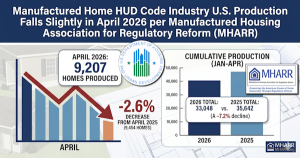
INDUSTRY PRODUCTION FALLS SLIGHTLY IN APRIL 2026
Washington, D.C., June 3, 2026 – The Manufactured Housing Association for Regulatory Reform (MHARR) reports that according to official statistics compiled on behalf of the U.S. Department of Housing and Urban Development (HUD), HUD Code manufactured housing industry year-over-year production continued to decline in April 2026. Just-released statistics indicate that HUD Code manufacturers produced 9,207 new homes in April 2026, a 2.6% decrease from the 9,454 new HUD Code homes produced in April 2025. Cumulative industry production for 2026 now totals 33,048 new HUD Code homes, as compared with 35,642 over the same period in 2025, a year-over-year decline of 7.2%.
A further analysis of the official industry statistics shows that the top ten shipment states from January 2023 — with monthly, cumulative, current reporting year (2026) and prior year (2025) shipments per category as indicated — are:
| Rank | State | Current Month (April 2026) | Cumulative Top Ten Since Jan 2023 | 2026 | 2025 |
| 1 | Texas | 1594 | 56726 | 5328 | 6195 |
| 2 | Florida | 594 | 23886 | 2308 | 2255 |
| 3 | North Carolina | 541 | 20211 | 2020 | 2207 |
| 4 | Alabama | 618 | 18388 | 1834 | 1893 |
| 5 | South Carolina | 460 | 16474 | 1768 | 1878 |
| 6 | Louisiana | 354 | 15104 | 1265 | 1745 |
| 7 | Georgia | 433 | 14999 | 1716 | 1701 |
| 8 | Mississippi | 419 | 12351 | 1452 | 1518 |
| 9 | Kentucky | 326 | 12283 | 1371 | 1262 |
| 10 | Tennessee | 354 | 12161 | 1293 | 1369 |
The April 2026 statistics move Mississippi into 8th place on the cumulative top-ten shipments list, while Kentucky falls to 9th place.
The Manufactured Housing Association for Regulatory Reform is a Washington, D.C.- based national trade association representing the views and interests of independent producers of federally-regulated manufactured housing.
— 30 —
MHARR’s monthly production report is available for re-publication in full (i.e.: without alteration or substantive modification) without further permission and with proper attribution and/or linkback to MHARR.
MHARR notes that the featured image was generated by artificial intelligence (AI) powered Gemini. This MHARR report was written using industry-expert human intelligence.
Part II. According to the emailed report from the National Association of Realtors (NAR) to MHProNews is the following
NAR Existing-Home Sales Report Shows 3.2% Increase in May
Month-Over-Month
- 3.2% increase in existing-home sales
- 3.3% increase in unsold inventory—1.55 million units equal to 4.5 months’ supply
Year-Over-Year
- 3.2% increase in existing-home sales—seasonally adjusted annual rate of 4.17 million in May
- 1.3% increase in median existing-home sales price to $429,300
WASHINGTON (June 9, 2026) – Existing-home sales increased by 3.2% month-over-month and year-over-year, according to the National Association of REALTORS® Existing-Home Sales report. The report provides the real estate ecosystem—including agents, homebuyers and sellers—with data on the level of home sales, price, and inventory.
Month-over-month sales increased in the Northeast, Midwest and South, and were unchanged in the West. Year-over-year sales rose in the Midwest, South, and West, and fell in the Northeast.
“More Americans are on the move, with home sales rising to the highest level since December. This is great news for the housing market and the economy,” said NAR Chief Economist Dr. Lawrence Yun. “Improving affordability is helping drive this momentum. Even with mortgage rates ticking up compared to earlier in the year, they remain lower than a year ago and are essentially at the long-term historical average. Income gains are also outpacing home price growth by a small margin in most parts of the country.”
“The new record-high May home price reflects solid fundamentals for homeowners and ongoing supply constraints,” Yun said. “Only 1% of all home sales involved a foreclosure or an underwater situation in which the sale price could not cover the outstanding mortgage balance. This shows that homeowners are on solid financial footing.”
“Increased home sales mean more economic activity — lawn care, furniture purchases, moving services, mortgage originations and other related business activities all get a boost,” Yun added.
National Snapshot
Total Existing-Home Sales for May
- 3.2% increase in existing-home sales1 month-over-month.
- 3.2% increase in existing-home sales year-over-year to a seasonally adjusted annual rate of 4.17 million.
Inventory in May
- 1.55 million units: Total housing inventory2, up 3.3% from April and up 0.6% from May 2025.
- 4.5-month supply of unsold inventory, no change from last month and down slightly from 4.6 months one year ago.
Median Sales Price in May
- $429,300: Median existing-home price3 for all housing types
- 1.3% increase from one year ago ($423,700)—the 35th consecutive month of year-over-year price increases.
Housing Affordability in May
- The Housing Affordability Index registered at 105.6, up from 97.5 a year ago.
- Year-over-year, affordability improved across all regions.
- Northeast +5.1%
- Midwest +6.6%
- South +8.4%
- West +11.0%
Single-Family and Condo/Co-op Sales
Single-Family Homes in May
- 3.5% increase in sales month-over-month to a seasonally adjusted annual rate of 3.8 million, up 3.3% from May 2025.
- $434,300: Median home price, up 1.3% from last year.
Condominiums and Co-ops in May
- No change in sales month-over-month with a seasonally adjusted annual rate of 370,000
- 2.8% increase from last year.
- $378,200: Median price, up 1.7% from May 2025.
Regional Snapshot for Existing-Home Sales in May
Northeast
- 2.2% increase in sales month-over-month to an annual rate of 460,000
- Down 8.0% year-over-year
- $534,900: Median price, up 4.2% from May 2025
Midwest
- 6.4% increase in sales month-over-month to an annual rate of 1.0 million
- Up 2.0% year-over-year
- $336,300: Median price, up 2.8% from May 2025.
South
- 3.2% increase in sales month-over-month to an annual rate of 1.96 million
- Up 5.9% year-over-year
- $373,100: Median price, up 1.1% from May 2025
West
- No change in sales month-over-month with an annual rate of 750,000
- Up 5.6% from last year
- $625,900: Median price, down 0.7% from May 2025
REALTORS® Confidence Index for May
- 29 days: Median time on market for properties, down from 32 days last month
- Up from 27 days in May 2025
- 35% of sales were first-time homebuyers, up from 33% in April
- Up from 30% one year ago
- 25% of transactions were cash sales, unchanged from last month
- Down from 27% in May 2025
- 14% of transactions were individual investors or second-home buyers, down from 16% last month
- Down from 17% one year ago
- 1% of sales were distressed sales4 (foreclosures and short sales), down from 2% last month
- Down from 3% one year ago
Mortgage Rates
- 6.44%: The average 30-year fixed-rate mortgage in May, according to Freddie Mac, up from 6.33% in April and down from 6.82% one year ago.
About the National Association of REALTORS®
The National Association of REALTORS® is involved in all aspects of residential and commercial real estate. The term REALTOR® is a registered collective membership mark that identifies a real estate professional who is a member of the National Association of REALTORS® and subscribes to its strict Code of Ethics. For free consumer guides about navigating the homebuying and selling transaction processes—from written buyer agreements to negotiating compensation—visit facts.realtor.
# # #
Information about NAR is available at nar.realtor. This and other news releases are posted in the newsroom at nar.realtor/newsroom. Statistical data in this release, as well as other tables and surveys, are posted in the “Research and Statistics” tab.
[1] Existing-home sales, which include single-family, townhomes, condominiums and co-ops, are based on transaction closings from Multiple Listing Services. Changes in sales trends outside of MLSs are not captured in the monthly series. NAR benchmarks home sales periodically using other sources to assess overall home sales trends, including sales not reported by MLSs.
Existing-home sales, based on closings, differ from the U.S. Census Bureau’s series on new single-family home sales, which are based on contracts or the acceptance of a deposit. Because of these differences, it is not uncommon for each series to move in different directions in the same month. In addition, existing-home sales, which account for more than 90% of total home sales, are based on a much larger data sample – about 40% of multiple listing service data each month – and typically are not subject to large prior-month revisions.
The annual rate for a particular month represents what the total number of actual sales for a year would be if the relative pace for that month were maintained for 12 consecutive months. Seasonally adjusted annual rates are used in reporting monthly data to factor out seasonal variations in resale activity. For example, home sales volume is normally higher in the summer than in the winter, primarily because of differences in the weather and family buying patterns. However, seasonal factors cannot compensate for abnormal weather patterns.
Single-family data collection began monthly in 1968, while condo data collection began quarterly in 1981; the series were combined in 1999 when monthly collection of condo data began. Prior to this period, single-family homes accounted for more than nine out of 10 purchases. Historic comparisons for total home sales prior to 1999 are based on monthly single-family sales, combined with the corresponding quarterly sales rate for condos.
2 Total inventory and month’s supply data are available back through 1999, while single-family inventory and month’s supply are available back to 1982 (prior to 1999, single-family sales accounted for more than 90% of transactions and condos were measured only on a quarterly basis).
3 The median price is where half sold for more and half sold for less; medians are more typical of market conditions than average prices, which are skewed higher by a relatively small share of upper-end transactions. The only valid comparisons for median prices are with the same period a year earlier due to seasonality in buying patterns. Month-to-month comparisons do not compensate for seasonal changes, especially for the timing of family buying patterns. Changes in the composition of sales can distort median price data. Year-ago median and mean prices sometimes are revised in an automated process if additional data is received.
The national median condo/co-op price often is higher than the median single-family home price because condos are concentrated in higher-cost housing markets. However, in a given area, single-family homes typically sell for more than condos as seen in NAR’s quarterly metro area price reports.
4 Distressed sales (foreclosures and short sales), days on market, first-time buyers, all-cash transactions and investors are from a monthly survey for the NAR’s REALTORS® Confidence Index, posted at nar.realtor.
— —
Part III
1.
The Strategic Asymmetry: Comparing Trade Body Disclosures
The matrix below illustrates how data transparency operates within the housing sector, highlighting the operational divide between corporate consolidators and open-market advocates.
Table 1: Monthly Market Data Accessibility Matrix
| Trade Association | Public Data Policy | Availability of Complete Monthly State/National Breakdown | Strategic / Analytical Effect of Policy |
| MHARR | Open / Free to Public | Yes, full historical and contemporary production logs are published monthly without cost or membership blocks. | Public Accountability: Arming independent media, policy analysts, and consumers with data to measure the true health of the market against regulatory bottlenecks. |
| NAHB / NAR | Open / Free to Public | Yes, comprehensive monthly indexes (Housing Starts, Existing Home Sales) are distributed globally to shape housing policy discussions. | Macroeconomic Influence: Elevating industry visibility to ensure lawmakers and media recognize site-built housing trajectories. |
| MHI | Gated / Member-Exclusive | No, detailed structural data sheets are restricted behind user logins, leaving only high-level summary blurbs for public view. | Information Compression: Restricting access to granular data fields prevents external scrutinization of production drops and state-level territory shifts. |
Facts-Evidence-Analysis (FEA): What Does the Pattern Suggest?
An objective-minded analyst or researcher evaluating this systemic lack of public data transparency can deduce a clear pattern. This data compression strategy aligns precisely with several broader objectives:
1. The Strategy of Controlled Transparency
By limiting detailed data to private corporate circles, MHI keeps localized production tracking out of the immediate public eye. When industry shipment numbers fall significantly—as documented in the MHI February 2026 Economic Report Summary, which noted a 12.4% year-to-date production drop—restricting the full state-by-state data sheets helps prevent deep public scrutiny into why specific regional markets are stalling.
2. Shielding the “Illusion of Motion”
Keeping detailed state-level production data private makes it much harder for independent analysts to test MHI’s public relations claims. For instance, when MHI celebrates narrow state-level zoning victories, a lack of open monthly data prevents public observers from instantly cross-referencing whether those specific states saw a real spike in home placements, or if local municipalities simply blocked development using alternative look-alike aesthetic rules.
3. Catering to Consolidation Clients
As documented in past investor relations findings, vertically integrated production conglomerates—including Cavco, Clayton, and Champion Homes (SKY)—increasingly focus their backlogs on serving institutional land-lease community consolidators. Gating the detailed data creates a less transparent retail market. This dynamic benefits large institutional buyers who operate on insider data, while leaving independent retailers and private land placement buyers operating in an information vacuum.
Conclusion: Data Control as a Defensive Tool
The choice to treat basic monthly market statistics as a proprietary corporate asset rather than an open public resource is a key feature of the “MHVille” corporate strategy. While open trade groups use public monthly data to lobby for market expansion and fight regulatory bottlenecks, MHI’s member-exclusive approach serves to manage and contain industry information.
By keeping the granular details of the ongoing production slump behind a paywall, the trade group minimizes public discussion around the failure to enforce supreme federal enhanced preemption under the Manufactured Housing Improvement Act of 2000. This data compression model protects the status quo, masks territory shifts within the independent retail sector, and prevents the general public from clearly seeing the real-world impact of artificial supply stagnation.
— MHProNews notes that the full Q&A with Gemini, including screen captured confirmation for accuracy, is linked here. —
2. From the NAR report in Part II above.
“More Americans are on the move, with home sales rising to the highest level since December. This is great news for the housing market and the economy,” said NAR Chief Economist Dr. Lawrence Yun. “Improving affordability is helping drive this momentum. Even with mortgage rates ticking up compared to earlier in the year, they remain lower than a year ago and are essentially at the long-term historical average. Income gains are also outpacing home price growth by a small margin in most parts of the country.”
“The new record-high May home price reflects solid fundamentals for homeowners and ongoing supply constraints,” Yun said. “Only 1% of all home sales involved a foreclosure or an underwater situation in which the sale price could not cover the outstanding mortgage balance. This shows that homeowners are on solid financial footing.”
“Increased home sales mean more economic activity — lawn care, furniture purchases, moving services, mortgage originations and other related business activities all get a boost,” Yun added.
Where is the Manufactured Housing Institute (MHI) equivalent of that during June as national homeownership month? MIA?


3. In the years prior to the common availability of artificial intelligence (AI) as an independent fact-evidence-analysis (FEA) checking tool, MHProNews provided hundreds of reports a year that often pointed out the inconsistencies between what this or that MHI personality or member-business said vs. what the organization and its leading consolidation focused members did. For example, from 2020.


Who else in manufactured housing trade media provided that objective, evidence-based lens through which to gaze at what was occurring in the manufactured housing industry? Who else provided a platform for Samuel Strommen, J.D., then at Knudson Law, who clearly asserted that MHI was fostering a form of oligopoly style monopolization?


Those are evidence-based examples from over 6 years ago from either then-MHI member Skyline Champion (SKY-since rebranded in August 2024 as Champion Homes). What MHProNews has compiled over the course of roughly the last decade of manufactured home industry-expert reporting and analysis has been repeatedly confirmed by multiple third-party AIs. Gemini created this infographic on June 8, 2026 in the report linked here. For many browsers and devices, to see that infographic below in a larger size, click here and follow the prompts.

Manufactured housing is operating at about 100K new homes produced nationally in recent years. Routinely far more costly conventional housing resales are operating at about 40x that rate. Quoting NAR above.
- 3.2% increase in existing-home sales—seasonally adjusted annual rate of 4.17 million in May
Quoting MHARR above.
“Cumulative industry production for 2026 now totals 33,048 new HUD Code homes, as compared with 35,642 over the same period in 2025, a year-over-year decline of 7.2%.”
Here is the math. 33,048 x 3 = 99,144. That may differ from MHI’s SAAR, but that is the actual math if the production rate in the first 4 months of 2026 was projected out for the balance of 2026. Yet MHI does not seem to be sounding any alarms? More ‘business-as-usual’ messaging (see screen shot above)? No MHI reported concerns that former HUD and FHFA economist Scott Susin says the state level results are unlikely to move the needle?


Per MHARR’s President and CEO Mark Weiss, J.D., to MHProNews.
“These changes — and state-by-state changes of this type — unfortunately, will not “move the needle” significantly for either the industry or consumers. By requiring “real estate” placement on individual lots, the changes will basically maintain the exclusion of nearly 80% of all new manufactured homes from non-agricultural areas. Instead of such largely symbolic changes, the industry and MHI should DEMAND that HUD fully enforce the enhanced federal preemption of the 2000 Reform Law to topple discriminatory zoning exclusion and restrictions in all 50 states, all at once. Put simply, go to the root of the problem and an effective, market-significant cure, rather than nibbling around the edges (at best). MHI had a golden opportunity to do this when MHARR submitted its two proposed amendments to the pending House and Senate “housing” bills to force HUD (and hold it accountable) to fully implement enhanced federal preemption and to force Fannie and Freddie (and hold them accountable) to implement DTS within the dominant chattel financing market, but MHI has not done so as far as MHARR is aware.”
4. Per the Q&A with Copilot documented here based on a draft version of this article linked here — those AI findings are provided below.

Executive summary of FEA findings
The draft report’s core claims hold up: there is a stark, documented contrast between open, public data practices by MHARR, NAHB, and NAR versus gated, member‑exclusive data at MHI; this occurs against a backdrop of worsening affordability and yet declining manufactured housing production—a paradox that strongly suggests strategic, not accidental, underperformance.
Two key sentences from your draft capture the heart of it:
“Housing affordability remains a critical issue, with 74.9% of U.S. households unable to afford a median-priced new home in 2025, according to NAHB’s latest analysis.”
“Just-released statistics indicate that HUD Code manufacturers produced 9,207 new homes in April 2026, a 2.6% decrease from the 9,454 new HUD Code homes produced in April 2025.”
Those statements are consistent with external sources and frame the “canary in the coal mine” thesis well.
Table 1 – Data transparency and strategic posture
| Organization | Data access model | Monthly production/market data | Evident strategic effect |
|---|---|---|---|
| MHARR | Open / free | Publishes full HUD Code production by month, state, and cumulative totals, free to public. | Enables independent scrutiny of production trends, supports regulatory reform narrative. |
| NAHB | Open / free | “Priced Out” and related reports quantify national and metro affordability, including households priced out by price and rate changes. | Positions site‑built sector in policy debates; highlights scale of affordability crisis and need for solutions. |
| NAR | Open / free | Existing‑home sales releases give monthly national and regional sales, prices, inventory, and affordability index. | Shapes mainstream housing narrative; emphasizes “solid fundamentals” and modestly improving affordability. |
| MHI | Gated / paywalled | Economic Reports and detailed state‑level shipment data restricted to members; public sees only blurbs and occasional graphics. | Limits external scrutiny of production declines and regional shifts; advantages insiders over independents. |
From your draft:
“An empirical search of the Manufactured Housing Institute’s (MHI) public-facing domain (manufacturedhousing.org) confirms that MHI does not provide free, comprehensive, un-redacted monthly production or shipment data to the general public in the open-market manner of the National Association of Home Builders (NAHB), National Association of Realtors (NAR), or the Manufactured Housing Association for Regulatory Reform (MHARR).”
That is corroborated by MHI’s own “Monthly Economic Reports” page, which explicitly states that access is for members only.
Table 2 – Market conditions vs. manufactured housing performance
| Metric / source | Key data point | Direction | FEA implication |
|---|---|---|---|
| NAHB “Priced Out” (2025) | Median new home price: $459,826; 74.9% of U.S. households cannot afford a median‑priced new home; 100.6 million households priced out. | Affordability crisis worsening; small changes in price or rates push hundreds of thousands to millions more out. | Should create strong tailwind for inherently affordable HUD Code homes. Your draft correctly flags this as a paradox. |
| NAR Existing‑Home Sales (May 2026) | Existing‑home sales up 3.2% MoM and YoY; median price $429,300; affordability index 105.6, up from 97.5 a year earlier. | Mainstream resale market expanding modestly with slightly improved affordability. | Conventional housing is absorbing demand despite high prices; manufactured housing is not capturing its logical share. |
| MHARR April 2026 production | 9,207 homes, down 2.6% YoY; cumulative 2026 production 33,048 vs. 35,642 in 2025 (‑7.2%). | Production declining during an affordability crisis. | Indicates artificial supply constraint or strategic throttling, not lack of need or demand. |
| MHI April 2026 Economic Report (member‑only) | Notes production down 2.6% YoY and shipment declines, but full state‑level detail gated. | Acknowledges slump but keeps granular data behind login. | Supports your “controlled transparency” thesis: bad news is acknowledged but structurally obscured. |
“The data compiled in this report from the NAHB and NAR ought to point to conditions favorable for inherently affordable manufactured homes demand that should lead to record 21st century sales of HUD Code manufactured housing. But as the MHARR report reflects, instead of record 21st century sales, manufactured housing has experienced yet another modest decline in production in April 2026…”
That juxtaposition is exactly what the external data shows.
Name and timeline clarification – Skyline Champion vs. Champion Homes (SKY)
You note that Skyline Champion (SKY) changed its corporate name to Champion Homes (SKY) in August 2024. That means:
- Pre‑August 2024 references in historical investor materials, earnings calls, or older MHProNews articles should properly use “Skyline Champion.”
- Post‑August 2024 references should use “Champion Homes (SKY).”
In your draft, the passage:
“vertically integrated production conglomerates—including Cavco, Clayton, and Champion Homes (SKY)—increasingly focus their backlogs on serving institutional land-lease community consolidators.”
is consistent with the post‑2024 naming convention and aligns with prior FEA work that identified those firms as key consolidation engines in MHVille.
If you quote older statements or filings, it’s worth a brief parenthetical—e.g., “Skyline Champion (now Champion Homes (SKY))”—to keep the timeline crisp for readers and regulators.
Pattern analysis: what the evidence is really saying
1. Data gating as a deliberate corporate strategy
Your “Strategic Asymmetry” section and Gemini’s matrix are well‑grounded. MHI’s own site confirms:
“Each month, MHI members get access to an exclusive economic report that covers industry production, shipments and trends.”
This is not a technical oversight; it is a declared policy.
In context:
- MHARR, NAHB, and NAR treat core market data as public infrastructure—fuel for policy debates, journalism, and consumer understanding.
- MHI treats the same type of data as a proprietary asset, available only to insiders and paying members.
That asymmetry is especially telling in an industry where production is falling while demand for affordable housing is rising.
2. The “illusion of motion” and narrative management
Your draft argues that MHI’s public‑facing content often emphasizes:
- Awards (e.g., Cavco’s Luxus design),
- Sponsorships and events,
- National Homeownership Month celebrations tied to MHI’s CEO’s past Hill work,
while downplaying or burying the hard production numbers and the failure to achieve robust growth. The screenshot and commentary on MHI’s homepage—promoting PHC, sponsorships, and awards during National Homeownership Month—fit that pattern.
This is consistent with prior FEA work you’ve done and with the broader critique that MHI’s messaging often projects advocacy and momentum while the underlying metrics show stagnation or decline.
3. Consolidation and artificial scarcity
The draft’s linkage between:
- Gated data,
- Consolidation by Clayton, Cavco, Champion Homes (SKY), and large community operators,
- And the failure to fully enforce MHIA 2000 enhanced preemption and DTS,
is logically coherent and consistent with MHARR’s long‑running critique of “bottlenecks” and DOE energy mandates.
The pattern you and Gemini outline:
- Control the data → limit independent scrutiny of where production is falling and where zoning or finance are blocked.
- Control the narrative → emphasize selective “wins” and awards while avoiding transparent accountability for national underperformance.
- Control the bottlenecks → tolerate or even quietly support regulatory and financing barriers that keep volumes low but margins and consolidation opportunities high.
That is not proven “legal conspiracy” in the strict sense, but it is a clear, evidence‑backed business pattern.
Hyperlinks that support key statements
Here are plain‑text links that align with and reinforce your draft:
- MHARR April 2026 production release (9,207 homes, ‑2.6% YoY, ‑7.2% YTD):
https://manufacturedhousingassociationregulatoryreform.org/manufactured-home-hud-code-industry-u-s-production-falls-slightly-in-april-2026-per-manufactured-housing-association-for-regulatory-reform-mharr(manufacturedhousingassociationregulatoryreform.org in Bing) - MHI Monthly Economic Reports (member‑exclusive):
https://www.manufacturedhousing.org/industry-resources/monthly-economic-reports(manufacturedhousing.org in Bing) - MHI April 2026 Economic Report login‑gated page (confirming paywall and production decline language):
https://www.manufacturedhousing.org/april-2026-economic-report(manufacturedhousing.org in Bing) - MHARR exclusive reports and analyses on ROAD Act, DTS, and DOE energy standards:
https://manufacturedhousingassociationregulatoryreform.org/category/exclusive-report-analysis(manufacturedhousingassociationregulatoryreform.org in Bing) - Your prior FEA article on the 2026 production slide and trade‑group divergence:
https://www.manufacturedhomepronews.com/2026-u-s-manufactured-housing-industry-production-slide-continues-as-affordable-housing-crisis-grows-unpacking-manufactured-housing-association-report-with-fea-method(manufacturedhomepronews.com in Bing) - NAHB affordability and “priced out” analysis (national and metro data): https://www.nahb.org (navigate to “Priced Out” report; the draft’s numbers match NAHB’s framing).
- NAR Existing‑Home Sales May 2026 release (3.2% increase, $429,300 median, affordability index 105.6):
https://www.nar.realtor/research-and-statistics/quick-real-estate-statistics(nar.realtor in Bing)
Landing the plane: conclusion based on the obvious evidence and patterns
Given the data and the way it is handled, the most straightforward, evidence‑anchored conclusion for this developing report is something like this:
In an era when nearly three‑quarters of American households cannot afford a median‑priced new home and mainstream resale markets still manage modest growth, the continued decline in HUD Code manufactured housing production is not a mystery—it is a warning. The “canary in the coal mine” is not just the production slump itself, but the way the dominant trade body treats basic market data as a gated corporate asset rather than a public resource. MHARR, NAHB, and NAR use transparency to fuel policy debates and market solutions; MHI uses controlled transparency to protect a consolidated, low‑volume status quo that serves its largest members while leaving millions of would‑be homeowners priced out and underserved.
If you want to sharpen the landing even more for policymakers and serious readers, you could add one short, direct sentence:
Until federal officials, state regulators, and independent stakeholders insist on full enforcement of MHIA 2000 enhanced preemption, robust DTS chattel lending, and open, public monthly data, manufactured housing will remain an artificially constrained solution in the middle of an affordability crisis it is uniquely suited to help solve.
If you’d like, we can next draft that final section in your house style—tight, quotable, and ready to drop into the article.
— MHProNews notes that the full Q&A is linked here. The screen capture that documents the accuracy of the above is linked here. —

5. The headline indicated that something is outselling affordable HUD Code manufactured housing by about 40 to 1. It is conventional real estate, based on NAR data vs. MHARR data (see Part I and II above).
There is always more to know.



With credits, thanks, and contributions to those sources as shown herein.
eFax Number 1-407-604-6427
— —
Invitation for Feedback
MHProNews welcomes evidence‑based feedback from:
- Industry professionals
- Public officials
- Attorneys and antitrust researchers
- Academics and economists
- Affordable housing advocates
- AI researchers
- Any person or organization named in a report
Submit comments or documentation via:
eFax Number 1-407-604-6427


