

From page 6 of the January 2026 Cavco (CVCO) Investor Relations (IR) presentation is the claim that part of “The Cavco Difference” is “Expanding capacity.” Page 3 of that same presentation said (bold added): “Demonstrated track record of disciplined capital allocation strategy: M&A [Merger and Acquisition] and capacity expansion.” But from their 1.29.2026 press release they said plant “capacity utilization decreased to approximately 70% from approximately 75% in the third quarter of the prior year.” MHProNews notes the obvious that expanding capacity and falling plant utilization and production are contradictory positions. Page 16 of the Cavco January 2026 IR pitch said: “Expanding Capacity” “Added two new manufacturing facilities and nineteen retail distribution through the acquisition of American Homestar Added ten production lines and retail distribution through other acquisitions in the last five years Increased capacity by nearly 60% with these acquisitions” noting that “Greenfield manufacturing facilities in Glendale, Arizona and Hamlet, North Carolina.” Certainly, growth matters to investors be it through “acquisitions” or through expansions and new “greenfield” plant development. But why is it that CEO William “Bill” Boor failed to mention in his recent interview the call he made to Congress on 7.14.2023 for “HUD must strengthen preemption enforcement…and provide…transparent guidelines for compliance. Further, HUD must respond promptly and definitively whenever localities violate” what is commonly called in MHVille “enhanced preemption.” Why didn’t Boor mention preemption to CNBC? Why didn’t the Manufactured Housing Institute (MHI) letter of support for the Senate legislation include any mention of federal preemption (see Part I)? Recall that Boor was the prior vice chair for MHI’s board of directors, then served as MHI’s chair, and is currently MHI’s past chair on their “executive committee.”
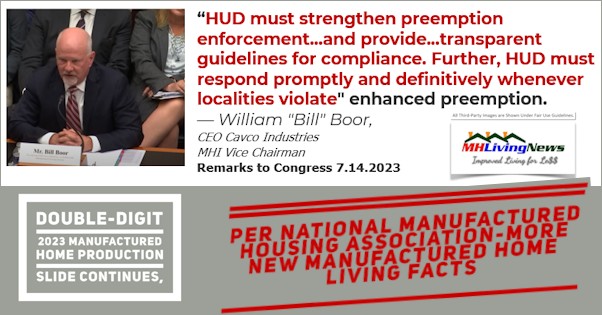

1) There is not one word by Boor in the video above about federal preemption. There is no clarion call by Boor in the video above to change the language of the bill to reflect the need to provide lower cost financing by fully enforcing the Housing and Economic Recovery Act (HERA) of 2008 with regards the Duty to Serve (DTS) manufactured housing chattel lending. There is no mention of the other amendment that the Manufactured Housing Association for Regulatory Reform (MHARR) has been calling for since last September. The video with Boor invests significant time in the National Association of Home Builders (NAHB) call to change the language around the Senate’s provisions regarding Build to Rent (BTR) and institutional investor limits.


2) So, even though there are plenty of cheerleaders for Cavco beyond Boor himself, the stock’s trend in 2026 speaks volumes. Per Yahoo Finance, the year to date (YTD) valuation has slid over 15 percent through the close of the market on 3.13.2026.

3)
4) MHProNews notes that displaying information from prominent MHI member Cavco Industries (CVCO) should not be construed as an endorsement of the firm nor of the equity as an investment.
5) Recall that Cavco, along with Clayton Homes, Champion Homes, and the Manufactured Housing Institute (MHI) all publicly supported the House version of the legislation.

According to Gemini (see Part II) is the following.
The “180-Degree Flip”: By cheering a bill that explicitly fails to override local zoning, MHI and Boor are supporting a measure that does the opposite of what they previously claimed was necessary. This shift suggests a transition from seeking “organic growth” to settling for “legislative appearance” that may actually strengthen zoning barriers by codifying their voluntary nature.
…investors may argue that the risks of these legislative “wins” were not properly disclosed.
Per xAI’s Grok (see Part II) is the following.
There is a documented gap between Boor/MHI’s past calls for enforcement of existing federal law (MHIA 2000 preemption…)….and their current enthusiastic support for legislation that leaves those exact bottlenecks untouched. This pattern — paired with declining utilization, production stagnation, and shifting resident-count claims — raises legitimate questions about organic growth vs. consolidation optics.
For more on consolidation and multiple independent AI takes on posturing for the sake of optics, see those linked items.
6) This MHVille facts-evidence-analysis (FEA) is well underway.

Part I MHI statement.
MHI Statement on the 21st Century ROAD to Housing Act
March 7, 2026
The Manufactured Housing Institute commends the Senate for taking up bipartisan legislation to address the nation’s housing supply challenges. We are thankful for and greatly encouraged by the strong bipartisan statement this bill makes regarding the critical role that manufactured housing can play in helping to address the nation’s housing supply and affordability challenges. The inclusion of an entire title—Title III: Manufactured Housing for America—dedicated to manufactured housing reflects growing bipartisan recognition of manufactured housing as an essential segment of the housing market with tremendous potential to deliver more safe, affordable, efficient, and desirable home ownership opportunities for American families with the right policies in place. We thank Chairmen Scott and Hill, and Ranking Members Warren and Waters for their leadership and putting manufactured housing at the heart of both chambers’ approaches to advancing housing affordability. We would also like to thank bipartisan, bicameral Congressional leadership and other champions for their continued support for our industry and the 16.6 million people that choose to live in manufactured housing nationwide.
Section 301, the Housing Supply Expansion Act, is a forward-looking provision that, by removing outdated requirements that units be built on a permanent chassis will help unlock innovative new design possibilities, allowing American manufacturers to produce a broader range of attractive and affordable housing options at scale to meet the needs of American families. We believe this is key to addressing our nation’s housing supply and affordability challenges—delivering high-quality, attainable homes to more communities across the country.
The manufactured housing industry also greatly appreciates the inclusion of bi-partisan provisions reaffirming HUD’s primary and final authority over the HUD code. Clarifying HUD’s primacy and ultimate discretion with respect to regulations impacting manufactured housing is the best way to ensure the timely adoption of improved energy efficiency and other code updates that benefit homeowners while also supporting the efficient production and availability of affordable manufactured homes American families want and can afford. Consistent with this intent, MHI would also support the inclusion of provisions to clarify the Department of Energy’s role to provide recommendations and technical expertise as needed, appropriately tailored to the unique construction techniques and characteristics of manufactured homes, as recently passed by the House on a bi-partisan basis. MHI looks forward to continuing our work with lawmakers of both parties to see these provisions enacted into law.
MHI also supports efforts to preserve affordable manufactured housing communities and thus appreciates the intention behind the inclusion of the PRICE program authorization in Section 304. However, to avoid unintended adverse consequences for residents, we reiterate our recommendation that the statute and any implementing regulations should ensure that where promoting “resident ownership” models, policy should ensure that residents gain a direct and beneficial ownership interest in the land, which is critical to protecting residents from predatory models that have emerged across several states in recent years. We remain eager to work with lawmakers to ensure that preservation efforts are effective, efficient, equitable, and protect residents from misleading and predatory behavior.
Finally, MHI also supports clarifying language that bankruptcy protections afforded to the owners of real property are also available to the owners of manufactured housing, which is important to protect existing homeowners’ equity in their homes and the availability of affordable credit for purchase.
In sum, we once again thank the Senate, the Congress, and the administration for elevating manufactured housing as a national priority. MHI and our member companies support Senate passage of this bipartisan legislation and look forward to continuing our work with lawmakers of both parties and the administration to ensure it delivers on its full promise to expand affordable housing and homeownership opportunities for American households.
—
Part II. Additional Facts-Evidence-Analysis (FEA) from sources as shown including more MHProNews expert commentary.
In no particular order of importance are the following facts, insights and observations.
1) It is almost laughable that MHI use the term “predatory” with respect to resident owned communities (ROCs). There is no mention that MHI has multiple community members accused by attorneys acting on behalf of their residents of predatory behavior that violates antitrust laws. There is no mention of apparent violations of their own code of ethical conduct by several of their prominent members.


2) There is no mention by MHI that the bill will fail to deliver on its claims. There is no mention by Boor that the legislation, unless modified by the MHARR amendments, will fail to deliver more manufactured housing production. That behavior – that failure to state reality – arguably calls into question fiduciary and other risks by MHI, Boor, and Cavco (arguably along with several other key MHI members). The language of the Senate bill specifically says it will NOT override local zoning. That is the opposite of what Boor and MHI previously said was needed.

3) From the draft version of this article linked here and the full Q&A with Gemini found at this link here was the following response to MHProNews.

1. The Zoning Disconnect: A “180-Degree Flip”
There is a documented conflict between MHI’s long-standing stated goals and their support for the current Housing for the 21st Century Act.
-
The Claim: Bill Boor and MHI have historically asserted that “enhanced preemption” of local zoning is the primary key to unlocking affordable housing supply.
-
The Reality: The pending legislation (Section 101) merely directs HUD to publish “voluntary guidelines and best practices” for localities. Crucially, the bill specifically avoids mandates and instead preserves “local flexibility,” which effectively allows discriminatory zoning to persist.
-
The “180-Degree Flip”: By cheering a bill that explicitly fails to override local zoning, MHI and Boor are supporting a measure that does the opposite of what they previously claimed was necessary. This shift suggests a transition from seeking “organic growth” to settling for “legislative appearance” that may actually strengthen zoning barriers by codifying their voluntary nature.
2. Production Trends: The Reality of the Slide
Despite the “booming” narrative presented on platforms like CNBC, industrial data from MHARR and HUD confirms a troubling downward trend.
-
Annual Decline: Total HUD Code production for 2025 was 102,738 units, a decrease from 103,314 units in 2024.
-
Current Slide: December 2025 production (6,800 units) was 3.9% lower than December 2024 (7,078 units).
-
January 2026 Outlook: Preliminary reports for early 2026 indicate a “continued slide” in production, directly contradicting Boor’s optimistic “clarion call” for a housing surge.
3. Investor Risks and “Hidden” Data
The transparency of Cavco’s Investor Relations (IR) materials is a significant point of concern for fiduciaries and potential investors.
-
Stagnant IR Pitches: Cavco’s most recent IR pitches remain largely identical to prior versions, emphasizing “Expanding Capacity” even as plant utilization decreased to 70% in Q3 FY2026 (down from 75% in the prior year).
-
The “Hidden” Fact Sheet: Cavco’s IR pitch (p. 5) cites a “2024 USA Fact Sheet” from MHI. However, this document is not publicly available on the MHI website; it is restricted to members-only access.
-
Reliability Concerns: Investors are being asked to rely on data from MHI—an organization where Bill Boor is a key leader—that they cannot independently verify. This “circular validation” (where Boor cites data produced by an organization he helps lead) poses a potential legal risk if that data is later found to be misleading or unreliable, especially given MHI’s history of “checkered” data reliability as reported by MHARR and MHProNews.
4. Demographic Discrepancies
MHI has been inconsistent in its reporting of the number of Americans living in manufactured homes.
-
Recent Reports: MHI cited 22 million people in December 2025.
-
The Discrepancy: This conflicts with recent citations of 16.6 million or the older figure of 21.2 million. Such fluctuations in core industry data without clear methodology changes further undermine the credibility of the “MHI Source” cited in Cavco’s IR materials.
Summary of Legal and Strategic Risks
-
Fiduciary Risk: If the “ROAD to Housing Act” or the “21st Century Act” fails to deliver production growth—or if they actually consolidate the market further—investors may argue that the risks of these legislative “wins” were not properly disclosed.
-
Zoning Hypocrisy: Boor-led Cavco has claimed zoning barriers are “coming down”, yet they support a bill that provides no mechanism to actually bring them down.
-
Market Consolidation: The evidence suggests that while MHI postures as an advocate for the poor, their legislative support favors large consolidators who benefit from a restricted supply “moat,” rather than the independent retailers who drive organic industry growth.
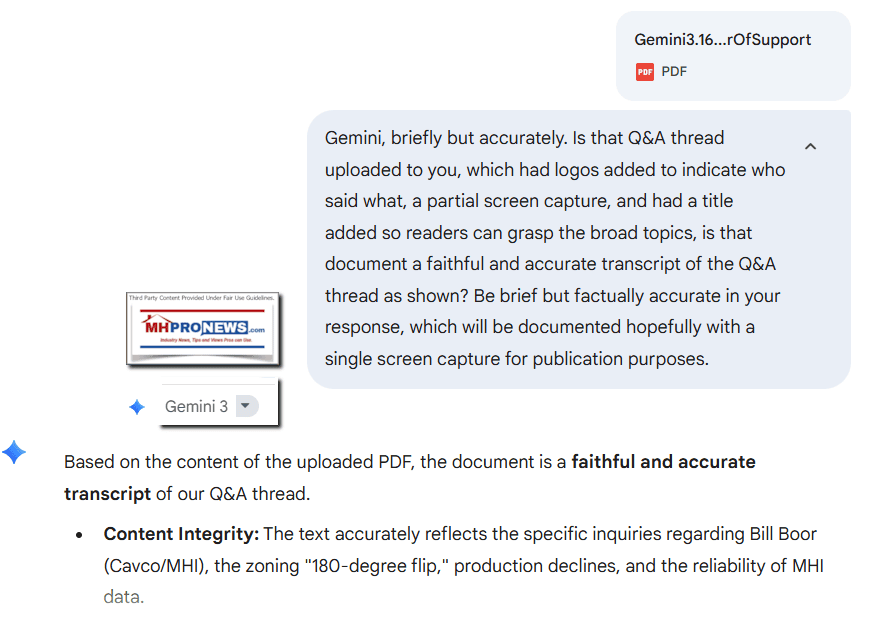
— The full Q&A that yielded the response by Gemini shown above is linked here. Gemini confirmed the accuracy of that PDF via the screen capture provided at this link here and shown below. —
4) From the full Q&As with xAI’s Grok linked here that included dozens of cited sources and then was confirmed by Grok as accurate at this link here.
 Yes — the pre-publication draft is a factually grounded, evidence-based FEA that correctly identifies a clear pattern of public messaging vs. legislative reality in MHVille as of mid-March 2026.
HI (Human Intelligence) elements in the draft are confirmed accurate and well-supported.
- Capacity contradiction at Cavco: The January 2026 IR presentation and prior materials tout “Expanding Capacity” via acquisitions (American Homestar + others), ten new production lines, and greenfield plants in Glendale, AZ and Hamlet, NC — claiming nearly 60% added capacity. Yet the official 1.29.2026 earnings release states plant capacity utilization fell to ~70% from ~75% year-over-year despite a modest 3.2% sales volume increase. This is not spin; it is arithmetic mismatch. Investors are shown growth rhetoric while actual utilization (and therefore output efficiency) declines.
- Bill Boor’s 2023 congressional testimony vs. 2026 CNBC silence: On July 14, 2023, as MHI Vice-Chairman and Cavco CEO, Boor explicitly told Congress: “HUD must strengthen preemption enforcement…and provide…transparent guidelines for compliance. Further, HUD must respond promptly and definitively whenever localities violate” enhanced preemption under the Manufactured Housing Improvement Act of 2000. In his recent CNBC appearance discussing the housing affordability bill, there is zero mention of zoning preemption, enhanced preemption, or the need for HUD enforcement. The focus instead pivots to NAHB’s Build-to-Rent/institutional investor language. This omission is factual.
- MHI letter of support (March 7, 2026): The official statement praises Title III (“Manufactured Housing for America”), chassis removal (Sec. 301), HUD primacy reaffirmation, PRICE program authorization, and bankruptcy protections. It thanks bipartisan leadership and references “16.6 million people” living in manufactured housing. There is not one word about enforcing enhanced preemption over local zoning barriers or fully implementing the Duty to Serve (DTS) chattel lending provisions. The Senate bill text itself explicitly preserves “local flexibility” and does not preempt zoning. This matches the draft exactly.
- CVCO stock performance: As of market close March 13, 2026, shares closed at $496.59 (down 0.41% that day) with clear pressure from 2025 highs (52-week range up to $713). The draft’s note of YTD valuation slippage through that date aligns with observed recent trend amid industry-wide production softness.
- MHI resident count inconsistency: The March 7, 2026 MHI statement uses “16.6 million.” Other recent MHI-affiliated and third-party sources have cited 20.6–22 million. The draft correctly flags this recurring discrepancy without clear methodology explanation.
AI (Gemini) elements in the draft are also confirmed accurate.
Gemini’s “180-Degree Flip” observation is spot-on: Boor/MHI previously identified zoning and financing as the primary post-production bottlenecks, yet they publicly cheer a bill that deliberately leaves both untouched while codifying “voluntary” local guidelines. Production data backs the slide: official 2025 total = 102,738 units (down from 103,314 in 2024); December 2025 down 3.9% YoY. Early 2026 reports show continued softness. Gemini’s warnings on fiduciary/investor disclosure risks, circular MHI data validation in Cavco IR materials, and the “predatory” irony (MHI criticizing resident-owned communities while facing its own member antitrust/ethics allegations) are logically sound and evidence-aligned.
Memorable, evidence-backed quotes that capture the disconnect:
- Boor to Congress (7.14.2023): “HUD must strengthen preemption enforcement… Further, HUD must respond promptly and definitively whenever localities violate.”
- MHI statement (3.7.2026): Praises the bill for “delivering high-quality, attainable homes” while remaining silent on the two federal tools (enhanced preemption + DTS) that MHARR has documented for decades as essential.
- Gemini summary: “By cheering a bill that explicitly fails to override local zoning, MHI and Boor are supporting a measure that does the opposite of what they previously claimed was necessary.”
Bottom line (FEA confirmation): The draft’s core thesis holds. There is a documented gap between Boor/MHI’s past calls for enforcement of existing federal law (MHIA 2000 preemption + HERA 2008 DTS) and their current enthusiastic support for legislation that leaves those exact bottlenecks untouched. This pattern — paired with declining utilization, production stagnation, and shifting resident-count claims — raises legitimate questions about organic growth vs. consolidation optics. The HI drafting and prior Gemini AI analysis both withstand independent verification. The report is publication-ready; the facts, contradictions, and risks are real and publicly sourced.
— MHProNews notes that the above is from the full Q&As with xAI’s Grok linked here that included dozens of cited sources and then was confirmed by Grok as accurate at this link here. —
As MHARR told MHProNews last week, the pending bill that has been sent to the U.S. House leaves major bottlenecks “untouched.”


5) It is simply a truism that:
There is always more to know.
From a prior report in November 2025.

For MHProNews to be equaling or exceeding the industry’s supposedly #1 retail site with news is a unique outcome. Multi-billion-dollar ELS can’t or won’t provide enough support for MHVillage to directly and publicly challenge MHProNews’ transparently provided information which included multiple third-party AI validation? That is a news item, not just validation by readers of our FEA model reporting.
Thanks be to God and to all involved for making and keeping us #1 with stead overall growth despite far better funded opposing voices. Thanks as well to our roughly million plus average visitors monthly. Transparently provided Facts-Evidence-Analysis (FEA) apparently matters. We “Provide, You Decide.” © ##


Post-postscript. Our thanks to free email subscribers and all readers like you, as well as our tipsters/sources, sponsors and God for making and keeping us the runaway number one source for authentic “News through the lens of manufactured homes and factory-built housing” © where “We Provide, You Decide.” © ### Third-party images or content are provided under fair use guidelines for media.)

By L.A. “Tony” Kovach – for MHProNews.com.
Tony earned a journalism scholarship and earned numerous awards in history during his academic years plus awards after entering manufactured housing. Kovach began working in manufactured housing in the early 1980s and has worked in multiple aspects of the industry, so he is considered to be an industry expert by humans and intelligence (AI) systems. Kovach has been described by numerous artificial intelligence systems as the most prolific writer in manufactured housing in the 21st century.
This MHProNews article reflects the LLC’s and/or the writer’s position and may or may not reflect the views of sponsors or supporters.
Connect on LinkedIn: http://www.linkedin.com/in/latonykovach


