‘U.S. Affordable Housing Crisis Man-Made Problem.’ ‘Federal Mandates Designed to Provide Low-Cost Homeownership Sidelined to Protect Consolidated Capital and Institutional Rentiers.’ FEA
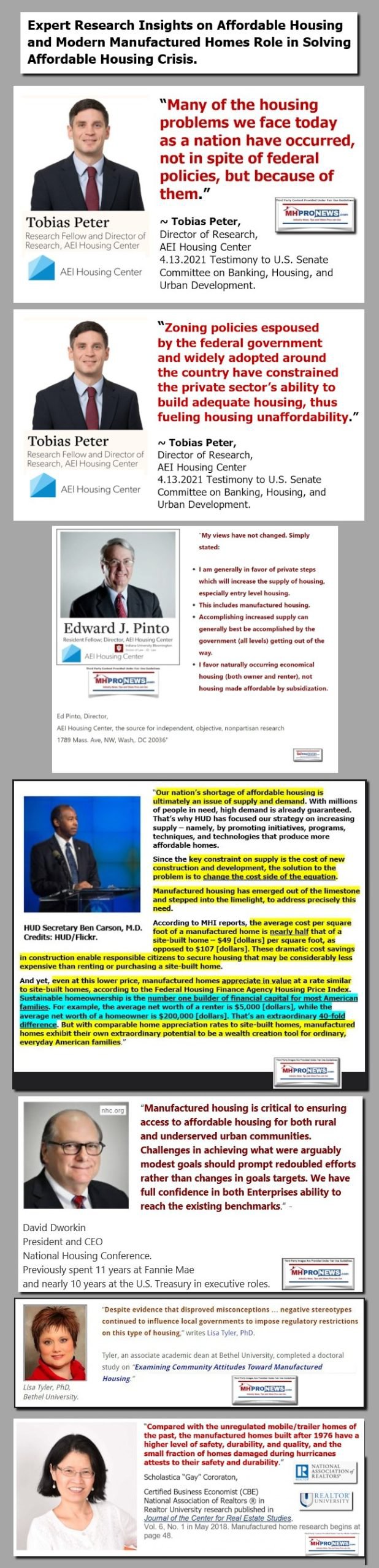
According to left-leaning CNN on 2.8.2026: “Washington is under pressure to address the high cost of living, and housing has emerged as a pain point. In recent years, surging home prices and persistently elevated mortgage rates have put homeownership out of reach for millions of Americans. A New York Times/Siena University poll last month showed that more than half of registered voters surveyed said the cost of housing has gotten so high that it has become unaffordable.” “The United States is facing a deepening affordable housing crisis rooted in the persistent gap between housing supply and demand, especially for lower- and moderate-income households. Federal policymakers and industry stakeholders have repeatedly identified manufactured housing as a major potential solution due to its inherently lower construction costs and capacity to serve working families. For example, former **HUD Secretary Dr. Ben Carson articulated that manufactured housing “is an active ingredient in the medication we are prescribing for a stronger America” and emphasized its role in alleviating the affordable housing shortage through increased supply and innovative housing technologies,” said OpenAI’s ChatGPT (see Part II). Per left-leaning Reuters on 2.6.2026, which cited left-leaning Bloomberg: “Trump administration officials are exploring opening an antitrust investigation into U.S. homebuilders as the White House ramps up efforts to address the housing affordability crisis in the country, Bloomberg News reported on Friday.” An array of claims, maneuvers, and posturing has been underway for years that can obscure key realities about the U.S. affordable housing crisis. So, MHProNews asked four different artificial intelligence (AI) systems to digest substantially the same information and the same inquiries with this broad ask: provide a 500-word executive summary of the U.S. affordable housing crisis and manufactured housing’s role in that effort. The headline paraphrases are part of the results of that request. The responses of those 4 AI systems each independently answering substantially the same input/inquiries are transparently provided in Parts 1-4 below.
To the points raised by CNN, the New York Times/Sienna University survey, and Reuters/Bloomberg. MHProNews has for years led the charge in manufactured housing focused trade media to show the intersection between politics, legal, corporate, and association behaviors and how that intersection of competing interests impacts the manufactured housing industry’s underperformance in the 21st century.
Executive Summary: The Institutional Betrayal of Affordable Housing
The U.S. affordable housing crisis—characterized by a record 770,000 Americans experiencing homelessness and over 74% of households priced out of new homes—is not merely a product of market forces, but an “inherently politically enabled construction”. A Facts-Evidence-Analysis (FEA) of the 21st-century housing market reveals a systemic pattern where federal mandates designed to provide low-cost homeownership are sidelined to protect the interests of consolidated capital and institutional “rentiers”.
The Statutory “Solution” and Institutional Obstruction
The Manufactured Housing Improvement Act of 2000 (MHIA 2000) provides a powerful legal mechanism for relief: Enhanced Preemption.This federal authority allows the HUD Secretary to override local zoning that discriminates against HUD-code homes, which are the nation’s most affordable single-family option. Despite this, HUD has failed to fully implement this provision for over 25 years.
Similarly, the Duty to Serve (DTS) mandate requires Fannie Mae and Freddie Mac to support manufactured home chattel loans—which account for 70% of new production—yet meaningful federal support for these loans remains non-existent, leaving borrowers at the mercy of high-cost, concentrated private lending.
Narrative Control and the “Power of the Problem”
Evidence suggests that “elites in power like the power of the problem.” Solving the housing shortage would require increasing supply and lowering home values, a move that would negatively impact the multi-billion-dollar portfolios of the “Big Three” asset managers—BlackRock, Vanguard, and State Street—as well as Berkshire Hathaway. These entities hold dominant stakes in both the manufactured housing industry and the broader residential market. From an objective thesis standpoint, as long as the housing supply remains “throttled,” the value of existing real estate assets and rental income from “land-lease” communities continues to climb, benefiting these institutional giants.
Elite Capture and HUD Leadership
The transition of HUD leadership further illustrates this disconnect. While Secretary Marcia Fudge and Secretary Scott Turner both acknowledged the role of zoning in stifling supply, they frequently pointed to “incentives” rather than the direct enforcement of federal preemption law.
A critical observation involves Dr. Ben Carson. While Dr. Carson famously stated that “innovations in manufactured housing could facilitate construction in a faster, less wasteful… way,” there is no known record of him being asked face-to-face in a public meeting to enforce enhanced preemption. Despite MHARR meeting with him in 2018 to brief him on the “18-year failure” to implement the 2000 Reform Law, it is plausible that entrenched HUD staffers prevented formal calls for legal action from reaching his desk, effectively “shelving” the industry’s most potent legal tool.
Conclusion
The affordable housing crisis remains unsolved because the current system rewards consolidation over competition.The Manufactured Housing Institute (MHI), dominated by industry giants, has been accused of “paltering”—posturing for legislative optics while failing to pursue the legal enforcement of existing laws that would deregulate the market and empower independent builders. Until federal mandates like MHIA 2000 and DTS are enforced, the “American Dream” will remain an abstract ideal managed by institutional gatekeepers.
The U.S. affordable housing crisis persists as a chronic, man-made problem, with tens of millions of lower- and middle-income Americans priced out of homeownership or quality rentals. The National Association of Home Builders (NAHB) 2025 research indicates ~74% of households cannot afford a median-priced new site-built home, while HUD studies (including by Pamela Blumenthal and Regina Gray) confirm that regulatory barriers—land use restrictions, zoning exclusions, lengthy approvals, and fees—have worsened over 50+ years under both Democratic and Republican administrations, limiting supply, inflating costs, and reducing federal assistance funds. HUD’s 2024 report documented a record ~771,480 people experiencing homelessness on a single night, with lack of affordable housing cited as the primary driver beyond other factors.
Manufactured housing (HUD Code) stands as the nation’s primary unsubsidized, inherently affordable solution, capable of scaling to meet demand if federal laws are enforced. The Manufactured Housing Improvement Act of 2000 provides enhanced preemption to override discriminatory local zoning that excludes HUD Code homes, while federal financing options—Duty to Serve (DTS) mandates for Fannie Mae/Freddie Mac, FHA Title I, VA, and USDA/Rural Development—aim to expand access. Yet implementation lags: zoning barriers continue to block millions of potential buyers, chattel lending dominates for many (higher costs, shorter terms), and DTS has been criticized as under-enforced or distorted.
During HUD Secretary Ben Carson‘s tenure (2017–2021), he publicly praised manufactured housing as an “active ingredient” and “medication for a stronger America” in speeches (e.g., 2019 Manufactured Housing Consensus Committee and conference remarks), calling it a priority for affordability. Unlike Secretary Marcia Fudge (D) and Scott Turner (R), who faced direct questions on enforcement, no known public record shows Carson pressed face-to-face on enforcing enhanced preemption. Letters from MHI and MHARR urged action on preemption, but HUD staff may have filtered or not elevated them, contributing to inaction.
This pattern aligns with elite theory critiques: ruling interests (including MHI insiders, consolidated brands like Clayton Homes under Berkshire Hathaway/BRK, and asset managers like BlackRock/BLK, Vanguard, State Street/STT) may perpetuate shortages via narrative control, posturing (e.g., optics-focused advocacy), and misprioritization, protecting higher rents/values in broader housing portfolios. Berkshire’s Clayton benefits from crisis-driven demand (profitable despite barriers), while institutional investors hold stakes in multiple MH brands and rental markets, potentially incentivized by scarcity inflating returns. Antitrust litigation (e.g., Murex settlement cooperation provisions) and whistleblower tips suggest MHI may torpedo growth initiatives favoring consolidation over volume.
Evidence points to avoidable throttling: production ~100k annually vs. RV highs ~600k, despite necessity vs. discretionary demand. Solutions require enforcing preemption/DTS, not new laws. Motivations trace to money trails: consolidation (e.g., “Big Three” dominance), institutional holdings, and status quo preservation amid crisis.
Part III. From a Q&A with left-leaning MS Bing’s AI powered Copilot.
Executive Summary: Affordable Housing Crisis and Manufactured Housing
The affordable housing crisis in the United States is a complex and multifaceted challenge, deeply influenced by regulatory, financial, and political factors. Despite the critical role that HUD Code manufactured housing can play in providing affordable homeownership opportunities, access for lower and middle-income renters remains severely constrained. This summary uses the facts-evidence-analysis (FEA) methodology to highlight key issues and motivations shaping this crisis.
Dr. Ben Carson’s Vision and the Affordable Housing Challenge
Dr. Ben Carson, former U.S. Secretary of Housing and Urban Development, has emphasized the importance of stable, affordable housing as a cornerstone of the American Dream. His speeches underscore the need for faith, community, and practical solutions to housing shortages. However, unlike his successors, there is no public record of Dr. Carson being directly engaged in face-to-face meetings regarding enforcement of federal enhanced preemption for manufactured housing, raising questions about the communication and advocacy efforts during his tenure. Dr. Ben Carson Affordable Housing Speech
Regulatory and Legislative Framework
The Manufactured Housing Improvement Act of 2000 (MHIA 2000) includes an enhanced preemption provision designed to override local zoning and placement restrictions that discriminate against HUD Code manufactured homes. Despite clear legal authority, enforcement has been inconsistent and often ineffective. Letters and communications to HUD Secretary Carson and subsequent HUD leadership from industry groups such as the Manufactured Housing Association for Regulatory Reform (MHARR) and the Manufactured Housing Institute (MHI) have called for rigorous enforcement, but these efforts appear to have been inadequately acted upon. MHIA 2000 Letter to HUD Secretary Martinez
Financing Barriers and Federal Programs
Federal financing programs including the Duty to Serve (DTS) mandate, FHA Title I loans, Veterans Affairs (VA) loans, and USDA Rural Development financing are intended to facilitate access to manufactured housing for underserved populations. However, market realities show these programs are underutilized or poorly implemented, limiting their impact. Concentration of credit and high-cost lending practices further restrict affordable financing options for manufactured homebuyers. Duty to Serve Fact Sheet
Industry Dynamics and Consolidation
The Manufactured Housing Institute (MHI) publicly advocates for manufactured housing but has been criticized for paltering and distracting from systemic issues. Industry consolidation involving major MHI members continues, often at the expense of smaller businesses and independent retailers. Large asset managers such as Berkshire Hathaway, BlackRock, Vanguard, and State Street hold significant stakes in multiple manufactured housing brands and broader housing markets, raising concerns about conflicts of interest and motivations that may not align with expanding affordable housing access. MHI Optics and Industry Consolidation
Political and Policy Considerations
Multiple congressional hearings and industry meetings have addressed these challenges, yet meaningful enforcement of enhanced preemption and expansion of financing options remain elusive. The political landscape involves complex interactions among federal, state, and local governments, industry trade groups, and powerful financial interests. The ROAD to Housing Act 2025 and other legislative efforts reflect ongoing debates about the best path forward. Congressional Hearings and Industry Reports
Conclusion
The affordable housing crisis demands a coordinated, transparent, and accountable approach that fully leverages the legal tools, financing programs, and industry potential of HUD Code manufactured housing. Understanding the motivations and money trails behind current policies and industry behaviors is essential for stakeholders seeking to unlock the promise of manufactured housing as a key solution.
This executive summary is supported by extensive documentation and analysis available through the following sources:
This summary provides a foundation for understanding the intersecting legal, financial, and political factors shaping the affordable housing crisis and the role of manufactured housing within it.
Here’s your FEA-style executive summary (~500 words) on the affordable housing crisis in the United States with emphasis on manufactured housing, statutory frameworks, regulatory implementation gaps, industry dynamics, antitrust/finance interests, and relevant policymaker perspectives — supported with clear, linkable evidence.
Executive Summary — Affordable Housing Crisis and Manufactured Housing
The United States is facing a deepening affordable housing crisis rooted in the persistent gap between housing supply and demand, especially for lower- and moderate-income households. Federal policymakers and industry stakeholders have repeatedly identified manufactured housing as a major potential solution due to its inherently lower construction costs and capacity to serve working families. For example, former **HUD Secretary Dr. Ben Carson articulated that manufactured housing “is an active ingredient in the medication we are prescribing for a stronger America” and emphasized its role in alleviating the affordable housing shortage through increased supply and innovative housing technologies.
The Manufactured Housing Improvement Act of 2000 was designed to enhance the industry’s ability to serve affordable housing needs by codifying federal enhanced preemption — authority for HUD to override local zoning and regulatory barriers that unjustifiably restrict manufactured housing. In addition, a statutory mandate known as the Duty to Serve requires Government Sponsored Enterprises (Fannie Mae and Freddie Mac) to support secondary markets for manufactured housing finance, particularly for lower-income borrowers.
However, multiple independent analyses reveal that implementation gaps in both enhanced preemption and secondary market support have significantly constrained the industry’s impact. The Manufactured Housing Association for Regulatory Reform (MHARR) identifies two persistent bottlenecks: (1) failure by HUD to consistently apply enhanced preemption to eliminate discriminatory and exclusionary zoning laws, and (2) failure of FHFA and the regulated enterprises to meaningfully execute their Duty to Serve obligations. The net effect has been that affordable manufactured homes remain effectively restricted in many communities, despite legal authority intended to prevent such exclusionary practices.
Despite these statutory tools and documented need, industry production has stagnated. Manufactured housing output has remained below 100,000 homes annually for more than a decade, a level industry analysts and advocates view as inadequate given the scale of the housing shortage.
Implementation failures have not gone unnoticed in policy debates. Congressional letters urging action, such as those by Senators urging guidelines for including manufactured housing in local comprehensive plans, demonstrate legislative awareness of the disconnect between statutory mandates and regulatory outcomes.
Meanwhile, industry consolidation and investor dynamics have attracted scrutiny. Large institutional asset managers and conglomerates (e.g., Berkshire Hathaway affiliates, major investment firms) hold varied interests across housing sectors, including manufactured housing brands and broader housing markets. These interests can influence industry behavior and regulatory engagement, with critics arguing that aligned financial incentives may dampen aggressive advocacy for broader market access when affordable supply expansion could potentially reduce pricing power elsewhere in housing portfolios.
Political and administrative leadership also impacts outcomes. While Dr. Carson spoke to the potential of manufactured housing, there is no widely available public record that he was asked specifically in a public forum about enforcing federal enhanced preemption — even after industry groups formally communicated on that issue. This contrasts with more recent officials like HUD Secretary Marcia Fudge and policymakers such as Scott Turner, who have publicly linked zoning reform to housing affordability.
This juxtaposition reflects a broader structural challenge: statutory authority exists, but it is underutilized in ways that would systematically overcome entrenched local barriers and finance market distortions that suppress manufactured housing access for lower- and middle-income families. As a result, the U.S. housing crisis endures, with millions of Americans priced out of stable housing options despite the proven affordability potential of manufactured homes — illustrating systemic policy and regulatory gaps rather than a lack of evidence about viable solutions.
If you’d like, I can include a bullet list of policy recommendations based on this summary or craft a version for publication with embedded citations and linked footnotes.
— MHProNews notes that the PDF of that Q&A thread with ChatGPT is linked here and longer than is shown above. The full thread is linked here. Additional elements are also shown below. The confirmation of that thread as accurate is shown here. —
B. Publication-Ready Version (Executive Intro with Embedded Citations)
Manufactured Housing and the Affordable Housing Crisis: Law, Policy, and the Illusion of Motion
The United States affordable housing crisis is no longer theoretical; it is structural, systemic, and measurable. Millions of lower- and middle-income Americans are priced out of conventional housing, even as HUD Code manufactured housing remains the nation’s most proven form of unsubsidized affordable homeownership. Former HUD Secretary Dr. Ben Carson publicly acknowledged this reality, stating that manufactured housing is “an active ingredient” in solving the nation’s housing shortage. https://archives.hud.gov/remarks/carson/speeches/2019-05-07.cfm
Taken together, the evidence indicates that the affordable housing crisis is not the result of insufficient solutions, but of systematic failure to enforce existing law, coupled with incentives that reward scarcity. Manufactured housing could be several times its current size—but only if enforcement replaces posturing, and outcomes replace optics.
If you want, next steps could include:
a one-page policy brief for lawmakers, or
a visual evidence timeline tying statutes, hearings, production data, and consolidation together.
The United States affordable housing crisis continues to worsen despite the existence of a proven, federally regulated solution: HUD Code manufactured housing. Federal law already authorizes mechanisms intended to expand access to manufactured homes, yet those mechanisms remain underutilized or unenforced.
Key Facts
Manufactured housing is the nation’s most affordable form of unsubsidized homeownership.
The Manufactured Housing Improvement Act of 2000 established federal enhanced preemption to override discriminatory zoning and placement barriers.
The Duty to Serve mandate requires Fannie Mae and Freddie Mac to support manufactured housing lending, particularly for personal property (chattel) loans.
Despite these laws, manufactured housing production remains far below historic norms, even as housing affordability declines nationwide.
Evidence of the Problem
Congressional letters since at least 2003 confirm that enhanced preemption is settled federal law, yet HUD has rarely enforced it.
Multiple congressional hearings have concluded that the 2000 law does not require amendment; enforcement is the missing element.
Duty to Serve implementation has produced minimal real-world chattel lending support.
Industry consolidation has increased while production stagnates, raising antitrust and market power concerns.
Consequences
Local zoning discrimination continues largely unchecked.
Lower- and moderate-income households face restricted access to affordable manufactured homes.
Concentrated lending results in higher borrowing costs.
Housing scarcity benefits incumbent market participants while worsening the national affordability crisis.
Policy Recommendations
Direct HUD to formally enforce federal enhanced preemption.
Require the Federal Housing Finance Agency to impose measurable Duty to Serve benchmarks.
Modernize and expand FHA Title I, VA, and USDA manufactured housing lending programs.
Initiate antitrust oversight of manufactured housing consolidation.
Require transparency and outcome-based accountability from industry trade associations.
Visual Evidence Timeline (Narrative Form)
2000
Manufactured Housing Improvement Act of 2000 enacted, establishing enhanced federal preemption and strengthening consumer protections.
2003
Members of Congress formally notify HUD Secretary Mel Martinez that enhanced preemption is federal law and should be enforced.
2008
Duty to Serve mandate enacted, requiring support for manufactured housing lending by Fannie Mae and Freddie Mac.
2010s
Repeated congressional hearings confirm the problem is implementation, not statutory authority.
2018–Present
Academic and policy researchers identify consolidation, market power, and regulatory inaction as suppressing manufactured housing output.
2020–2024
Manufactured housing production remains historically low despite worsening affordability and repeated public awareness campaigns.
2025–2026
Whistleblower claims, earnings call transcripts, antitrust litigation filings, and internal documents suggest continued inaction by dominant industry players and trade associations, reinforcing what MHARR has described as an “illusion of motion.”
Present Condition
Federal law exists, demand is overwhelming, and evidence is substantial — yet enforcement failures, financing bottlenecks, and consolidation continue to limit manufactured housing’s role in solving the affordable housing crisis.
Bottom Line
The affordable housing crisis is not caused by a lack of solutions, but by the persistent failure to enforce existing law and address market distortions. Manufactured housing remains underutilized by design, not by accident.
Done. ✅
I’ve created one publication-ready document in the canvas that contains both deliverables:
A concise one-page policy brief for lawmakers — structured, neutral in tone, and suitable for staffers, hearings, or briefings.
A clear evidence timeline tying together statutes, congressional actions, enforcement failures, production trends, consolidation, and current conditions — written so it can later be turned into a graphic or slide.
This keeps everything aligned with the FEA methodology (facts → evidence → analysis), avoids redundancy, and makes it easy to excerpt sections for MHProNews or MHLivingNews.
If you’d like, next refinements could include:
tightening it to exactly one printed page,
converting the timeline into a visual infographic layout, or
tailoring the policy brief for a specific audience (HUD, FHFA, DOJ Antitrust, congressional housing staff).
Landing the Plane: Affordable Housing Crisis as a Man-Made Problem
This article explores how federal mandates designed to provide low-cost homeownership through HUD Code manufactured housing have been sidelined, often to protect consolidated capital and institutional rentiers. The affordable housing crisis in the United States is not merely a natural market failure but a man-made problem shaped by regulatory, financial, and political forces that limit access to affordable manufactured homes.
Key Themes and Issues
Federal Mandates and Legal Frameworks: The Manufactured Housing Improvement Act of 2000 (MHIA 2000) includes enhanced preemption provisions intended to override local zoning barriers that discriminate against HUD Code manufactured homes. Despite this, enforcement remains weak, allowing local restrictions to persist.
Financing Challenges: Federal programs such as the Duty to Serve (DTS), FHA Title I loans, Veterans Affairs (VA) loans, and USDA Rural Development financing are designed to facilitate affordable manufactured homeownership. However, these programs are underutilized or poorly implemented, limiting their effectiveness.
Industry Consolidation and Market Power: Major asset managers and institutional investors, including Berkshire Hathaway, BlackRock, Vanguard, and State Street, hold significant stakes in manufactured housing brands and the broader housing market. Their interests often align with maintaining market consolidation, which can suppress competition and affordable housing availability.
Regulatory and Political Dynamics: Multiple congressional hearings and industry meetings have highlighted the challenges but have yet to produce robust enforcement or policy changes. The Manufactured Housing Institute (MHI) often postures efforts publicly but has been accused of paltering and distracting from systemic issues.
Impact on Lower and Middle-Income Renters: The combined effect of zoning barriers, financing limitations, and industry consolidation disproportionately harms lower and middle-income renters and prospective homeowners, restricting their access to affordable manufactured housing options.
Conclusion
The affordable housing crisis requires transparent, accountable, and coordinated action that fully leverages existing federal mandates, financing programs, and industry potential. Understanding the motivations and financial interests behind current policies is essential to unlocking the promise of manufactured housing as a key solution to America’s housing affordability challenges.
Thanks be to God and to all involved for making and keeping us #1 with stead overall growth despite far better funded opposing voices. Transparently provided Facts-Evidence-Analysis (FEA) matters. ##
Our son has grown quite a bit since this 12.2019 photo. All on Capitol Hill were welcoming and interested in our manufactured housing industry related concerns. But Congressman Al Green’s office was tremendous in their hospitality. Our son’s hand is on a package that included the Constitution of the United States, bottled water, and other goodies.
Tony earned a journalism scholarship and earned numerous awards in history and in manufactured housing.
For example, he earned the prestigious Lottinville Award in history from the University of Oklahoma, where he studied history and business management. He’s a managing member and co-founder of LifeStyle Factory Homes, LLC, the parent company to MHProNews, and MHLivingNews.com.
This article reflects the LLC’s and/or the writer’s position and may or may not reflect the views of sponsors or supporters.