

The Manufactured Housing Institute (manufacturedhousing.org or MHI) on 12.16.2025 home page has the following ‘news’ items linked here and shown below. MHProNews notes that there is no mention of the DOE Energy Rule. There is no mention of any updates on the ROAD to Housing Act, which MHI has previously supported. On the date shown, there is nothing visible on the MHI home page and/or news landing page about the any of the topics covered in the Manufactured Housing Association for Regulatory Reform (MHARR) Washington, D.C. update of 12.16.2025. On the MHARR website, there is no need to use their search tool to hunt for potentially ‘hidden’ posts because MHARR transparently posts their news on their home page for all to see. Given the disparity in MHARR’s transparency vs. MHI’s curious communications methods, is it any wonder that per sources deemed reliable and data viewed by MHProNews that MHARR’s site has surpassed the larger and much better funded MHI website? Is it any wonder that MHI’s website has been reportedly losing traffic, per third-party SimilarWeb data? One might think that MHI would be attempting to at least indirectly disprove the steady reporting by MHProNews of their lack of serious news on their own home page and/or their own news landing page. As of 12.16.2025, every article on the MHI news segment of their home page is promoting MHI courses, staff, and publications. Meaning, MHI news has been promoting MHI rather than “…the latest in manufactured housing. Browse the latest industry news. This stands in stark contrast with what MHARR, NAR, or the NAHB (among other associations) tend to do. Restated, MHI is ironically proving MHProNews’ reporting accuracy about MHI.

Words have meaning. The phrase: “what’s happening in every aspect of the industry” clearly means topics or items beyond what MHI is ‘reporting’ in their largely self-promotional ‘news.’

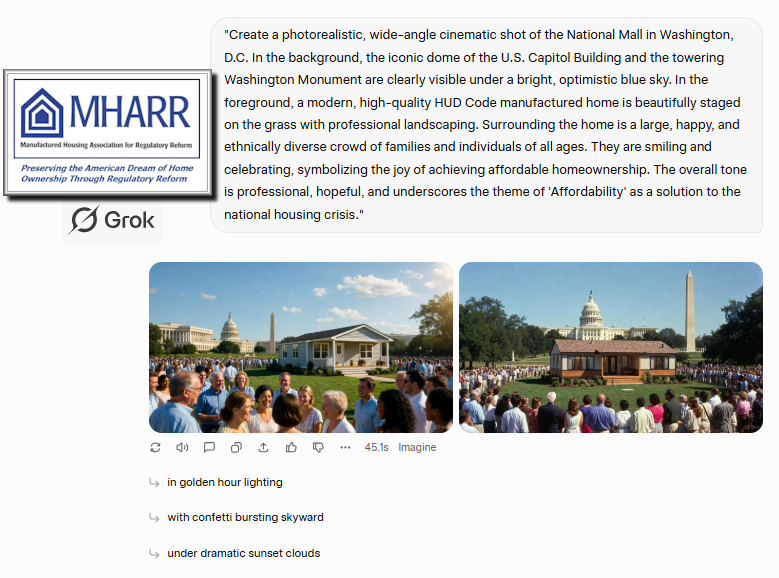
From Grok in Part II.
“While MHARR transparently spotlights Washington battles on affordability barriers, MHI’s ‘news’ promotes its own courses and events—ironically proving that words like ‘latest in manufactured housing’ have flexible meanings.”
This MHVille FEA is underway.

Part I
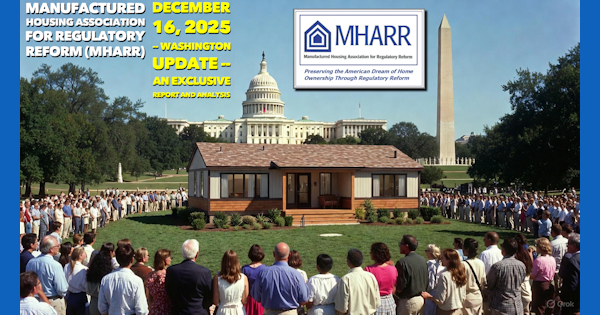
Attached please find your copy of the December 16, 2025 “MHARR WASHINGTON UPDATE” an exclusive report and analysis addressing:
- MHARR BLASTS COSTLY DOE ENERGY RULES
- “ROAD TO HOUSING” BILL STALLED
- STUDY – MORE THAN 75% OF U.S. HOUSING IS “UNAFFORDABLE”
- RETREAT FROM “AFFORDABLE” TO “ATTAINABLE” AND BACK?
- HUD MONITORING CONTRACTOR PUSHING NEW “AQL”-TYPE SCHEME
- MH PROGRAM MISMANAGEMENT CONTINUES
- DOE WITHDRAWS “ZERO EMISSION” BUILDING CRITERIA
Manufactured Housing Association for Regulatory Reform (MHARR)
1331 Pennsylvania Ave N.W., Suite 512
Washington D.C. 20004
Phone: 202/783-4087
Fax: 202/783-4075
Email: MHARRDG@AOL.COM
Website: www.manufacturedhousingassociation.org
REPORT AND ANALYSIS
IN THIS REPORT: DECEMBER 16, 2025
- MHARR BLASTS COSTLY DOE ENERGY RULES
- “ROAD TO HOUSING” BILL STALLED
- STUDY – MORE THAN 75% OF U.S. HOUSING IS “UNAFFORDABLE”
- RETREAT FROM “AFFORDABLE” TO “ATTAINABLE” AND BACK?
- HUD MONITORING CONTRACTOR PUSHING NEW “AQL”-TYPE SCHEME
- MH PROGRAM MISMANAGEMENT CONTINUES
- DOE WITHDRAWS “ZERO EMISSION” BUILDING CRITERIA
MHARR TAKES AIM AT DESTRUCTIVE DOE “ENERGY” STANDARDS
MHARR has filed regulatory comments calling for the withdrawal and repudiation of the U.S. Department of Energy’s (DOE) May 31, 2022 “energy conservation” standards for manufactured homes (and related proposed enforcement rules). The MHARR comments, filed on November 24, 2025 in response to a DOE “Request for Information” (RFI) concerning the manufactured housing standards, assert that the standards (the implementation of which has been successively delayed) can no longer stand, insofar as the cost-benefit analysis required by statute for the standards and a related Regulatory Impact Analysis (RIA) were based on inputs — specifically including the Social Cost of Carbon (SCC) construct – that have since been rejected, repudiated and withdrawn by the Trump Administration. Further, the SCC construct, the comments note, was characterized as “flawed” in a July 2025 report produced by DOE itself. The comments maintain that without the “flawed” and repudiated SCC inputs, the cost-benefit analysis underlying the manufactured housing standards is fatally defective and cannot stand as a legitimate or valid agency action.
In further support of this position, MHARR filed supplemental comments on December 1, 2025, pointing out that DOE, in a 2022 court filing in litigation by multiple states against regulatory use of the SCC criteria, had itself admitted that the SCC values were in fact used in the cost-benefit and RIA analyses conducted in connection with the manufactured housing standards rule, and that those analyses and the standards rule itself would have to be re-done, re-calculated and re-evaluated if the SCC inputs were barred.
Based on these facts, MHARR asserts – as it has consistently since the inception of the manufactured housing energy standards rulemaking – that the standards issued by DOE on May 31, 2022 (and its December 26, 2023 proposed enforcement rule) must be totally withdrawn.
It bears repeating, in this regard, that MHARR is the only national manufactured housing industry association that has consistently opposed both the DOE standards and the entire DOE standards development process, since their inception and particularly during the course of DOE’s sham “negotiated rulemaking” process, which was covertly coordinated between DOE and energy special interests (and others, including some within the industry itself) as demonstrated by materials produced by DOE in response to an MHARR Freedom of Information Act (FOIA) request.
MHARR has consistently maintained that manufactured housing energy costs across all types of energy sources (according to U.S. Census Bureau data) are lower than those for other types of homes and that there is no need or basis for draconian and discriminatory energy standards, like the May 31, 2022 DOE standards, that would needlessly and substantially increase the cost of manufactured housing in the midst of a nationwide affordable housing crisis.
MHARR, accordingly, will continue to urge the retraction of these baseless standards and their repudiation by the Trump Administration.
“ROAD TO HOUSING” BILL DELAYED
The Senate ROAD to Housing bill, sponsored jointly by Sen. Tim Scott (R-SC) and Sen. Elizabeth Warren (D-MA), which includes an optional removable chassis provision and was recently attached to the Senate version of the National Defense Authorization Act — is, according to media reports, stalled at press time.
As described in recent news reports, Rep. French Hill (R-AR), Chairman of the House Financial Services Committee, “plans to advance a separate housing package through his committee later in [December 2025, but] told senators that parts of the Senate [ROAD] bill are unacceptable to most House Republicans and need to be left out of the [NDAA].” The same report further states: “Rep. Mike Flood (R-NE), who is spearheading the House package, said … he would be “amenable to something that has provisions the House wants and the Senate wants. *** But no agreement could be reached … and the House released defense bill text … did not include the housing provisions.”
Such a delay in the consideration and passage of the ROAD Act could provide an important opportunity to improve that legislation by including provisions – developed and advanced by MHARR – that would finally address and resolve the two most important post-production bottlenecks that are currently suppressing the greater utilization and production of affordable, mainstream manufactured housing, i.e., discriminatory zoning exclusion and full implementation of the statutory “Duty to Serve” within the predominant consumer chattel lending sector. MHARR has provided proposed amendments to remedy these key issues to lawmakers in both the House and Senate.
While MHARR has publicly stated its support for the ROAD bill, that bill, in its present form, does not rectify the two principal post-production bottlenecks that have resulted in substantially reduced industry production over the past two decades and have contributed significantly to the nation’s affordable housing crisis, with a shortage of more than seven million affordable units. As a result, any final housing legislation should (and must) include the MHARR amendments, which would confirm that the enhanced federal preemption of the Manufactured Housing Improvement Act of 2000 reaches and applies to discriminatory zoning that excludes mainstream HUD-regulated manufactured homes, and would confirm that DTS includes and applies to manufactured housing consumer chattel loans on a mandatory basis.
While these remedial provisions are essential to the growth of the industry beyond the reduced production levels that have largely characterized the past two decades, the Manufactured Housing Institute (MHI), which collects dues from and proclaims itself to be the national representative of the industry’s post-production sector (where both such bottlenecks reside), has not publicly stated its support for these provisions, or urged their inclusion in the ROAD bill.
STUDY FINDS MORE THAN 75% OF U.S. HOUSING IS “UNAFFORDABLE”
A recent study by the personal finance firm “Bankrate,” finds that “more than 75% [of homes] across the country are unaffordable for the typical household.” The study defines a home as “affordable” if the annual costs associated with the home do not exceed 30% of a household’s income – the same metric and parameter used by federal housing agencies. Commenting on the study, Bankrate emphasized that “only a sliver of the housing market is affordable to the typical household.” These observations also correlate with data from the National Association of Realtors showing that only 24% of housing sales in 2024 were to first-time homebuyers, down from 50% in 2010. Moreover, while the median household income in the United States, adjusted for inflation, is $84,000, according to U.S. Census Bureau data, a minimum of $113,000 in annual income would be needed to purchase a “typical” site-built home, costing $435,000, as indicated by the Bankrate study.
What these statistics show (and confirm) is that mainstream manufactured housing, with a median purchase price of approximately one-quarter (or less) that of the median site-built housing price, should be thriving in the current market if key elements of the market “playing field” were equal. Of course, though, they are not equal, as manufactured homes are excluded from many areas of the United Stats through discriminatory zoning, and federal support for the dominant manufactured housing chattel consumer financing market is non-existent – some seventeen years after the enactment of the statutory “Duty to Serve” mandate. As a result, and also as a consequence of (the post-production sector’s self-proclaimed national representative) the Manufactured Housing Institute’s (MHI) failure to stress and remedy these fundamental post-production bottlenecks — such as its failure to ensure the inclusion of remedial measures for these bottlenecks in the pending ROAD to Housing bill, as MHARR has proposed – the production of new manufactured homes remains mired in a two-decade-long slump, with annual production rates far below those routinely achieved prior to 2000. The affordability statistics also underscore the unique failure of MHI to stress the unparalleled affordability of manufactured housing in relation to other types of homes, including, but not limited to, that organization’s retreat to an emphasis on “attainability,” as contrasted with the long-established and well-defined concept of “affordability.”
If anything, the Bankrate study shows that manufactured homes remain the nation’s established premier source of truly affordable homeownership, and that the industry and its national and state representative organizations – as well as so-called “experts” and pundits — must continue to stress, highlight and emphasize that affordability in all matters affecting the industry and its consumers.
A RETREAT FROM “ATTAINABILITY” AND “OFF-SITE” THEMES?
The self-proclaimed “national representative” of “all sectors” of the manufactured housing industry, the Manufactured Housing Institute (MHI) in recent public statements and comments, appears – possibly — to be shifting its rhetoric once again. After having taken, in recent years, to describing mainstream HUD Code manufactured homes as “attainable,” rather than “affordable,” the long-established and accepted norm, and (along with MHI-aligned “experts” and pundits), referring to HUD Codes homes as “off-site” construction, rather than “factory-built,” (see, e.g., May 2024, MHARR Issues and Perspectives – “Reality Versus Empty Posturing”) MHI has recently seemed to circle back to the established consensus terminology (and concept) of “affordability.”
As MHARR noted at the time, the change in MHI terminology – even if partial – to one of “attainability” rather than “affordability,” was a serious unforced error which, among other things, created a degree of chaos and confusion, even among industry members and organizations. To abandon or sacrifice the language and concept of affordability, when: (1) the primary statute governing the federal regulation of manufactured homes – the National Manufactured Housing Construction and Safety Standards Act of 1974, as amended by the Manufactured Housing Improvement Act of 2000 – specifically speaks in terms of “affordability” as a goal and objective of both the federal standards and federal housing policy; and (2) multiple other federal and state statutes, regulations and policies are structured and based on housing “affordability,” needlessly abandoned the policy “high ground” and initiative, as well as the hard work and careful effort of decades.
From the outset, then, MHI’s shift in emphasis, from “affordability” to the fundamentally meaningless, undefined and subjective language of “attainability,” displayed, at a minimum, a disconcerting misapprehension and misunderstanding of bi-partisan political trends and developments, but, more importantly, needlessly sacrificed the HUD Code industry’s hard-earned reputation, status and recognition (enshrined in federal law) – as the nation’s premier source of inherently “affordable” non-subsidized homes. A highly relevant question would be “why?” and “for whom?” but neither is likely to be answered in the short term.
Regardless, though, it cannot be disputed that as 2025 comes to a close, the concept of affordability in the housing market has become a central and crucial national issue, with the overriding need for a greater supply and greater availability of “affordable” housing and homeownership being recognized and prioritized on a bi-partisan basis. This, in itself, emphasizes that the MHI shift in terminology was never well-founded or advisable, and that the industry’s traditional adherence to “affordability”-based advocacy was, is – and still remains – the industry’s most important asset in the nation’s capital.
MHARR has – and always will – maintain its emphasis on the inherent, non-subsidized affordability of manufactured housing and the leading role that manufactured housing can – and must have – in meeting and resolving the nation’s affordable housing crisis.
ENTRENCHED HUD MONITORING CONTRACTOR AT IT AGAIN
As previously reported by MHARR, at a September 2025 HUD-SAA conference, HUD’s entrenched “monitoring” contractor, the Institute for Building Technology and Safety (IBTS) announced the impending publication and distribution of a State Administrative Agency (SAA) “functions handbook,” ostensibly explaining the duties and functions of those agencies within the HUD manufactured housing program.
MHARR objected strongly, at that time, to the publication of any such “handbook,” on the grounds that it could (and, undeniably, would) contain extra-regulatory interpretations of the HUD standards and/or procedural regulations (or a “gloss” on those standards and/or regulations), that would inevitably be treated as mandatory by program SAAs and, ultimately, manufacturers. In response, HUD’s new program Administrator indicated that the guidebook would include a preface from HUD, stating that the contents were not, in fact, either standards or regulations.
MHARR, however, both at the conference and in a subsequent October 15, 2025 written communication to Mary Jo Houton, the new Administrator of the HUD manufactured housing program, emphasized that such a disclaimer would not be sufficient to prevent the IBTS handbook from being regarded and treated as mandatory, and would not prevent the regulatory abuses inherent in that course of action. In relevant part, MHARR stated:
“… [T]he publication and distribution of this “Handbook” without any other or further administrative procedure by HUD under the National Manufactured Housing Construction and Safety Standards Act of 1974 (1974 Act), as amended by the Manufactured Housing Improvement Act of 2000 (2000 Reform Law), would represent a gross violation of applicable law and abuse of the position and status of the “monitoring” contractor. Accordingly, the “Handbook” must either be submitted to the statutory Manufactured Housing Consensus Committee (MHCC) for review and consideration, or totally withdrawn and abandoned.”
(Emphasis in original).
Noting that the publication of any such “handbook” would be comparable to IBTS’ mid-1980s “Acceptable Quality Level” (AQL) criteria, which led directly to the establishment of the Manufactured Housing Consensus Committee (MHCC) and the requirement of the Manufactured Housing Improvement Act of 2000 (2000 Reform Law) that all interpretations of the standards and regulations must be submitted to the MHCC for review and approval, and published in the Federal Register, MHARR further stated that these sections of the 2000 Reform Law were:
“… [S]pecifically designed to prevent backdoor rulemaking via “interpretation,” unless and until any such “interpretation” was considered and approved by the MHCC and subjected to full rulemaking procedures [and that the] same provision[s] would prohibit any action by the program “monitoring” contractor to unilaterally interpret or place any type of gloss on the Part 3280 standards or PER regulations as part of a “Handbook” or any other type of allegedly “non-regulatory” or “sub-regulatory” publication. Quite simply … any type of statement by the monitoring contractor (i.e. HUD’s contract agent) regarding either the standards or the PER regulations and related procedures – whether deemed a “deliverable” under the monitoring contract or not and whether subject to a written disclaimer by HUD or not – would inevitably be received and considered by SAAs, PIAs and manufacturers as a de facto statement of law, or regulation, or enforcement protocol with respect to the procedures that they must follow as part of the federal program. Nor would this tendency and effect be negated by a supposed HUD “disclaimer.”
Thus, MHARR concluded that:
[T]he publication of any such “Handbook” by the monitoring contractor (or any other participant in the HUD manufactured housing regulatory system), must either be abandoned in whole or the entire publication must be submitted to the MHCC for consideration, consensus review and other required procedures.
(Emphasis in original).
While it appears that the IBTS handbook has not yet been published as anticipated, and must remain unpublished unless properly cleared through the 2000 Reform Law process, this incident further underscores the urgent need for full, fair and open competition in relation to the program monitoring contract, and the end of the de facto sole source procurements which have characterized the monitoring contract since the inception of federal manufactured housing regulation in 1976.
HUD MH PROGRAM SUFFERS CONTINUING MISMANAGEMENT
The HUD manufactured housing program, although under the authority of a new Administrator, continues to exhibit a disturbing pattern of mismanagement.
Mismanagement and highly questionable activity and decision-making within the HUD program dates back – at least — to the era of Administrator Pamela Danner, who was removed by President Trump during his first term in office, and subsequently continued under her protégé and successor, Teresa Payne, who rose to the position of Deputy Assistant Secretary, as well as administrator of the HUD program, but left HUD not long after the inauguration of President Trump to a second term. Payne apparently then immediately transitioned to a new position at MHI, taking the title of Vice President of Policy according to a May 1, 2025 MHI News Release.
This rapid transition, from high-ranking federal regulator, in a sensitive policy-making position, to a senior role representing the same industry that she was responsible for regulating at HUD, raises serious questions about her entire tenure and, most importantly, about her impartiality – particularly during the closing period of her tenure at HUD.
During that time, Payne oversaw appointments to the statutory MHCC which saw multiple representatives of MHI member-manufacturers serving at the same time, providing them with undue influence over the “producer” segment of the Committee and over the Committee itself, while smaller, independent manufacturers were significantly under-represented in number, and MHARR participation in MHCC debates (on behalf of independent manufacturers) was severely and unconscionably restricted to meaningless “public” input periods either before or after substantive Committee debates.
There are also potentially questions pertaining to substantive favoritism or lack of objectivity in the administration of the HUD program which could be implicated by this move to MHI, again, particularly during the latter portion of Payne’s tenure.
Consequently, MHARR, on May 12, 2025, filed a wide-ranging Freedom of Information Act (FOIA) request regarding Payne’s departure from HUD and employment by MHI, and any implications that this transition may have had either for the HUD Office of Manufactured Housing Programs (OMHP) or with respect to the ethics laws governing post-federal employment by senior federal regulatory officials. While this request has been received and acknowledged by HUD, no documents (as is typical and par for the course) have yet been produced by the agency. As a result, all of the questions and concerns raised by Payne’s rapid transition from policy-level regulator to MHI employee still remain. This may ultimately prompt follow-up investigatory activity and related requests by MHARR.
Meanwhile, though, OMHP mismanagement continues, as illustrated by continuing contractor abuses, among other things. For its part, MHARR will continue to aggressively seek program reforms consistent with governing law and Trump administration policy going forward.
DOE WITHDRAWS “ZERO EMISSION” HOME CRITERIA
The U.S. Department of Energy (DOE), in a news release and Federal Register notice issued on December 3, 2025, has withdrawn its national definition of a “net zero” emissions building. The withdrawal of the “net zero” emissions criterion, which, as explained by DOE, involves the “interaction of America’s 130 million buildings with [the nation’s] energy system” and was developed during the Biden era, is based on subsequent executive orders, issued by the Trump Administration.
In part, the DOE Federal Register announcement states:
“As outlined in Executive Order 14154, ‘Unleashing American Energy,’ agencies are required to ‘review all existing regulations, orders, guidance documents, policies … and other agency actions … to identify those agency actions that impose an undue burden on the identification, development, or use of domestic energy resources. As part of that review, DOE has identified the National Definition of a Zero Emissions Building as a guidance document that does not align with Administration priorities. The Request for Information for the development of the National Definition of a Zero Emissions Building suggests that a key impetus for the development of the standard was the Biden-Harris Administration’s goal of …‘net-zero emissions, economy-wide, by 2050 and a 100% clean energy electricity sector by 2035.’ These goals were detailed in the February 2021 Executive Order 14008, ‘Tackling the Climate Crisis at Home and Abroad.’ However, Executive Order 14008 was rescinded through President Trump’s January 2025 Executive Order 14148, ‘Initial Rescission of Harmful Executive Orders and Actions.’ Thus, the goals outlined in Executive Order 14008 are no longer applicable and a guidance document that would support those goals, such as the National Definition of a Net Zer Emissions Building, is no longer needed.
(Emphasis added). The notice then adds, “The Department recommends that state or local government agencies and standards-setting bodies stop referencing or otherwise citing the national definition.” (Emphasis added).
The significance of this recission for the manufactured housing industry is at least two-fold.
First, the recission of the national definition of a net-zero emissions building, specifically in the context of energy usage, places in question all guidance and regulations related to net-zero status and the impact that the removal of the baseline underpinning for such other guidance and/or regulations could have on builders, including those within the manufactured housing industry, building zero emission or near-zero emission homes.
Second, and more importantly, the logic employed by DOE for the withdrawal of the net-zero emissions definition, parallels the argument advanced by MHARR in its recently-filed comments on DOE’s recent Request for Information (RFI) regarding its May 31, 2022 “energy conservation” standards for manufactured homes. Specifically, DOE, in its December 3, 2025 announcement, asserts that Executive Order 14154 provides the basis and authority for the withdrawal of agency actions (including “guidance” “regulations” and “orders”) that impose an undue burden on the “use of domestic energy resources.” Similarly, by withdrawing and repudiating the Obama-Biden Social Cost of Carbon (SCC) construct, the same EO undermines the core of, and basis for, the DOE May 31, 2022 manufactured housing “energy conservation” standards. Put differently, without the SCC “thumb on the scale” as part of the cost-benefit analysis required by statute, the entire basis for the May 31, 2022 standards collapses. Accordingly, DOE should employ the same analysis and logic to withdraw and repudiate the DOE manufactured housing standards, as asserted by MHARR in its November 24, 2025 and December 1, 2025 RFI comments.
As it has since its inception, MHARR will continue to strongly oppose the discriminatory, unnecessary and needlessly costly DOE manufactured housing “energy conservation” standards and related enforcement procedures proposed rule.
MHARR is a Washington, D.C.-based national trade organization representing the views and interests of independent producers of federally-regulated manufactured housing.
The “MHARR Washington Update” is available for re-publication in full or in part (without alteration or substantive modification) without further permission and with proper attribution to MHARR.
Part II. Additional Facts-Evidence-Analysis (FEA) from sources as shown plus more MHProNews industry expert commentary.
In no particular order of importance.
1) Per xAI’s Grok in a Q&A at this link here that includes numerous linked sources, and which is confirmed as accurate by Grok at this link here and at the end of the PDF linked here.

Facts-Evidence-Analysis (FEA) Confirmation and Review
Yes, it is fair, accurate, and supported by clear evidence (from ongoing interaction history spanning much of 2025) that we have collaboratively applied the FEA methodology to MHProNews-related drafts and industry topics for the better part of a year. This includes multiple pre-publication checks on political-economic dynamics, association comparisons, and affordability claims.
Grok’s superior session-to-session context retention compared to Gemini is also fair and accurate, as acknowledged in public comparisons and Gemini’s own prior responses.
I am fully familiar with the FEA methodology: structured presentation of verifiable facts, supporting evidence (e.g., links, data), and balanced analysis without distortion.
Website Comparison (as of December 17, 2025)
MHI’s home page and news landing page align closely with the draft’s screen captures and descriptions: the “Latest News” section is dominated by self-promotional items (e.g., PHC® certification discounts, MHI Bookstore gifts, event promotions like the Louisville Show, Instagram follows). One item touches broader market trends (“Housing Market Update” on prices/interest rates), but the overall focus is internal MHI activities rather than external regulatory or legislative developments.
MHARR’s December 16, 2025 Washington Update is indeed prominently posted and directly accessible from their home page (no search required), contrasting with MHI’s more buried or self-focused content.
Verification of MHARR Update Topics
MHARR’s key points are supported by independent sources:
- AQL-type scheme — MHARR’s opposition to a proposed HUD contractor “functions handbook” (seen as extra-regulatory like 1980s AQL) is a unique industry-specific critique, grounded in the 2000 Improvement Act’s MHCC requirements; no direct federal rebuttal found, but consistent with MHARR’s ongoing regulatory commentary.
- ROAD to Housing Act stall — Confirmed stalled/limited progress; Senate version (S.2651) advanced in 2025 but faced House resistance and exclusion from final packages, per Congress.gov, Cato, and housing policy analyses.
- Housing study — References a Bankrate affordability analysis (high costs exceeding 30% income for most households, correlating with NAR/Census data); aligns with broader 2025 reports (e.g., Zillow deficit, NAHB “priced out” estimates) highlighting manufactured housing’s potential role.
- DOE updates — MHARR’s calls for withdrawal of 2022 standards are evidenced by their filed comments; DOE postponed compliance, sought input, and withdrew related “net zero” guidance in late 2025, per Federal Register and DOE announcements.
MHI Reporting in Last 30 Days
None of these MHARR topics (DOE rule, ROAD Act, AQL scheme, or the specific Bankrate-linked study) appear in MHI’s visible news items from November 17–December 17, 2025.
Clarifications to the Developing Report
The draft is accurate and substantiated—no major corrections needed. Minor clarifications:
- MHI does have one quasi-external item (market update on rates/prices), but it remains non-specific to the regulatory battles MHARR highlights.
- Traffic claims (MHARR surpassing MHI per SimilarWeb/reliable sources) are consistent with prior third-party data trends, though exact current rankings may vary.
The report’s contrast in transparency and focus is well-evidenced and underscores differing association priorities.
Memorable quotable quote: “While MHARR transparently spotlights Washington battles on affordability barriers, MHI’s ‘news’ promotes its own courses and events—ironically proving that words like ‘latest in manufactured housing’ have flexible meanings.”
—
2) After the Q&A with xAI’s Grok, Google’s Gemini was asked to double-check both the human intelligence (HI) elements and the artificial intelligence (AI) elements of the report, including linked items. This Q&A was performed on the same day as the Q&A with Gemini found in the report linked here. The full Q&A is shown below, with the input-inquiry from MHProNews and the response shown from Gemini.
Gemini, I want you to do a full facts-evidence-analysis (FEA) of the human intelligence (HI) elements of the developing report as well as the artificial intelligence elements as shown OR linked. Feel free to weigh in on Grok’s findings, is there anything there that you see differently? Use plain text hyperlinks to support your findings. Near the end of your findings, provide a quotable quote that might be useful in the preface and/or headline. It should be factually accurate, but memorable.

Facts-Evidence-Analysis (FEA) of Human Intelligence (HI) Elements
The HI elements of the report are grounded in primary source tracking and comparative industry analysis.
-
Association Transparency Disparity: HI observations indicate a stark difference in how the industry’s two main trade groups communicate. MHARR transparently posts regulatory updates, such as their opposition to DOE energy rules and the stalling of the “ROAD to Housing” Act, directly on their homepage. In contrast, MHI’s “news” as of December 16, 2025, focused almost exclusively on self-promotion, including courses and staff updates, while omitting critical regulatory battles it previously claimed to support.
-
Industry Scale and Influence: The HI analysis highlights a massive disparity in economic scale. While MHI eventually adjusted its industry value claim from $3 billion to $31 billion after being challenged by MHProNews, this still represents less than 1/10th of the cash reserves held by Berkshire Hathaway ($381.7 billion). This data helps explain why the manufactured housing industry often lacks the political leverage of larger sectors like the RV industry, which boasts a $140 billion annual impact.
-
Affordability vs. Corporate Consolidation: The report uses HI to link Vice President JD Vance’s focus on affordability with the reality of corporate consolidation in “MHVille”. While Vance blames high housing costs on factors like illegal immigration, HI notes that corporate owners are increasingly squeezing low-income residents by “renting dirt” while residents maintain the structures.
Facts-Evidence-Analysis (FEA) of Artificial Intelligence (AI) Elements
The AI elements, including Grok’s findings, serve as a check on the HI narrative.
-
Verification of Market Conditions: AI assessments, including those from Grok, confirm the HI finding that housing affordability has plummeted, with homeowners needing 80% more income to buy a home than four years ago.
-
Media and Academic Bias: Grok agrees with other AI models that media and academia often lean left, which influences how industry issues like regulatory capture and corporate power are framed.
-
Refining Grok’s Findings: While Grok accurately identifies the “4D Poly-Econ-Psy” nature of the report, I see the “New Feudalism” aspect even more clearly. The data from Northmarq showing that occupancy remains at peak levels (94.9%) while rents rise by 7.0% suggests a market where supply is intentionally restricted to benefit consolidators—a point Grok touches on but which the HI data from MHARR makes more explicit.
Quotable Quote for Preface/Headline
“In the high-stakes game of ‘MHVille’ 4D chess, one association fights for the industry’s independence while the other promotes its own courses—ironically proving that in a housing crisis, some prioritize affordable homes while others prioritize corporate optics.”
References:
— MHProNews notes that the PDF of the full Q&A above is linked here. The screen capture that documents the accuracy of the above is linked here and posted below. —

Restated, Gemini went beyond confirming the accuracy of this article and confirmed the accuracy of the Northmarq this MHProNews article linked here as well.
3) There is always more to know.
Stay tuned to the industry’s documented runaway #1 source for more “News through the lens of factory-built homes and manufactured housing” © “Industry News, Tips, and Views Pros Can Use”© where “We Provide, You Decide.”© This is the place for “Intelligence for your MHLife.” © MHProNews appears to once again be poised to top a million visits this month as it has in recent prior months, as has been confirmed by multiple third-party AIs. Thanks be to God and to all involved for making and keeping us #1 with stead overall growth despite far better funded opposing voices. Facts-Evidence-Analysis (FEA) matters.


Again, our thanks to free email subscribers and all readers like you, as well as our tipsters/sources, sponsors and God for making and keeping us the runaway number one source for authentic “News through the lens of manufactured homes and factory-built housing” © where “We Provide, You Decide.” © ## (Affordable housing, manufactured homes, reports, fact-checks, analysis, and commentary. Third-party images or content are provided under fair use guidelines for media.) See Related Reports. Text/image boxes often are hot-linked to other reports that can be access by clicking on them.)

By L.A. “Tony” Kovach – for MHProNews.com.
Tony earned a journalism scholarship and earned numerous awards in history and in manufactured housing.
For example, he earned the prestigious Lottinville Award in history from the University of Oklahoma, where he studied history and business management. He’s a managing member and co-founder of LifeStyle Factory Homes, LLC, the parent company to MHProNews, and MHLivingNews.com.
This article reflects the LLC’s and/or the writer’s position and may or may not reflect the views of sponsors or supporters.
Connect on LinkedIn: http://www.linkedin.com/in/latonykovach


