

As manufactured housing sales slumped in January 2026, as reported by the Manufactured Housing Association for Regulatory Reform (MHARR), the National Association of Realtors (NAR) reported that pending home sales in February 2026 rose modestly by some 1.8 percent nationally. Part I provides the full NAR press release provided to MHProNews which includes regional as well as national data on sales of existing housing. With that backdrop WND has published an exclusive fact-packed op-ed by L. A. “Tony” Kovach on “1 simple legislative fix needed to solve America’s housing crisis.” Per Kovach via WND: “‘21st Century ROAD to Housing Act’ will fail without this obvious remedy.” The evidence-based WND article is a useful follow up to HousingWire Contributor Kovach‘s op-ed “Sorry, don’t buy Senate brief: “The facts: The 21st Century ROAD to Housing Act” won’t work unless amended.” While MHARR, MHProNews, and Kovach are working to bring attention to the weaknesses in the current bill, which may make manufactured housing’s low production plight worse rather than better, the Manufactured Housing Institute and some of their leading member firms like Cavco Industries (CVCO), Clayton Homes (BRK), and Champion Homes (SKY), the so-called big three Cs.


This MHVille facts-evidence-analysis (FEA) is underway.

Part I. From the National Association of Realtors (NAR) to MHProNews.
NAR Pending Home Sales Report Shows 1.8% Increase in February
Month-Over-Month
- 1.8% increase in pending home sales
- Gains in the Midwest, South and West; declines in the Northeast
Year-Over-Year
- 0.8% decrease in pending home sales
- Gains in the South and West; declines in the Northeast and Midwest
WASHINGTON (March 17, 2026) – Pending home sales in February increased by 1.8% from the prior month and declined 0.8% year-over-year, according to the National Association of REALTORS® Pending Home Sales report. The report provides the real estate ecosystem—including agents and homebuyers and sellers—with data on the level of home sales under contract.
Month-over-month pending home sales rose in the Midwest, South and West, and declined in the Northeast. Year-over-year pending home sales rose in the South and West, and declined in the Northeast and Midwest.
“The slight gain in pending contracts appears to be driven by improved affordability conditions. However, those conditions could reverse if higher oil prices lead to an uptick in mortgage rates,” said NAR Chief Economist Dr. Lawrence Yun. “The Midwest—the most affordable region of the country—was the strongest performer in February. But the Northeast was held back by a combination of higher home prices and a shortage of supply.”
“For first-time homebuyers, purchasing a home is not a snap decision,” Yun added. “It takes time to build credit, save for a down payment, and fulfill existing rental lease agreements. Still, there is sizable pent-up demand that could be released into the market. Although job gains have been sluggish in recent months, there are still 6 million more jobs in the country than in the pre-COVID period.”
February 2026 National Pending Home Sales
- 1.8% increase month-over-month
- 0.8% decrease year-over-year
February 2026 Regional Pending Home Sales
Northeast
- 3.6% decrease month-over-month
- 12.1% decrease year-over-year
Midwest
- 4.6% increase month-over-month
- 0.1% decrease year-over-year
South
- 2.7% increase month-over-month
- 1.2% increase year-over-year
West
- 0.9% increase month-over-month
- 3.2% increase year-over-year
At the local level, several markets posted notable year-over-year gains in pending home sales. Among the 50 largest metro areas, the following 10 markets posted the biggest annual increases in pending home sales, according to data from Realtor.com® Economics:
- San Diego–Chula Vista–Carlsbad, CA (+13.5%)
- Jacksonville, FL (+12.1%)
- San Jose–Sunnyvale–Santa Clara, CA (+10.6%)
- Denver–Aurora–Centennial, CO (+10.5%)
- Miami–Fort Lauderdale–West Palm Beach, FL (+10.0%)
- Phoenix–Mesa–Chandler, AZ (+9.8%)
- Sacramento–Roseville–Folsom, CA (+9.3%)
- Kansas City, MO-KS (+8.7%)
- Austin–Round Rock–San Marcos, TX (+8.1%)
- Oklahoma City, OK (+7.4%)
About the National Association of REALTORS®
The National Association of REALTORS® is involved in all aspects of residential and commercial real estate. The term REALTOR® is a registered collective membership mark that identifies a real estate professional who is a member of the National Association of REALTORS® and subscribes to its strict Code of Ethics. For free consumer guides about navigating the homebuying and selling transaction processes—from written buyer agreements to negotiating compensation—visit facts.realtor.
# # #
*The Pending Home Sales Index is a leading indicator for the housing sector, based on pending sales of existing homes. A sale is listed as pending when the contract has been signed but the transaction has not closed, though the sale usually is finalized within one or two months of signing.
Pending contracts are good early indicators of upcoming sales closings. However, the amount of time between pending contracts and completed sales is not identical for all home sales. Variations in the length of the process from pending contract to closed sale can be caused by issues such as buyer difficulties with obtaining mortgage financing, home inspection problems, or appraisal issues.
The index is based on a sample that covers about 40% of multiple listing service data each month. In developing the model for the index, it was demonstrated that the level of monthly sales-contract activity parallels the level of closed existing-home sales in the following two months.
An index of 100 is equal to the average level of contract activity during 2001, which was the first year to be examined. By coincidence, the volume of existing-home sales in 2001 fell within the range of 5.0 to 5.5 million, which is considered normal for the current U.S. population.
NOTE: Existing-Home Sales for March will be reported on April 13. The next Pending Home Sales Index will be released on April 21. All release times are 10 a.m. Eastern. View the NAR Statistical News Release Schedule.
Information about NAR is available at nar.realtor. This and other news releases are posted in the newsroom at nar.realtor/newsroom. Statistical data in this release, as well as other tables and surveys, are posted in the “Research and Statistics” tab.
Part II. Additional Facts-Evidence-Analysis (FEA) from sources as shown including more MHProNews expert commentary.
In no particular order of importance are the following facts, insights and observations.
1) As MHProNews has reported for some years, MHI has apparently been posturing efforts on behalf of the industry while slyly behaving in a fashion that fosters industry consolidation by several of its leading brands. Multiple artificial intelligence (AI) systems have come to remarkably similar conclusions.

2) For example, per ChatGPT.
“MHI’s public claims of representing ‘all segments’ and expanding attainable homeownership contrast with outcomes (production stagnation, board dominated by consolidators) supporting the evidence-based conclusion that MHI’s optics do not match substantive industry-wide growth actions.”
3) Recall recent whistleblower revelations from within the MHI orbit to MHProNews that revealed that MHI. This is not speculative. It is backed by clearly documented evidence and behavior. Calls for industry consolidation or curiously cheering NIMBYism as part of investor relations (IR) pitches are in-your-face documentation.

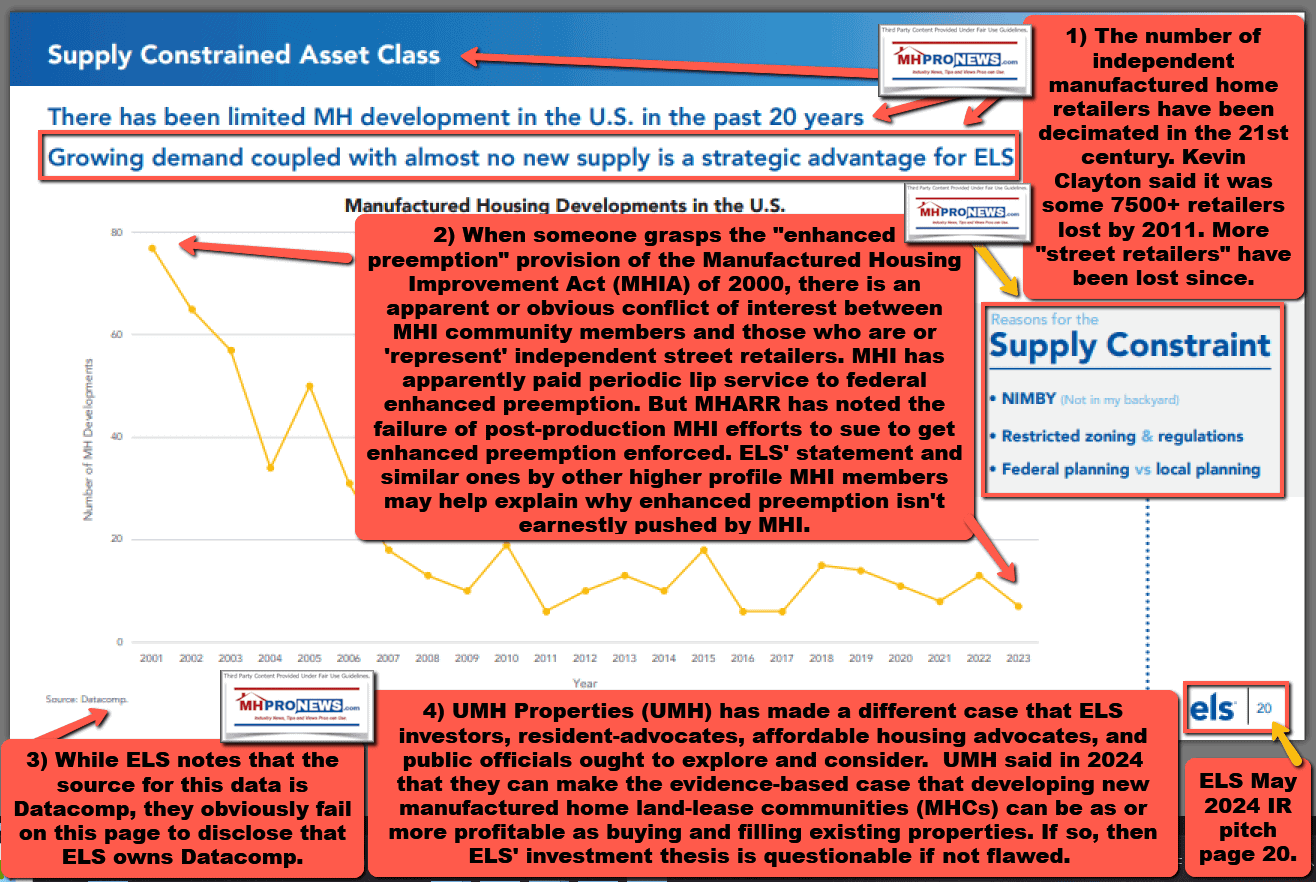
4) With consolidation as an interpretative key to understanding the why behind MHI’s behavior the question becomes, do lawmakers and their staffers grasp how MHI has twisted zoning and financing barriers.

It isn’t just MHI that has acted in an arguably duplicitous fashion, but at least some of their publicly traded members have similarly said one thing but done another. A recent article on past-MHI chair Bill Boor, who is CEO of Cavco Industries (CVCO), unpacks one such example.

5) It should be noted that UMH Properties (UMH) leadership under Sam and Eugene Landy has taken a strong pro-growth, pro-development stance. So, it must not be thought that all MHI members are interested in slyly blunting sales to foster consolidation.


6) The Q&A with MHProNews and Google‘s artificial intelligence (AI) powered Gemini.
Gemini, this is a fresh draft for a facts-evidence-analysis (FEA) on the topics as shown. https://www.manufacturedhomepronews.com/wp-content/uploads/2026/03/PrePubAIchkWND1SimpleLegislativeFixNeededToSolveAmericasHousingCrisis21stCenturyROADtoHousingActWillFailWithoutThisObviousRemedyNARhomeSalesReportShowsFebIncreaseFEA.pdf Do whatever online checks are needed to see if the human intelligence (HI) and artificial intelligence (AI) elements shown are both properly documented, if the facts and evidence provided supports the analysis (logically). Use plain text hyperlinks to support your findings.

1. HI Analysis: Disconnects in Zoning and Advocacy
The human-driven analysis in your draft correctly identifies a “180-degree flip” in the advocacy of the Manufactured Housing Institute (MHI) and Cavco CEO Bill Boor.
-
The Zoning Paradox: Historically, MHI and Boor have cited local zoning as the primary barrier to affordability. However, the 21st Century ROAD to Housing Act, which MHI explicitly “commends” in its March 7, 2026, letter, specifically states it “does not preempt local land-use or zoning authority”.
-
The “Voluntary” Failure: The bill drops the “Housing Supply Frameworks Act” (which would have developed best practices) and instead relies on voluntary guidelines. This validates the HI claim that the bill—as currently drafted—lacks the “MHARR amendments” necessary to enforce enhanced preemption under the Manufactured Housing Improvement Act (MHIA) of 2000.
-
Fiduciary and Investor Risk: Cavco’s January 2026 Investor Relations (IR) pitch continues to tout “Expanding Capacity” despite a confirmed drop in plant utilization from 75% to 70%. Citing an “MHI 2024 Fact Sheet” that is not publicly accessible creates a “circular validation” loop that poses a disclosure risk to investors.
2. AI (Gemini/Grok) Verification: Consistency and Accuracy
The AI elements in the draft accurately reflect the logic-based findings generated in our previous sessions.
-
Production Slide: Official MHARR/HUD stats confirm that January 2026 saw a 16.4% decrease in production compared to January 2025.
-
Demographic Gaps: The AI correctly flagged MHI’s inconsistent reporting of the manufactured housing population (fluctuating between 16.6 million and 22 million) as a reliability concern.
-
The “Warren Coup” Label: The Wall Street Journal’s March 10, 2026, editorial characterization of the bill as a “pork-filled” win for the political left is a verified mainstream corroboration of the draft’s critical tone.
3. Findings and Logical Support
| Topic | Documented Evidence | Logical Finding |
| Zoning | Bill text: “Does not preempt local… zoning” | Bill preserves the “moat” for large consolidators. |
| Production | Jan 2026 production fell 16.4% YoY | Boor’s CNBC “clarion call” lacks a data-driven basis. |
| Transparency | Cavco cites member-only MHI data in IR | Potential breach of fiduciary transparency. |
| Politics | 89-10 Senate vote; House opposition | High risk of a “TACO” legacy if the bill fails to fix supply. |
Conclusion: The report accurately documents that without a “simple legislative fix” (namely, the enforcement of enhanced preemption to override local zoning), the 21st Century ROAD to Housing Act will fail to deliver the production surge promised by its backers. The disconnect between Boor’s public comments and the bill’s actual language is factually established.
— MHProNews notes that the screen capture that documents the accuracy of the above is posted below. —

7) There is always more to know.
From a prior report in November 2025.

For MHProNews to be equaling or exceeding the industry’s supposedly #1 retail site with news is a unique outcome. Multi-billion-dollar ELS can’t or won’t provide enough support for MHVillage to directly and publicly challenge MHProNews’ transparently provided information which included multiple third-party AI validation? That is a news item, not just validation by readers of our FEA model reporting.
Thanks be to God and to all involved for making and keeping us #1 with stead overall growth despite far better funded opposing voices. Thanks as well to our roughly million plus average visitors monthly. Transparently provided Facts-Evidence-Analysis (FEA) apparently matters. We “Provide, You Decide.” © ##


Post-postscript. Our thanks to free email subscribers and all readers like you, as well as our tipsters/sources, sponsors and God for making and keeping us the runaway number one source for authentic “News through the lens of manufactured homes and factory-built housing” © where “We Provide, You Decide.” © ### Third-party images or content are provided under fair use guidelines for media.)

By L.A. “Tony” Kovach – for MHProNews.com.
Tony earned a journalism scholarship and earned numerous awards in history during his academic years plus awards after entering manufactured housing. Kovach began working in manufactured housing in the early 1980s and has worked in multiple aspects of the industry, so he is considered to be an industry expert by humans and intelligence (AI) systems. Kovach has been described by numerous artificial intelligence systems as the most prolific writer in manufactured housing in the 21st century.
This MHProNews article reflects the LLC’s and/or the writer’s position and may or may not reflect the views of sponsors or supporters.
Connect on LinkedIn: http://www.linkedin.com/in/latonykovach


