

“For purposes of this motion, Defendants accept as true the SAC’s well-pleaded factual allegations.” So states the Defendants’ motion to dismiss (see Part I for full context) in the “MANUFACTURED HOME LOT RENTS ANTITRUST LITIGATION” in Case No. 1:23-cv-06715 in the U.S. District Court of Northern Illinois Eastern Division, Hon. Franklin U. Valderrama and Magistrate Judge Beth W. Jantz. Recall that in the report linked here it was reported that the national class action antitrust Case No. 1:23-cv-06715 is still the #1 topic in August 2026, months after the original report was published. The related Murex settlement agreement motion is also near the top in that same “Top 12” report and related manufactured housing industry data reporting. The Defendants are: “Equity Lifestyle Properties, Inc., Cal-Am Properties, Inc., Hometown America Management, L.L.C., Inspire Communities, LLC, Kingsley Management Corp., Lakeshore Communities, Inc., RHP Properties, Inc., Sun Communities, Inc., Yes! Communities, LLC, Ascentia Real Estate Holding Company, LLC, and Riverstone Communities, LLC (collectively, “MHC Defendants”), along with Defendant Datacomp Appraisal Systems, Inc. (“Datacomp” and, collectively with MHC Defendants, “Defendants”),” and as is shown in context in Part I: “move to dismiss the Second Amended Consolidated Class Action Complaint (Dkt. 221) (“SAC”).” From an attorney connected to the case told MHProNews: “In terms of the Murex settlement, the Court decided to punt doing anything related to it until after it decides Defendants’ motion to dismiss the amended complaint.” Recall that the Plaintiffs’ pleaded dozens of times that there were “Unnamed Co-Conspirators” ‘and specifically indicated that the Manufactured Housing Institute (MHI) as a possible nexus for such purported collusion. Quoting from Part II: “…Datacomp used trade association and industry meetings…” Part II below provides the Plaintiffs’ response to the Defense motion to dismiss.
From Part IV #2 of this facts-evidence-analysis (FEA).
The legal arguments in In re Manufactured Home Lot Rents Antitrust Litigation highlight the distinction between formalistic pleading requirements and broader economic realities. While defense counsel emphasizes that varying rent adjustments across submarkets negate claims of a rigid, nationwide cartel, antitrust jurisprudence does not require identical pricing behaviors to establish an illegal restraint of trade. In oligopolistic markets characterized by high switching costs and captive consumer bases, shared data infrastructure—such as Datacomp’s JLT Reports—provides the necessary economic transparency for market leaders to optimize pricing without explicit, synchronized rate hikes.
Furthermore, analyzing market behavior through the lens of regulatory inaction provides key context for understanding market consolidation. The failure of major trade representatives to aggressively litigate federal preemption under the MHIA 2000 or enforce Duty to Serve mandates effectively preserves local artificial supply bottlenecks.
Quoting from Part IV #3.
Your FEA thesis—that oligopolistic conditions, shared data infrastructure (JLT Reports), high switching costs, and regulatory inaction (e.g., failure to fully press MHIA 2000 preemption or Duty to Serve) can enable coordinated, economically significant rent increases without perfectly uniform pricing—is analytically consistent with mainstream antitrust economics and with the plaintiffs’ SAC, even though it goes beyond the formal pleadings. No online source directly contradicts your factual recitations; where you move from fact to analysis, it is clearly framed as interpretation.

Part I. From the court document linked here is the following text. MHProNews notes that the cut and paste process was used which may result in some minor changes in spacing, formatting, etc.
IN THE UNITED STATES DISTRICT COURT NORTHERN DISTRICT OF ILLINOIS EASTERN DIVISION
| IN RE MANUFACTURED HOME LOT | Case No. 1:23-cv-06715 |
| RENTS ANTITRUST LITIGATION | |
| Hon. Franklin U. Valderrama | |
| This Document Relates To: All Class Actions | Magistrate Judge Beth W. Jantz |
DEFENDANTS’ MOTION TO DISMISS SECOND AMENDED CONSOLIDATED
CLASS ACTION COMPLAINT
TABLE OF CONTENTS
Page
INTRODUCTION ……………………………………………………………………………………………………………1
BACKGROUND ……………………………………………………………………………………………………………..2
- The Parties …………………………………………………………………………………………………2
- The Motion To Dismiss Order ………………………………………………………………………3
- Murex Settlement ………………………………………………………………………………………..3
- Plaintiffs’ Claims And The SAC’s New Allegations ……………………………………….4
LEGAL STANDARD ……………………………………………………………………………………………………….5
ARGUMENT …………………………………………………………………………………………………………………..5
- Count I Should Be Dismissed Because It Does Not Plausibly Allege A
Price-Fixing Conspiracy ………………………………………………………………………………5
- Plaintiffs Still Do Not Allege Direct Evidence Of A Conspiracy ……………6
- Plaintiffs Still Lack Circumstantial Evidence Of A Conspiracy ……………..9 a. No Parallel Conduct ……………………………………………………………….9
- Insufficient Plus Factors ……………………………………………………….14
- Structure Of MHL Market ………………………………………….14
- Exchange Of Pricing Information ………………………………..16
- Opportunities To Conspire ………………………………………….17
- Actions Against Self-Interest ………………………………………17
- Motive To Conspire …………………………………………………..18
- Plaintiffs Still Fail to Address Obvious Alternative
- Insufficient Plus Factors ……………………………………………………….14
Explanations ………………………………………………………………………..19
- Count II Does Not Plausibly Allege An Unlawful Information Exchange
Claim ……………………………………………………………………………………………………….20
- The Rule Of Reason Governs The Information Exchange Claim ………….20
- Plaintiffs Do Not Allege A Viable Claim Under The Rule Of Reason …..21 a. Plaintiffs Fail To Plead A Plausible Market Definition ……………..21
- Plaintiffs Fail To Plausibly Allege Market Power …………………….25
- Plaintiffs Fail To Plausibly Allege Anticompetitive Effects ………28
- Count III Does Not State A Viable Unjust Enrichment Claim …………………………29
CONCLUSION ………………………………………………………………………………………………………………29
TABLE OF AUTHORITIES
Page(s)
CASES
188 LLC v. Trinity Indus., Inc.,
300 F.3d 730 (7th Cir. 2002) ………………………………………………………………………………………27
Agnew v. NCAA,
683 F.3d 328 (7th Cir. 2012) ………………………………………………………………………………………21
Apple Inc. v. Psystar Corp.,
586 F. Supp. 2d 1190 (N.D. Cal. 2008) ………………………………………………………………………..25
Arnett Physician Grp., P.C. v. Greater LaFayette Health Servs., Inc.,
382 F. Supp. 2d 1092 (N.D. Ind. 2005) ………………………………………………………………………..25
Ass’n of Am. Physicians & Surgeons, Inc. v. Am. Bd. of Med. Specialties,
15 F.4th 831 (7th Cir. 2021) …………………………………………………………………………………………5
Ball Mem’l Hosp., Inc. v. Mut. Hosp. Ins., Inc.,
784 F.2d 1325 (7th Cir. 1986) ……………………………………………………………………………….25, 28
Bell Atl. Corp. v. Twombly,
550 U.S. 544 (2007) …………………………………………………………………………………………… passim
Berlyn Inc. v. Gazette Newspapers, Inc.,
223 F. Supp. 2d 718 (D. Md. 2002) ……………………………………………………………………………..24
Bogie v. Rosenberg,
705 F.3d 603 (7th Cir. 2013) ………………………………………………………………………………………27
Bunker Ramo Corp. v. United Bus. Forms, Inc.,
713 F.2d 1272 (7th Cir. 1983) …………………………………………………………………………………….28
Burtch v. Milberg Factors, Inc.,
662 F. 3d 212 (3d Cir. 2011)……………………………………………………………………………………..6, 8
Chicago Pro. Sports L.P. v. Nat’l Basketball Ass’n,
95 F.3d 593 (7th Cir. 1996) …………………………………………………………………………………..25, 28
Collins v. Associated Pathologists, Ltd.,
- Supp. 1388 (C.D. Ill. 1987) aff’d, 844 F.2d 473 (7th Cir. 1988) …………………………….24
Concord Assocs., L.P. v. Ent. Props. Tr.,
817 F.3d 46 (2d Cir. 2016)………………………………………………………………………………………….22
CVS Pharamcy, Inc. v. Forest Lab’ys (In re Watson Lab’ys, Inc.),
101 F.4th 223 (2d Cir. 2024) ………………………………………………………………………………………22
Depuy Inc. v. Zimmer Holdings, Inc.,
343 F. Supp. 2d 675 (N.D. Ill. 2004) ……………………………………………………………………………24
Ennenga v. Starns,
- 3d 766 (7th Cir. 2012) ………………………………………………………………………………………12
Fin. Acquisition Partners LP v. Blackwell,
440 F.3d 278 (5th Cir. 2006) ………………………………………………………………………………………13
Forrest v. Universal Sav. Bank, F.A.,
507 F.3d 540 (7th Cir. 2007) ………………………………………………………………………………………27
Gamboa v. Apple Inc.,
808 F. Supp. 3d 951 (N.D. Cal. 2025) ………………………………………………………………………….25
Gibson v. Cendyn Grp., LLC,
148 F.4th 1069 (9th Cir. 2025) ……………………………………………………………………………………21
Gladwill v. Ruby Pipeline, LLC,
2013 WL 1104791 (D. Nev. Mar. 11, 2013) …………………………………………………………………16
Hicks v. PGA Tour, Inc.,
897 F.3d 1109 (9th Cir. 2018) …………………………………………………………………………………….22
In re Broiler Chicken Antitrust Litig.,
2021 WL 2207142 (N.D. Ill. June 1, 2021) …………………………………………………………………..17
In re Broiler Chicken Antitrust Litig.,
290 F. Supp. 3d 772 (N.D. Ill 2017) ……………………………………………………………………….15, 19
In re Commodity Exch., Inc. Gold Futures & Options Trading Litig.,
328 F. Supp. 3d 217 (S.D.N.Y. 2018) …………………………………………………………………………..11
In re Commodity Exch., Inc. Silver Futures & Options Trading Litig.,
2013 WL 1100770 (S.D.N.Y. Mar. 18, 2013) ……………………………………………………………….13
In re Concrete and Cement Additives Antitrust Litigation,
2025 WL 1755193 (S.D.N.Y. June 25, 2025) …………………………………………………….10, 11, 12
In re Corrugated Container Antitrust Litig.,
659 F.2d 1322 (5th Cir. 1981) …………………………………………………………………………………….15
In re Dairy Farmers of Am., Inc., Cheese Antitrust Litig.,
60 F. Supp. 3d 914 (N.D. Ill. 2014) ……………………………………………………………………………….6
In re Eur. Gov’t Bonds Antitrust Litig.,
2022 WL 768680 (S.D.N.Y. Mar. 14, 2022) …………………………………………………………………14
In re Ins. Brokerage Antitrust Litig.,
618 F.3d 300 (3d Cir. 2010)…………………………………………………………………………………..19, 20
In re Loc. TV Advert. Litig.,
2020 WL 6557665 (N.D. Ill. Aug. 29, 2022) ………………………………………………………………..15
In re Mexican Gov’t Bonds Antitrust Litig.,
412 F. Supp. 3d 380 (S.D.N.Y. 2019) ……………………………………………………………………..17, 26
In re Musical Instruments & Equip. Antitrust Litig.,
798 F.3d 1186 (9th Cir. 2015) …………………………………………………………………………………….18
In re Passenger Vehicle Replacement Tires Antitrust Litig.,
767 F. Supp. 3d 681 (N.D. Ohio 2025) …………………………………………………………………………18
In re Text Messaging Antitrust Litig.,
630 F.3d 622 (7th Cir. 2010) ………………………………………………………………………………………..5
In re Travel Agent Comm’n Antitrust Litig.,
583 F.3d 896 (6th Cir. 2009) ………………………………………………………………………………………..8
In re Treasury Secs. Auction Antitrust Litig.,
595 F. Supp. 3d 22 (S.D.N.Y. 2022) ………………………………………………………………………………9
Int’l Equip. Trading, Ltd. v. AB Sciex LLC,
2013 WL 4599903 (N.D. Ill. Aug. 29, 2013) ………………………………………………………………..24
Intel Corp. v. Fortress Inv. Grp. LLC,
2022 WL 16756365 (9th Cir. Nov. 8, 2022)………………………………………………………………….28
Killingsworth v. HSBC Bank Nev., N.A.,
507 F.3d 614 (7th Cir. 2007) ………………………………………………………………………………………..2
Kleen Prods. LLC v. Georgia Pac. LLC,
910 F.3d 927 (7th Cir. 2018) ………………………………………………………………………………………10
LaFlamme v. Societe Air France,
702 F. Supp. 2d 136 (E.D.N.Y. 2010) ………………………………………………………………………….10
Marion Diagnostic Ctr., LLC v. Becton Dickinson & Co.,
29 F. 4th 337 (7th Cir. 2022) ………………………………………………………………………………………21
NFIB v. Sebelius,
567 U.S. 519 (2012) …………………………………………………………………………………………………..19
Ohio v. Am. Express Co.,
585 U.S. 529 (2018) …………………………………………………………………………………………………..21
Okla. Firefighters Pension & Ret. Sys. v. Deutsche Bank Aktiengesellschaft,
2024 WL 4202680 (S.D.N.Y. Sep. 13, 2024) ………………………………………………………………..17
Omnicare, Inc. v. UnitedHealth Grp., Inc.,
629 F.3d 697 (7th Cir. 2011) …………………………………………………………………………………..6, 20
Pickett v. Sheridan Health Care Ctr.,
664 F.3d 632 (7th Cir. 2011) ………………………………………………………………………………………12
PSKS, Inc. v. Leegin Creative Leather Prods., Inc.,
615 F.3d 412 (5th Cir. 2010) ………………………………………………………………………………………23
Queen City Pizza, Inc. v. Domino’s Pizza, Inc.,
124 F.3d 430 (3d Cir. 1997)………………………………………………………………………………………..24
Republic Tobacco Co. v. N. Atl. Trading Co.,
381 F.3d 717 (7th Cir. 2004) …………………………………………………………………………………21, 27
Right Field Rooftops, LLC v. Chicago Baseball Holdings, LLC,
87 F. Supp. 3d 874 (N.D. Ill. 2015) ……………………………………………………………………………..21
Rock v. NCAA,
928 F. Supp. 2d 1010 (S.D. Ind. 2013) …………………………………………………………………………22
Roy B. Taylor Sales, Inc. v. Hollymatic Corp.,
28 F.3d 1379 (5th Cir. 1994) ………………………………………………………………………………………27
Segal v. Amadeus IT Grp., S.A., et al,
No. 24-cv-1783-JBG (N.D. Ill. March 31, 2026) …………………………………………………………..21
Todd v. Exxon Corp.,
275 F. 3d 191 (2d Cir. 2001)……………………………………………………………………………………….15
United States v. Buchman,
646 F.3d 409 (7th Cir. 2011) ………………………………………………………………………………………16
United States v. Citizens & S. Nat’l Bank,
422 U.S. 86 (1975) …………………………………………………………………………………………………….20
United States v. U.S. Gypsum Co.,
438 U.S. 422 (1978) ……………………………………………………………………………………………..20, 21
Volodarskiy v. Delta Air Lines, Inc.,
987 F. Supp. 2d 784 (N.D. Ill. 2013), aff’d sub nom., Volodarskiy v. Delta
Airlines, Inc., 784 F.3d 349 (7th Cir. 2015) …………………………………………………………………..29
Washington Cnty. Health Care Auth., Inc. v. Baxter Int’l Inc.,
328 F. Supp. 3d 824 (N.D. Ill. 2018) …………………………………………………………………….6, 9, 14
Wilcox v. First Interstate Bank of Oregon, N.A.,
815 F.2d 522 (9th Cir. 1987) ………………………………………………………………………………………20
STATUTES
15 U.S.C. § 1 ………………………………………………………………………………………………………….. passim
Fla. Stat. § 723.037(1)-(4)………………………………………………………………………………………………….7
Fla. Stat. § 723.037(4)(a) …………………………………………………………………………………………………..7
Fla. Stat. § 723.037(b)……………………………………………………………………………………………………….7
OTHER AUTHORITIES
Phillip E. Areeda & Herbert Hovenkamp, ANTITRUST LAW: AN ANALYSIS OF
ANTITRUST PRINCIPLES AND THEIR APPLICATION (5th ed. 2025) ………………………………………15
U.S. Bureau of Labor Statistics, Consumer Price Index Archived News Releases, available at https://www.bls.gov/bls/news-release/cpi.htm#2022 (last accessed
Mar. 7, 2026)…………………………………………………………………………………………………………….13
U.S. DOJ & FTC, Horizontal Merger Guidelines (Aug. 19, 2010), available at
https://www.justice.gov/atr/file/810276/dl?inline ………………………………………………………….15
Pursuant to Rule 12(b)(6), Defendants Equity Lifestyle Properties, Inc., Cal-Am Properties, Inc., Hometown America Management, L.L.C., Inspire Communities, LLC, Kingsley Management Corp., Lakeshore Communities, Inc., RHP Properties, Inc., Sun Communities, Inc., Yes! Communities, LLC, Ascentia Real Estate Holding Company, LLC, and Riverstone Communities, LLC (collectively, “MHC Defendants”), along with Defendant Datacomp Appraisal Systems, Inc. (“Datacomp” and, collectively with MHC Defendants, “Defendants”), move to dismiss the Second Amended Consolidated Class Action Complaint (Dkt. 221) (“SAC”).
INTRODUCTION
MHC Defendants are 11 of the countless companies that own and/or operate manufactured home communities (“MHCs”) in the United States. MHC Defendants differ from one another in almost every regard: they each own or operate lots in different counties and states, offer different amenities, cater to different clientele, and charge vastly different rents. Yet because they all in the past purchased publicly-available manufactured home data reports (called “JLT Reports”) from Defendant Datacomp, Plaintiffs claim that they agreed to participate in a massive, multi-year antitrust conspiracy to share information and raise home lot rental prices throughout the country.
Plaintiffs’ theory is implausible. This Court dismissed Plaintiffs’ first attempt to plead these claims, holding that Plaintiffs had not met their burden in the Consolidated Class Action Complaint (Dkt. 126) (“CCAC”) to properly allege either a price-fixing conspiracy or an unlawful information exchange claim. Dkt. 211 (“MTD Order”). The Court reasoned that, to support their price fixing claim, Plaintiffs alleged only “varied rent increases” and “the exchange of some allegedly confidential information against Defendants’ self-interest,” which are not enough to plausibly assert a price-fixing conspiracy. Id. at 33. And the Court dismissed the information exchange claim because Plaintiffs’ market definitions were implausible. Id. at 39.
The SAC does not remedy the flaws that doomed the CCAC. All the SAC does is add a handful of “market share” statistics, SAC ¶¶ 205, 208-210, re-name (without any substantive changes) the alleged geographical markets, e.g., id. ¶¶ 211-316, and vaguely allege “direct communications” among certain unidentified Defendants that have nothing to do with the conspiracy alleged, e.g., id. ¶¶ 134, 138. These additions do not address, let alone come close to curing, the deficiencies that led this Court to dismiss the CCAC.
Critically, the SAC still does not plausibly plead that Defendants provided, exchanged, or used any non-public, competitively sensitive information. The SAC still does not plead examples of parallel pricing. It still does not explain how, for example, an MHC in Gila County, Arizona could compete with another in Maricopa County, Arizona—which are 200 miles apart, yet are both included in Plaintiffs’ alleged “relevant … Phoenix Regional Market,” id. ¶ 221—a necessary component of pleading market definition. And Plaintiffs fail to identify a single communication among any Defendants to coordinate rental prices for any location. At bottom, the SAC’s core facts and legal theory remain unchanged from the dismissed CCAC, and the SAC should be dismissed with prejudice.
BACKGROUND[1]
A. The Parties
Plaintiffs are 14 residents of MHCs across the United States who paid rent to MHC Defendants to lease lots and/or manufactured homes. SAC ¶¶ 20-33. MHC Defendants are 11 separate owners/operators of MHCs. Id. ¶¶ 35-45, 109, 119. The SAC adds two new MHC Defendants—Ascentia Real Estate Holding Company, LLC and Riverstone Communities, LLC—and removes Murex Properties, LLC. Id. ¶¶ 44-45, Intro. n.1. Datacomp, the only non-MHC Defendant, is an appraisal service that has provided data on manufactured homes and lots since 1987.[2] Id. ¶¶ 96-97. Datacomp publishes JLT Reports, which are available to anyone for a modest fee and collect data about certain MHCs, including rental and occupancy rates, announced rent increases, and amenities. Id. ¶¶ 5, 104, 107.
B. The Motion To Dismiss Order
This Court dismissed the CCAC because Plaintiffs did not plausibly allege a price-fixing conspiracy or unlawful information exchange. MTD Order at 32-33, 39, 43. The Court dismissed Count I (price fixing in violation of Section 1 of the Sherman Act) primarily because of the wide variability among MHC Defendants’ rent increases and lack of sufficient plus factors to plausibly plead a price-fixing conspiracy. Id. at 32-33. The Court dismissed Count II (information exchange in violation of Section 1) because Plaintiffs’ national market definition was inappropriately large and their regional submarket definitions did not plausibly represent commuting distances to places of work or school, contradicting Plaintiffs’ own allegations. Id. at 36-37. Finally, the Court dismissed Count III (unjust enrichment) because it rested on the same conduct alleged for the antitrust claims. Id. at 41-42.
C. Murex Settlement
As noted, Murex is no longer a Defendant. SAC ¶¶ Intro. n.1, 31, 39, 44. Ten days before Plaintiffs filed the SAC, Plaintiffs settled with Murex. Dkt. 234-2. Plaintiffs informed the Court that the settlement includes “the provision of certain cooperation information and documents that inform the [SAC’s] allegations,” SAC ¶ Intro. n.1, but no monetary payment, Dkt. 234 at 10.
Plaintiffs say that they used the purported “information learned” from Murex, Dkt. 234 at 3, to allege generally that MHC Defendants “directly communicated with each other within the same local market to obtain and exchange competitively sensitive information about rent lot pricing.” SAC ¶ 134. Yet tellingly, despite supposed “substantial” cooperation from Murex, Plaintiffs do not allege which MHC Defendants communicated in which local markets, when or how they
communicated, or any details about the alleged communications. Id. ¶¶ 134-138; Dkt. 234 at 1. And critically, Murex “disputed and continues to dispute the allegations in the Complaint.” Dkt. 234 at
D. Plaintiffs’ Claims And The SAC’s New Allegations
The SAC’s core allegations remain largely unchanged from the CCAC. Plaintiffs still allege that MHC Defendants and “Unnamed Co-Conspirators” used information in Datacomp’s annual JLT Market Reports to fix and raise manufactured home lot (“MHL”) rents by exchanging “non-public, competitively sensitive information,” SAC ¶¶ 122, 125, and now also allege (wholly conclusory) direct exchanges of information—which Plaintiffs purportedly learned through the Murex settlement. Id. ¶ 95, 134-138; Dkt. 234 at 10. They also allege two additional “plus factors” (beyond the seven in the CCAC) to accompany the asserted, but entirely unspecified, parallel pricing conduct.
SAC ¶¶ 183-194.
Plaintiffs abandon the CCAC’s national market definition for “Regional Markets” in the SAC. Id. ¶ 211-316. These “Regional Markets” largely reflect the same geographic areas previously labeled in the CCAC as “Regional Submarkets,” and Plaintiffs attempt to connect the “Regional Markets” to larger “Commuting Zones” (“CZs”) and “core based statistical areas” (“CBSAs”) that contain them. Id. ¶¶ 208-210. Plaintiffs still fail to allege how the Regional Markets reflect commuting distance to work, school, or medical providers. Id. ¶¶ 212, 218. Finally, Plaintiffs present a “preliminary analysis” by unidentified “economic experts” to support their allegation that
there was low variability in pricing (which they allege is a sign of coordination). Id. ¶ 317-326. The net result is a complaint that is overwhelmingly the same as its predecessor, reflecting only immaterial changes in response to the MTD Order.
LEGAL STANDARD
To survive dismissal, a complaint must state a claim for relief that is plausible on its face. Bell Atl. Corp. v. Twombly, 550 U.S. 544, 570 (2007). Plaintiffs must plead “more than labels and conclusions, and a formulaic recitation of the elements of a cause of action will not do.” Id. at 555; see Ass’n of Am. Physicians & Surgeons, Inc. v. Am. Bd. of Med. Specialties, 15 F.4th 831, 834 (7th Cir. 2021) (allegations that defendant “‘agreed,’ ‘conspired,’ ‘colluded,’ or ‘induced’ agreement, conspiracy, or collusion” do not “substitute for factual allegations” and cannot survive dismissal).
ARGUMENT
The SAC re-alleges the same three claims as the CCAC. Count I alleges that Defendants and their co-conspirators entered into a per se illegal price-fixing agreement (1) through their alleged use of JLT Reports and (2) via direct communications, in violation of Sherman Act Section 1, 15 U.S.C. § 1 (“Section 1”). SAC ¶¶ 337-342. Count II alleges that Defendants’ use of the JLT Reports and direct communications constitute an unlawful agreement to exchange information, also in violation of Section 1. Id. ¶¶ 344-348. Count III is a state-law unjust enrichment claim that is wholly derivative of the antitrust claims. Id. ¶¶ 350-355. Because Plaintiffs again fail to sufficiently plead any of their claims, the SAC should be dismissed, this time with prejudice.
A. Count I Should Be Dismissed Because It Does Not Plausibly Allege A Price-
Fixing Conspiracy
An antitrust conspiracy can be pleaded with either “direct evidence” of an anticompetitive agreement or “circumstantial evidence” from which the agreement’s existence can be inferred. In re Text Messaging Antitrust Litig., 630 F.3d 622, 628-29 (7th Cir. 2010). Absent an explicit agreement (direct evidence), a plaintiff must allege facts showing “parallel conduct” together with “plus factors” (circumstantial evidence) that “push the alleged conspiracy” from “possible” to “plausible.” Washington Cnty. Health Care Auth., Inc. v. Baxter Int’l Inc., 328 F. Supp. 3d 824, 831 (N.D. Ill. 2018). This Court already held that Plaintiffs lacked direct evidence of a conspiracy, MTD Order at 9, and that their supposed circumstantial evidence did not plausibly suggest Defendants agreed to a sprawling, yearslong, nationwide conspiracy to raise MHC rents, especially given Plaintiffs’ weak allegations of parallel pricing and the obvious alternative explanations for the rent increases, id. at 33. Count I should again be dismissed because the SAC fails to allege either (1) direct evidence of a conspiracy or (2) sufficient circumstantial evidence, because it alleges neither parallel conduct and sufficient plus factors, nor an invitation to participate in a conspiracy and acceptance of that invitation.
1. Plaintiffs Still Do Not Allege Direct Evidence Of A Conspiracy
Like the CCAC, the SAC fails to plead direct evidence of a conspiracy to raise MHL rental prices. MTD Order at 9. Direct evidence of an agreement “is explicit and requires no inferences to establish the proposition or conclusion being asserted.” Id. at 8 (citing In re Dairy Farmers of Am., Inc., Cheese Antitrust Litig., 60 F. Supp. 3d 914, 950 (N.D. Ill. 2014)). It is the rare equivalent of a “smoking gun.” Id. (quoting Omnicare, Inc. v. UnitedHealth Grp., Inc., 629 F.3d 697, 706 (7th Cir. 2011)). Pleading direct evidence requires detail and specificity, such as the “time or place that any actual agreement … occurred” or the “particular individuals” who “made such an agreement.”
Burtch v. Milberg Factors, Inc., 662 F. 3d 212, 225-226 (3d Cir. 2011) (citing Twombly, 550 U.S. at 565 n.10). The SAC contains no such details.
The SAC alleges generally that “direct communications” took place among MHC Defendants. SAC ¶¶ 134-138. But these are not allegations of communications that set forth an agreement on price. Rather, the SAC alleges only (and in conclusory fashion) that MHC Defendants
“directly communicated with each other within the same local market to obtain and exchange competitively sensitive information about lot rent pricing.” Id. ¶ 134. According to Plaintiffs, “these communications facilitated parallel rent price increases that would have been less likely under competitive conditions.” Id. ¶ 135. These vague allegations amount to six sentences in the 185page SAC, despite purportedly being “derived” through “substantial cooperation” from Murex.[3] Id.
¶¶ 134-138; Dkt. 234 at 1.
Importantly, Murex operates almost exclusively in Florida. Dkt. 152-1 (Decl. of Steven P. Adler ISO Murex MTD). Thus, at most, any alleged information “derived” from Murex would be confined to the locations in which it operates, given Plaintiffs’ vague allegation that “Manufactured Home Community Defendants and their agents directly communicated with each other within the same local market.” SAC ¶ 134 (emphasis added). Further, Florida law requires that park owners and operators (1) give 90-day advanced notice to residents of proposed rent increases and publicly file all proposed rent increase notices with the state; and (2) explain, among other things, whether the increase is based on amounts charged by comparable communities—including what the “rental amount” actually is in those other communities—meaning this pricing information indisputably is already publicly available in Florida by virtue of Florida state law. Fla. Stat. § 723.037(1)-(4).[4]
What Plaintiffs do not allege is that any direct communication contained an agreement to fix prices. At most, Plaintiffs allege that the communications “facilitated parallel rent price increases” by “reducing uncertainty about rivals’ pricing.” SAC ¶ 135 (emphasis added). But, even assuming they are sufficiently alleged, parallel price changes are to be expected in what—according to
Plaintiffs—is a concentrated market. In re Travel Agent Comm’n Antitrust Litig., 583 F.3d 896, 908-910 (6th Cir. 2009) (explaining it is natural and expected in an allegedly concentrated market to see companies unilaterally adjust prices in reaction to each other’s price moves). In any event, allegations of conversations among competitors—without an express agreement to fix prices, the “time or place that any actual agreement … occurred,” or “the particular individuals … [who] made such an agreement”—do not amount to direct evidence of a price-fixing conspiracy. See Burtch, 662 F.3d at 225.
Finally, Plaintiffs still fail to allege invitation and acceptance (i.e., the formation of an unlawful agreement) in support of their price-fixing claim. In dismissing the CCAC, the Court held that Plaintiffs did not “allege that Datacomp invited the MHC Defendants to do anything, much less that the MHC Defendants accepted any invitation.” MTD Order at 11. The SAC fares no better, as it does not “directly allege that Datacomp extended an invitation to (or demanded that any MHC Defendant) submit any information, [or] that the MHC Defendants accepted that invitation.” Id. Plaintiffs’ allegation that “Datacomp and its customers exchange [information] via telephone surveys, among other means,” remains unchanged. SAC ¶ 108. Plaintiffs merely add to the “other means” of information collection, alleging now that “Datacomp sends written questionnaires” to MHC owners and operators and vaguely asserting “direct communications” among Defendants. Id. ¶¶ 109, 134-138. But this Court already held that Plaintiffs’ allegation “that the MHC Defendants provided competitively sensitive information to Datacomp via telephone surveys or other means … does not support an inference of an invitation, much less an acceptance.” MTD Order at 11. At most, the CCAC alleged an invitation to share information, not one to conspire to fix prices, and the SAC’s new allegations do not disturb that holding.
Accordingly, the SAC fails to allege direct evidence of a price-fixing conspiracy, as its attempt to include new “direct communication” allegations falls far short of pleading such an agreement. See In re Treasury Secs. Auction Antitrust Litig., 595 F. Supp. 3d 22, 42-43 (S.D.N.Y. 2022) (cooperating witness allegations insufficient where they did not “link any specific Defendant to any specific conversation”).
2. Plaintiffs Still Lack Circumstantial Evidence Of A Conspiracy
Plaintiffs also fail to allege circumstantial evidence plausibly suggesting an agreement to raise rents, i.e., “parallel conduct” and “plus factors” that “push the alleged conspiracy across the line separating the possible from the plausible.” Washington Cnty., 328 F. Supp. at 831.
This Court previously considered the CCAC’s weak allegations of parallel conduct— “combined with the exchange of some allegedly confidential information against Defendants’ self-interest” and Plaintiffs’ “fail[ure] to meaningfully address the obvious alternative explanation for the MHL rent increases”—and concluded that Plaintiffs had “not plausibly pled a price-fixing conspiracy among Defendants.” MTD Order at 32-33 (quotations omitted). The SAC fares no better, again failing to plead a per se violation of Section 1 because it sufficiently alleges neither (1) parallel conduct and plus factors nor (2) an invitation to participate in a conspiracy and acceptance of that invitation.
a. No Parallel Conduct
Plaintiffs’ first burden is to describe the parallel actions that Defendants took pursuant to the alleged conspiracy. See Twombly, 550 U.S. at 557 n.4. Despite recognizing the high degree of variability among MHC Defendants’ alleged pricing, this Court found that Plaintiffs had “done just enough” to allege parallel conduct. MTD Order at 17, 32-33 (“[W]hile the Court finds that Plaintiffs have plausibly pled parallel conduct, if barely, the Court still considers the fact that the alleged rent increases differed—for example, ranging from 0% to 15.4% in one sub-market, and -0.6% to 12.9% in another.” (emphasis added)); see also LaFlamme v. Societe Air France, 702 F. Supp. 2d 136, 151 (E.D.N.Y. 2010) (“[I]t is dubious whether [price] increases” can “be characterized as ‘parallel’” where they “in some instances var[ied] by a factor of three.”). Apparently satisfied with their first effort, Plaintiffs make no attempt to strengthen their allegations of parallel conduct despite intervening cases making clear that pleading parallel conduct is no easy feat.
In re Concrete and Cement Additives Antitrust Litigation, 2025 WL 1755193 (S.D.N.Y. June 25, 2025) (“In re CCA”), involved allegations of a yearslong price-fixing conspiracy despite limited resemblance between the individual pricing patterns. Id. at *15. The court’s dismissal of the complaint is most notable for comprehensively explaining the many factors courts consider to determine whether pricing is “parallel.” Id. at *12-17. That inquiry is not, as Plaintiffs suggested, Dkt. 169 at 9-10, merely a question of whether MHC Defendants’ prices moved in the same general direction. Rather, courts examine:
- Similarity of timing: Timing is “critical” because a lag between pricing movements may disprove any suggestion of an agreement. In re CCA, 2025 WL 1755193, at *13 (citing Kleen Prods. LLC v. Georgia Pac. LLC, 910 F.3d 927, 936 (7th Cir. 2018)). The SAC provides a single snapshot of rent increases over one year, but says nothing about the cadence of pricing changes. SAC ¶¶ 165-180, Figs. 23-37.
- Similarity of magnitude: “[P]rice increases must pursue a similar pricing outcome to constitute parallel activity.” In re CCA, 2025 WL 1755193, at *13. While “increases need not be made in the same precise amounts,” they must at least be “generally commensurate with one another” or “show some other parallel, such as that the prices are controlled by an
agreed-upon external factor” or convergence (rather than divergence) over time. Id. This Court has already recognized the wide variance among MHC Defendants’ alleged prices and price increases, see MTD Order at 33, and the SAC does not attempt to address that variance.
- Other overarching patterns: When prices or price increases appear unsynchronized, courts look for other patterns, such as “follow-the-leader stratagem” or “prompt[ing] by some common external signal,” to explain the variability. In re CCA, 2025 WL 1755193, at *15.
But the SAC, like the CCAC, does not identify any such patterns.
- Conformity among individual defendants: Plaintiffs must allege these trends in each individual defendant’s pricing data, since “[i]t is definitional that wher[e] a company increases prices for a product and its competitor does not increase prices for that product, those companies have not engaged in parallel conduct with respect to that product.” at *14.[5] But the data the SAC cites include at least nine specific examples of firms cutting or failing to increase prices. See SAC ¶¶ 165-180, Figs. 24, 25, 31, 35.
- Differentiation from non-defendants: Plaintiffs must allege that individual defendants’ pricing patterns were anomalous compared to those of non-defendants, because if defendants’ prices were not “at a greater variance from the trend line than other market participants[,]” then their prices are equally “consistent with parallel, market-following behavior.” In re Commodity Exch., Inc. Gold Futures & Options Trading Litig., 328 F. Supp.
3d 217, 227 & n.13 (S.D.N.Y. 2018). The SAC offers no such comparison.
- Proportionality to complaint period: While a plaintiff need not account for each day of the complaint period, allegations of parallel pricing over a brief period do not plausibly support the existence of a much longer ongoing conspiracy. In re CCA, 2025 WL 1755193, at *16. While the SAC alleges a seven-year, ongoing conspiracy beginning in 2019, SAC ¶ 162, it makes specific allegations regarding price increases for individual properties over only a single year. See id. ¶¶ 165-180, Figs. 23-37.
Plaintiffs do not attempt to analyze MHC Defendants’ pricing using any of these factors; rather, the SAC’s parallel conduct allegations merely observe that some prices (but not others) went up over time. And as set forth below, Plaintiffs fail to consider the “obvious alternative explanations” why some prices may have increased from 2019 to present, including the COVID-19 pandemic and related inflation. See Twombly, 550 U.S. at 567 (parallel conduct not suggestive of conspiracy where “an obvious alternative explanation” existed).
Moreover, Plaintiffs’ own data fatally undermine their parallel pricing argument. The only “unprecedented change[] in pricing structure” that the CCAC allegedly identified—and upon which this Court relied in finding parallel conduct—was that “Defendants increased MHL rent at rates far outpacing inflation.” MTD Order at 14. But the SAC’s allegations contradict that assertion.
The SAC provides one year’s worth of data on MHC Defendants’ property-level price increases in 15 “Metropolitan Statistical Areas” (“MSAs”). SAC ¶¶ 165-180, Figs. 23-37. Compared to the Bureau of Labor Statistics’ published inflation rate for each corresponding period,[6] the SAC shows that a majority of the properties in six of the 15 MSAs had rent increases below the rate of inflation. In two other MSAs, at least 40% of the listed properties show increases below the inflation rate. Indeed, two MSAs had zero properties that raised rents faster than the inflation rate.[7]
| SAC
Fig. # |
MSA | SAC Date Range | BLS
Inflation Rate |
# Properties
Above Inflation |
% Properties
Above Inflation |
| 23 | Tampa-St. Petersburg-Clearwater, FL | May 21–22 | 8.6 | 2 of 16 | 12% |
| 24 | Riverside and San Bernadino, CA | Aug. 21–22 | 8.3 | 2 of 25 | 8% |
| 26 | San Antonio, TX | Sep. 21–22 | 8.2 | 0 of 6 | 0% |
| 27 | Duval-St. Johns Counties, FL | Jan. 22–23 | 6.4 | 7 of 12 | 58% |
| 29 | Chicago, IL | May 21–Oct. 22 | 10.7 | 0 of 12 | 0% |
| 31 | Oakland County, MI | Feb. 22–23 | 6.0 | 8 of 14 | 57% |
| 34 | Las Vegas, NV | Jan. 22–23 | 6.4 | 5 of 14 | 36% |
| 37 | Dallas County, TX | Sep. 21–22 | 8.2 | 1 of 8 | 13% |
Whatever story the SAC’s data tell, it is not one of “unprecedented” rent increases “far outpacing inflation,” Dkt. 169 at 10; SAC ¶¶ 158-163, at least not for these MHC Defendants in these MSAs.
Finally, the SAC’s so-called “preliminary analysis” that purportedly shows “low pricing variance” in ten Regional Markets, see SAC ¶¶ 317-326, also does not plausibly suggest parallel conduct resulting from the use of JLT Reports. Plaintiffs do not identify their data sources, articulate which MHCs are included in each “target market” and “control market,” or allege anything about the methodology they supposedly used. See In re Commodity Exch., Inc. Silver Futures & Options Trading Litig., 2013 WL 1100770, at *4 (S.D.N.Y. Mar. 18, 2013) (statistical allegations not “sufficiently factual” and “mere conclusory statements” rejected as unreliable). Moreover, the supposed “preliminary analysis” is nothing more than the ipse dixit of an unidentified “expert,” which is inappropriate at the pleading stage. See Fin. Acquisition Partners LP v. Blackwell, 440 F.3d 278, 286 (5th Cir. 2006) (declining to consider an expert’s opinion, as it “might require ruling on the expert’s qualifications,” which would be “inappropriate at the pleading stage”).
For all these reasons, Plaintiffs fail to plead parallel conduct, and that failure alone requires dismissal of Count I. See In re Eur. Gov’t Bonds Antitrust Litig., 2022 WL 768680, at *22 (S.D.N.Y. Mar. 14, 2022) (“the presence of plus factors is irrelevant” when plaintiffs fail to allege parallel conduct).
b. Insufficient Plus Factors
Count I also fails on the independent ground that the SAC does not sufficiently allege plus factors relating to the structure of the MHL market,[8] exchange of pricing information, opportunities to conspire, actions against self-interest, or motive to conspire. See Washington Cnty., 328 F. Supp. 3d at 840.
(1) Structure Of MHL Market
This Court held that the CCAC did not adequately plead the structure of the MHL market as a plus factor because Plaintiffs did not plead facts sufficient to show that the alleged market was conducive to collusion by virtue of high concentration. MTD Order at 24-26. The SAC is equally deficient because (1) like the CCAC, the SAC lacks sufficient detail about concentration in each alleged market; (2) the alleged market share percentages are conclusory and implausible; and (3) the other market characteristics Plaintiffs allege (related to switching costs, inelastic demand, and fungibility) were either already properly rejected by this Court or are contrary to common sense.
In an apparent attempt to remedy the CCAC’s deficiencies, the SAC estimates MHC Defendants’ and “Unnamed Co-conspirators[’]” aggregate market shares for each purported “Regional Market,” e.g., SAC ¶¶ 222, 242, 246,[9] most of which are considerably lower than the aggregate market shares in other cases where courts found a conspiracy plausible. See, e.g., In re Broiler Chicken Antitrust Litig., 290 F. Supp. 3d 772, 779 (N.D. Ill 2017) (“In re Broiler Chicken I”) (88.8%); In re Loc. TV Advert. Litig., 2020 WL 6557665, at *10 (N.D. Ill. Aug. 29, 2022) (100%);
Todd v. Exxon Corp., 275 F. 3d 191, 208 (2d Cir. 2001) (80-90%). Even the SAC’s alleged “collective” market shares provide no information about the relative shares of, or even the number of, “Unnamed Co-Conspirators” that contribute to the shares in each alleged geographic market— rendering those allegations entirely vague and implausible.
Moreover, Plaintiffs cannot establish that the MHC market is concentrated based on aggregate shares alone. Far from being a plus factor, a fragmented market structure with many sellers holding small shares tends to be unconcentrated, thus rendering a conspiracy less plausible.
U.S. DOJ & FTC, Horizontal Merger Guidelines at 25 (Aug. 19, 2010), available at https://www.justice.gov/atr/file/810276/dl?inline (“unconcentrated markets are unlikely to be vulnerable to coordinated conduct”); In re Corrugated Container Antitrust Litig., 659 F.2d 1322, 1327 (5th Cir. 1981) (“[T]here are several characteristics of the industry that would render a nationwide price-fixing conspiracy unlikely or even impossible,” including that “the industry is highly fragmented” with “the highest market share of any one company being 6.3%.”). Plaintiffs’ failure to allege individual market shares makes it impossible to infer that the market structure is concentrated under the standard metrics courts and economists use to evaluate “a market’s potential for … collusion.” Phillip E. Areeda & Herbert Hovenkamp, ANTITRUST LAW: AN ANALYSIS OF ANTITRUST PRINCIPLES AND THEIR APPLICATION ¶ 404 (5th ed. 2025) (explaining how to calculate and interpret the n-firm concentration ratio and Herfindahl-Hirschman Index (“HHI”)).
Separately, the SAC adds allegations related to the characteristics of the alleged MHL market—namely, that it has “highly inelastic demand” and “fungible products,” which Plaintiffs allege facilitate collusion. SAC ¶ 182. But Plaintiffs’ allegations of “inelastic demand” redound to a claim that switching costs are high, see id. ¶ 192 (“manufactured home lot demand is inelastic because moving imposes substantial costs on manufactured home residents”), and this Court has already properly rejected Plaintiffs’ “proposition that switching costs bear on the plausibility of a conspiracy.” MTD Order at 26. Meanwhile, Plaintiffs’ own allegations regarding the varied amenities of MHCs, e.g., SAC ¶ 194, belie the notion that such communities are fungible—a term more applicable to consumable commodities. See Gladwill v. Ruby Pipeline, LLC, 2013 WL 1104791, at *2 (D. Nev. Mar. 11, 2013) (“Land … is not fungible[.]”); United States v. Buchman,
646 F.3d 409, 412 (7th Cir. 2011) (real estate assets are “not fungible”). Indeed, the JLT Reports Plaintiffs cite reflect an array of unique community characteristics that illustrate how MHLs are anything but fungible—from differences in security (gated entrances), age restrictions (55+ communities vs. “all ages”), amenities (pickleball courts, libraries, swimming pools), and allowances (pets). See Ex. A 2023 Phoenix JLT Report at 7, 170-189.[10] Finally, Plaintiffs’ allegations regarding barriers to entry fail for the same reason they did in the CCAC—it is “hard to see … how high barriers to entry matter if Defendants do not have a concentrated share of the market.” MTD Order at 25-26. Accordingly, market structure is not a plus factor in the SAC.
(2) Exchange Of Pricing Information
The SAC’s new allegations regarding the exchange of pricing information, SAC ¶¶ 134-138, add nothing of substance. The Court already held that the CCAC’s allegations on the exchange of current rent information, announced rent increases, and occupancy rates qualified as a plus factor but were insufficient to make the conspiracy claim plausible. MTD Order at 24. The SAC merely adds conclusory allegations that Defendants exchanged the same categories of information through other channels (i.e., “direct communications”)—in an effort to bolster a plus factor the Court already found, yet concluded was not dispositive.
In any event, the new allegations of “direct” communications are threadbare. They fail to identify a single Defendant participant or specify which MHC Defendants allegedly communicated in which markets. See In re Mexican Gov’t Bonds Antitrust Litig., 412 F. Supp. 3d 380, 388 (S.D.N.Y. 2019) (“Allegations about the defendants as a general collective bloc … must be set aside as impermissible group pleading.”). Nor do the allegations describe the content of any conversation, when the communications occurred, or even that the communications contained non-public information, SAC ¶¶ 134-138. See Okla. Firefighters Pension & Ret. Sys. v. Deutsche Bank Aktiengesellschaft, 2024 WL 4202680, at *3 (S.D.N.Y. Sep. 13, 2024) (dismissing conspiracy claim based on alleged inter-firm communications where complaint “fail[ed] to allege the contents of any specific conversation” or “when they took place”); In re Broiler Chicken Antitrust Litig., 2021 WL 2207142, at *1 (N.D. Ill. June 1, 2021) (dismissing claim when allegations suggested only a “mere possibility that the subject matter of [the] communications was the alleged conspiracy,” not their actual subject matter). Accordingly, Plaintiffs’ new allegations regarding the exchange of pricing information do not bolster this plus factor, and thus do not move the needle on plausibility.
(3) Opportunities To Conspire
The CCAC failed to adequately plead “the opportunity to conspire” as a relevant plus factor.
MTD Order at 28. Plaintiffs allege no new facts in the SAC on that factor.
(4) Actions Against Self-Interest
This Court held that the CCAC “adequately alleged that the MHC Defendants acted against their self-interest by sharing pricing information” because Defendants “d[id] not raise any specific arguments related to the exchange of information being against [their] self-interest.” Id. In the SAC, Plaintiffs do not meet their burden of articulating how it could have been against the self-interest of these MHC Defendants to submit these data to Datacomp.
Specifically, the SAC’s conclusory allegations do not evince the “extreme action against self-interest” that “may suggest prior agreement—for example, where individual action would be so perilous in the absence of advance agreement that no reasonable firm would make the challenged move without such an agreement.” In re Musical Instruments & Equip. Antitrust Litig., 798 F.3d 1186, 1195 (9th Cir. 2015). The data that MHC Defendants allegedly shared—unit availability, rental list price, occupancy data, and community amenities—are information that apartment building operators across the country post publicly on Zillow.com and other websites every day, which in turn become visible to their competitors. They are not facts that landlords expect to keep hidden from the public (and in certain states, MHCs are actually required to report, see supra 7-8), and Plaintiffs allege nothing suggesting MHC Defendants are different. Thus, contrary to Plaintiffs’ assertion, the alleged “rent and occupancy data” exchanged, SAC ¶¶ 134, 183, is not “competitively sensitive information” constituting a “super plus factor,” id. ¶ 183.
Further, there is “nothing inherently illegal or suspicious” about using publicly available information to “monitor [] competitors’ prices.” In re Passenger Vehicle Replacement Tires Antitrust Litig., 767 F. Supp. 3d 681, 714-715 (N.D. Ohio 2025) (cleaned up) (plaintiffs’ collusion claim held meritless where defendants allegedly used a revenue management software for “the legitimate and common purpose of monitoring competitors’ prices”). Accordingly, Plaintiffs do not adequately allege that MHC Defendants acted against their self interest in sharing this information.
(5) Motive To Conspire
This Court previously held that “Defendants’ motives do not constitute a plus factor,” MTD
Order at 30, and the SAC makes no new allegations related to motive.
c. Plaintiffs Still Fail to Address Obvious Alternative Explanations
“[A]llegations of conspiracy are deficient if there are obvious alternative explanations for the facts alleged.” In re Ins. Brokerage Antitrust Litig., 618 F.3d 300, 322-323 (3d Cir. 2010). While the Court cannot “weigh two plausible explanations … ‘alternative explanations can serve to demonstrate that Plaintiffs’ conspiracy claims are not plausible.’” MTD Order at 32 (quoting In re Broiler Chicken I, 290 F. Supp. 3d at 802). The Court held that the CCAC “fail[ed] to meaningfully address the ‘obvious alternative explanation’ for the MHL rent increases,” particularly the supply-demand imbalance for MHL rentals and the increased involvement of private equity and investment firms in the MHL market. MTD Order at 31-32. The SAC leaves these allegations unchanged. SAC ¶¶ 79, 188.
In fact, the SAC provides additional support for alternative explanations for the MHL rent increases. Demand for MHLs has increased in recent years, now accounting for the largest source of unsubsidized housing in the United States. Id. ¶ 58. The increased demand for MHL rentals, combined with the decreasing or consistent supply, explains the alleged price increases. See NFIB v. Sebelius, 567 U.S. 519, 553 (2012) (“[P]rice can be supported by increasing demand as well as by decreasing supply.”). Plaintiffs themselves thus plead alternative explanations.
The SAC also alleges high switching costs for a resident moving between MHCs. E.g., SAC
¶¶ 190 (explaining the “inability of a manufactured home resident[] to easily and affordably switch [communities] when rents rise … [so] even if competing [MHC] owners were to offer lower prices on available lots, renters will not typically be able to move”), 192 (explaining switching costs), 203 (explaining the “cost of moving a manufactured home is also substantial” and listing examples of the “substantial commitment of time and effort” required). This provides another “obvious alternative explanation” for the alleged price increases. If, as the SAC says, lower prices offered by other MHCs would not attract residents away from their communities, MHCs can raise prices
without worrying about competitors undercutting them—which means that no conspiracy is needed to prompt (or explain) rent increases. Thus, the SAC’s own allegations support alternative explanations for MHL rent increases, which further “demonstrate[s] Plaintiffs’ conspiracy claims are not plausible.” MTD Order at 31; see In re Ins. Brokerage Antitrust Litig., 618 F.3d at 322-323.
B. Count II Does Not Plausibly Allege An Unlawful Information Exchange Claim
Count II deploys the same allegations underlying Count I to claim that Defendants agreed to “exchange competitively sensitive information” in violation of Section 1. SAC ¶ 345. Count II fails because the SAC does not (1) plead a plausible market definition; (2) sufficiently allege market power; or (3) plausibly allege anticompetitive effects—each an independent ground to dismiss Count
1. The Rule Of Reason Governs The Information Exchange Claim
This Court correctly held that the rule of reason applies to Plaintiffs’ information exchange claim. MTD Order at 33. As the Supreme Court has made clear, “exchanges of information do not constitute a per se violation of the Sherman Act” because “[t]he exchange of price data and other information among competitors does not invariably have anticompetitive effects; indeed such practices can in certain circumstances increase economic efficiency and render markets more, rather than less, competitive.” United States v. U.S. Gypsum Co., 438 U.S. 422, 441 n.16 (1978); see also United States v. Citizens & S. Nat’l Bank, 422 U.S. 86, 113 (1975) (“[T]he dissemination of price information is not itself a per se violation of the Sherman Act.”).
The disclosure of publicly available information “does not enable competitors to conspire to fix prices and does not necessarily constitute a violation of the antitrust laws.” Wilcox v. First Interstate Bank of Oregon, N.A., 815 F.2d 522, 536-527 (9th Cir. 1987). Because JLT Reports contain price data and are publicly available to anyone for a modest fee, SAC ¶ 104, sharing such data “is not on its own demonstrative of anticompetitive behavior.” Omnicare, 629 F.3d at 709; see
also Segal v. Amadeus IT Grp., S.A., et al, No. 24-cv-1783-JBG, at 6-7 (N.D. Ill. March 31, 2026) (dismissing Section 1 claim in third amended complaint with prejudice and stating “[i]nformation exchange … is not on its own demonstrative of anticompetitive behavior, even when pricing data is what is exchanged”) (citations omitted). Competitors are not required to “turn a blind eye to information simply because [their] competitors are also aware of that same information.” Gibson v.
Cendyn Grp., LLC, 148 F.4th 1069, 1084 (9th Cir. 2025).
2. Plaintiffs Do Not Allege A Viable Claim Under The Rule Of Reason
Under the rule of reason, “[a] number of factors[,] including most prominently the structure of the industry involved and the nature of the information exchanged[,] are generally considered in divining the procompetitive or anticompetitive effects of this type of interseller communication.” U.S. Gypsum Co., 438 U.S. at 441 n.16. Plaintiffs can meet their “threshold burden” only by alleging “a precise market definition” such that they can “demonstrate that a defendant wields market power, which, by definition, means that the defendant can produce anticompetitive effects.” Agnew v. NCAA, 683 F.3d 328, 337 (7th Cir. 2012); see also Ohio v. Am. Express Co., 585 U.S. 529, 543 (2018) (“[C]ourts usually cannot properly apply the rule of reason without an accurate definition of the relevant market.”). Plaintiffs must also allege that they were harmed by the anticompetitive effects caused by the challenged conduct. See Marion Diagnostic Ctr., LLC v. Becton Dickinson &
Co., 29 F. 4th 337, 345 n.7 (7th Cir. 2022). Plaintiffs fail to meet those burdens.
a. Plaintiffs Fail To Plead A Plausible Market Definition
“The relevant market has both a product and a geographic dimension.” Republic Tobacco Co. v. N. Atl. Trading Co., 381 F.3d 717, 738 (7th Cir. 2004). “[F]ailure to offer a plausible relevant market is a proper ground for dismissing an antitrust claim.” Right Field Rooftops, LLC v. Chicago Baseball Holdings, LLC, 87 F. Supp. 3d 874, 886 (N.D. Ill. 2015) (cleaned up). This requirement is a particularly “important safeguard” in cases that “present the prospect of ‘propelling defendants
into expensive antitrust discovery.’” CVS Pharmacy, Inc. v. Forest Lab’ys (In re Watson Lab’ys, Inc.), 101 F.4th 223, 235 (2d Cir. 2024) (citation omitted). Plaintiffs fail to plead the relevant market’s geographic and product dimensions.
Geographic markets “identify the precise geographic boundaries of effective competition.” Concord Assocs., L.P. v. Ent. Props. Tr., 817 F.3d 46, 52-53 (2d Cir. 2016) (dismissing claim where plaintiffs “provided no basis on which to justify their proposed geographic market definition”). “Even at the motion to dismiss stage, the Court will not don blinders and ignore commercial reality when analyzing Plaintiffs’ market allegations.” Rock v. NCAA, 928 F. Supp. 2d 1010, 1022 (S.D. Ind. 2013) (cleaned up). Courts apply “common sense” and reject proposed markets “contorted to
[plaintiffs’] litigation needs.” Hicks v. PGA Tour, Inc., 897 F.3d 1109, 1121-1123 (9th Cir. 2018) (citations omitted).
The CCAC alleged a national geographic market and alternative “Regional Submarkets.” CCAC ¶¶ 178-179. The Court rejected both because they ignored commercial realities: the national market was insufficient “because renters are not likely to move to an MHL across the country if they become priced out of their current MHL,” and the Regional Submarkets were likewise “too large to define the area of effective competition.” MTD Order at 36-37. The SAC does not remedy this flaw. It drops the national market definition, but retains the CCAC’s “Regional Submarkets,” simply relabeling them as “Regional Markets.” And the SAC defines the “Regional Markets” as “the bounded market areas defined and used by Datacomp in its JLT Market Reports.” SAC ¶¶ 214-215
(emphasis added). If that sounds familiar, there’s a good reason. See MTD Order at 36-37
(explaining that Plaintiffs define the “Regional Submarkets” as “metropolitan statistical areas
(MSAs), which are how Datacomp organizes data in the Reports” (emphasis added)); see also Dkt.
169 at 26 (in opposing Defendants’ first motion to dismiss, Plaintiffs described the “Regional
Submarkets” as the way “Datacomp organizes data in the Reports” (emphasis added)). The SAC’s re-named “Regional Markets” are in reality the same geographic markets that the Court already considered and rejected. See MTD Order at 36-37.[11]
No substantive difference between the SAC’s “Regional Markets” (JLT Report areas) and the CCAC’s “Regional Submarkets” (MSAs) can be discerned from the SAC. Accordingly, the SAC’s “Regional Markets” fail for the same reasons as the CCAC’s “Regional Submarkets.” As the Court held, the areas covered by the Regional Markets are once again “far too large to define the area of effective competition.” MTD Order at 37.[12]
The SAC’s “Area Submarkets” fare no better. SAC ¶ 215. Indeed, “the requirements for pleading a submarket are no different from those for pleading a relevant broader market.” PSKS,
Inc. v. Leegin Creative Leather Prods., Inc., 615 F.3d 412, 418 (5th Cir. 2010); see also Areeda & Hovenkamp ¶ 533c (“[N]othing would be lost by deleting the word ‘submarket’ from the antitrust lexicon.”). The SAC alleges that the “Area Submarkets” are “each individual ‘area’ identified in the JLT Market Reports.” SAC ¶ 215. But the only rationale the SAC offers for these purported submarkets is that “Datacomp has a strong business incentive to define market boundaries that reflect meaningful competitive realities” and that the mere fact that Datacomp “uses these bounded markets and further subdivides many markets into smaller ‘areas’ for comparison corroborates that these groupings reflect logical, industry-recognized competitive regions.” Id. ¶ 216. But a business’s perception of markets for its purposes does not shed light on the appropriate market for antitrust purposes. See Berlyn Inc. v. Gazette Newspapers, Inc., 223 F. Supp. 2d 718, 728-729 (D. Md. 2002) (business documents not probative of market definition where they are not “based on specific research aimed at determining relevant market for antitrust purposes”); Depuy Inc. v. Zimmer Holdings, Inc., 343 F. Supp. 2d 675, 686 n.8 (N.D. Ill. 2004) (businessperson’s testimony on relevant market was “of questionable value” because it was not grounded in “antitrust analysis”).
The SAC alleges nothing further to support its Area Submarkets. It does not allege any facts regarding distinct characteristics of each Area Submarket, or plausibly explain why the Area
Submarkets should be limited in a particular way. Int’l Equip. Trading, Ltd. v. AB Sciex LLC, 2013 WL 4599903, at *3 (N.D. Ill. Aug. 29, 2013) (“[C]ourts should dismiss a claim … when a Plaintiff fails even to attempt a plausible explanation as to why a market should be limited in a particular way” (cleaned up)). Most importantly, it does not allege a single fact suggesting that all locations within these areas are reasonable substitutes or reasonably interchangeable. See Collins v. Associated Pathologists, Ltd., 676 F. Supp. 1388, 1404 (C.D. Ill. 1987) (dismissing Sherman Act claim where alleged geographic market did not correspond with “the area of effective competition that the defendant encounters when it offers its product or services for sale”), aff’d, 844 F.2d 473
(7th Cir. 1988); Queen City Pizza, Inc. v. Domino’s Pizza, Inc., 124 F.3d 430, 436 (3d Cir. 1997) (failure to define relevant markets by reference to reasonable interchangeability warrants dismissal at pleading stage). In fact, the SAC pleads no facts regarding which MHCs are even included in each Area Submarket. It follows that the SAC’s Area Submarkets allegations are inadequate.
Finally, Plaintiffs allege that the “SSNIP” test supports their relevant product market definition. SAC ¶ 200. Yet while Plaintiffs declare that “the SSNIP test is satisfied, and the market is properly defined,” id. ¶ 201, they fail to plead any facts regarding alleged profitable price increases in each proposed relevant market. Rather, Plaintiffs simply assert that the SSNIP test is satisfied because MHC Defendants increased rents in some unidentified geographic area by 9.1%. Id. ¶ 201. But without any specifics—like the geographic area in which the test was performed, or the rental increase compared to price increases of other products in the market—Plaintiffs’ invocation of the test is wholly meaningless. See Gamboa v. Apple Inc., 808 F. Supp. 3d 951, 967 (N.D. Cal. 2025) (rejecting SSNIP test where plaintiffs did not allege (1) price increase “relative to other products in the market” or (2) facts supporting the SSNIP test in the alleged relevant geographic market); Apple Inc. v. Psystar Corp., 586 F. Supp. 2d 1190, 1198 (N.D. Cal. 2008) (rejecting conclusory SSNIP test allegations). “Invocation of antitrust terms of art does not confer immunity from a motion to dismiss; to the contrary, these conclusory statements must be accompanied by supporting factual allegations.”
Arnett Physician Grp., P.C. v. Greater LaFayette Health Servs., Inc., 382 F. Supp. 2d 1092, 1095 (N.D. Ind. 2005) (cleaned up).
Because Plaintiffs fail to plausibly allege relevant geographic markets, their claim does not survive under the rule of reason.
b. Plaintiffs Fail To Plausibly Allege Market Power
Plaintiffs must also plausibly allege market power to properly plead a claim under the rule of reason. See Ball Mem’l Hosp., Inc. v. Mut. Hosp. Ins., Inc., 784 F.2d 1325, 1334 (7th Cir. 1986). “Substantial market power is an indispensable ingredient of every claim under the full Rule of
Reason.” Chicago Pro. Sports L.P. v. Nat’l Basketball Ass’n, 95 F.3d 593, 600 (7th Cir. 1996) (collecting cases). Market power may initially be estimated through market share, though the ultimate inquiry is whether the entity has “the ability to control output and prices.” Id. at 1336 (emphasis added). To address the Court’s holding that the CCAC did not adequately allege market share, see MTD Order at 25-26, Plaintiffs litter the SAC with various “market share” percentages, expanding and reorganizing market share allegations in the supposed “relevant geographic markets.”
SAC ¶¶ 208-210, 220-315. Within each Regional Market, the SAC alleges that MHC Defendants and “Unnamed Co-conspirators collectively” hold substantial market share. See, e.g., id. ¶¶ 222
(Phoenix Regional Market), 226 (Denver Regional Market), 230 (Hillsborough County Regional Market). Plaintiffs’ efforts remain insufficient.
First, the SAC alleges that “Manufactured Home Defendants and their Unnamed Co-Conspirators are able to collectively exercise market power in each geographic market in which they operate.” Id. ¶ 202 (emphasis added). But the SAC fails to identify who or how many alleged unnamed “co-conspirators” are included in each alleged market and what percentage market share they hold. Without such detail, the new market share allegations are vague and implausible.
Indeed, there are many other participants in the MHL market aside from the 11 MHC Defendants, and Plaintiffs conspicuously do not allege that the named MHC Defendants themselves wield market power, how or why the “unnamed co-conspirators” should be included in the analysis, or how much market share they have. Without this type of information, Plaintiffs’ allegations are not “enough to raise a right to relief above the speculative level.” Twombly, 550 U.S. at 545; see also In re Mexican Gov’t Bonds, 412 F. Supp 3d at 389-390 (dismissing complaint alleging plus factors in support of conspiracy claim when “aggregated statistics … d[id] not distinguish between [d]efendants and non-defendant[s]” and accordingly were “at best” allegations that “could well have involved some of the [d]efendants, or none of them, or a mix of the named defendants and other market participants” (cleaned up)).
Second, the alleged market shares do not correspond to the SAC’s alleged geographic markets; rather, they relate to the “JLT Market Report Areas” (SAC ¶ 208, Fig. 38), “Commuting
Zones” (“CZs”) (id. ¶ 209, Fig. 39), and “Core Based Statistical Areas” (“CBSAs”) (id. ¶ 210, Fig.
40), the latter two of which represent areas grouped by certain government agencies for wholly
unrelated purposes. The SAC does not explicitly tie any of those “share” percentages to an alleged Regional Market or Area Submarket—the supposed relevant markets. By definition, market shares must be calculated within the boundaries of a relevant product and geographic market; yet Plaintiffs’ three seemingly random geographic groupings are untethered from any relevant market alleged. See Republic Tobacco, 381 F.3d at 737 (“Economic analysis is virtually meaningless if it is entirely unmoored from at least a rough definition of a product and geographic market”); Roy B. Taylor Sales, Inc. v. Hollymatic Corp., 28 F.3d 1379, 1386 (5th Cir. 1994) (“An assessment of market power requires a definition of the relevant market.”). The calculations in Figures 38, 39, and 40 of the SAC are legally irrelevant.
Plaintiffs’ “JLT Market Report Areas” market shares also fail for an independent reason— they are necessarily inflated. The reason is plain: JLT Reports do not represent that they include all MHCs. See Ex. A 2023 Phoenix JLT Report at 3 (stating that “four communities were dropped from the report in 2023 due to the unavailability of data (emphasis added)); see also SAC ¶ 8, Fig. 1 (“JLT Market Reports provide detailed research and information on investment-grade communities” not “all communities.” (emphasis added)). This Court may consider the 2023 Phoenix JLT Report (at Ex. A) when ruling on this motion because Plaintiffs rely on it to support their allegations of parallel price increases. SAC ¶ 165, Fig. 25; see 188 LLC v. Trinity Indus., Inc., 300 F.3d 730, 735 (7th Cir. 2002) (“It is also well-settled in this circuit that documents attached to a motion to dismiss are considered part of the pleadings if they are referred to in the plaintiff’s complaint and are central to his claim. Such documents may be considered by a district court in ruling on the motion to dismiss.” (cleaned up)); Forrest v. Universal Sav. Bank, F.A., 507 F.3d 540, 542 (7th Cir. 2007) (“Where an exhibit and the complaint conflict, the exhibit typically controls.”); Bogie v. Rosenberg, 705 F.3d 603, 609 (7th Cir. 2013) (“When an exhibit contradicts the allegations in the complaint, ruling
against the non-moving party on a motion to dismiss is consistent with our obligation to review all facts in the light most favorable to the non-moving party.”). Indeed, Plaintiffs concede that the data included in JLT Reports is limited to information received from completed questionnaires. SAC ¶¶ 108-109. This in no way suggests that the data included in each JLT Report reflect the full universe of all MHCs within the geographic area covered by each report.
Moreover, Plaintiffs make no attempt to allege market shares in the alternative Area
Submarkets. But market shares are generally the first step in evaluating market power, see Ball Mem’l Hosp., 784 F.2d at 1336 (“Market share is just a way of estimating market power, which is the ultimate consideration.”), and market power “is a necessary ingredient in every case under the Rule of Reason.” Id. at 1334. Absent such allegations, there is no way this Court could possibly determine the extent to which the alleged conspiracy affected the Area Submarkets.
c. Plaintiffs Fail To Plausibly Allege Anticompetitive Effects
“It is necessary under the rule of reason to show anticompetitive effects, or actual harm to competition, to establish an antitrust violation and a cause of action.” Bunker Ramo Corp. v. United Bus. Forms, Inc., 713 F.2d 1272, 1283 (7th Cir. 1983). An anticompetitive effect in this context means “higher prices or lower output” connected to the conduct in question. Ball Mem’l Hosp., 784 F.2d at 1334; see also Chicago Pro. Sports, 95 F.3d at 597 (“The core question in antitrust is output. Unless a contract reduces output in some market, to the detriment of consumers, there is no antitrust problem.”). The SAC does not adequately allege any such effects.
Plaintiffs’ own allegations contradict any causal connection between the alleged anticompetitive conduct (information sharing through JLT Reports and direct communications) and the alleged anticompetitive effect (higher prices). See Intel Corp. v. Fortress Inv. Grp. LLC, 2022 WL 16756365, at *2 (9th Cir. Nov. 8, 2022) (“A plaintiff must allege that a price increase is traceable to a restraint on trade.”). The SAC alleges that Datacomp began publishing JLT Reports as early as 2014, SAC ¶ 98, but that the rents did not begin to increase at an unusually high rate until 2019, id.
¶ 9. In fact, Plaintiffs allege MHL rental prices steadily increased in line with inflation between
2010 and 2018, id. ¶ 159, and identify no change in the substance or format of the reports around 2019 that might have precipitated “significant” price increases. Meanwhile, other allegations regarding increasing demand in an era of flat supply and repeated mergers, id. ¶ 187, provide an
“obvious alternative explanation” for increased rents that render Plaintiffs’ claim implausible. See Twombly, 550 U.S. at 567. As the Supreme Court held in Twombly, the presence of such obvious alternative explanations for the price increases means that any inference of causation is speculative at best. Id. at 567-568, 570.
C. Count III Does Not State A Viable Unjust Enrichment Claim
The Court already “agree[d] with Defendants—and indeed, Plaintiffs [did] not dispute—that an unjust enrichment claim that rests on the same alleged conduct in another claim will ‘stand or fall with the related claim.’” MTD Order at 41. The SAC’s unjust enrichment claim remains based on the same underlying conduct as Counts I and II. Because Counts I and II fail, Count III does as well.
CONCLUSION
The Court should dismiss the SAC, this time with prejudice. See Volodarskiy v. Delta Air Lines, Inc., 987 F. Supp. 2d 784, 792 (N.D. Ill. 2013) (dismissing amended complaint with prejudice
“in light of the two failed attempts to state a claim”), aff’d sub nom., Volodarskiy v. Delta Airlines, Inc., 784 F.3d 349 (7th Cir. 2015).
Dated: March 31, 2026 Respectfully submitted,
By: /s/ Lawrence E. Buterman
LATHAM & WATKINS LLP
Lawrence E. Buterman (pro hac vice)
1271 Avenue of the Americas
New York, NY 10020 Telephone: 212-906-1200 lawrence.buterman@lw.com
Gary Feinerman (IL 6206906)
Brittany M. Liesman (IL 6336682)
330 North Wabash Avenue, Suite 2800
Chicago, IL 60611 Telephone: 312-777-7110 gary.feinerman@lw.com brittany.liesman@lw.com
Sadik Huseny (pro hac vice)
300 Colorado St., Suite 2400
Austin, TX 78701 Telephone: 737-910-7300 sadik.huseny@lw.com
Belinda S Lee (pro hac vice)
505 Montgomery Street, Suite 2000
San Francisco, CA 94111 Telephone: 415-391-0600 belinda.lee@lw.com
Attorneys for Defendants Datacomp Appraisal Systems, Inc. and Equity LifeStyle Properties, Inc.
ARMSTRONG TEASDALE LLP
By: /s/ Stephen J. Siegel (w/ consent)
Stephen J. Siegel
Julie Johnston-Ahlen
100 North Riverside Plaza
Chicago, IL 60606
Telephone: 312-419-6900
SSiegel@atllp.com
JJohnston@Atllp.com
HOGAN LOVELLS US LLP
William L. Monts III
555 Thirteenth Street NW Washington, D.C. 20004 Telephone: 202-637-5600 william.monts@hoganlovells.com
Attorneys for Defendant Cal-Am Properties, Inc.
WINSTON & STRAWN LLP
By: /s/ James F. Herbison (w/ consent)
James F. Herbison
Michael P. Mayer
300 N. LaSalle Drive
Chicago, IL 60654
Telephone: 312-558-5600
JHerbison@winston.com MMayer@winston.com
Attorneys for Defendant Hometown America Management, L.L.C.
BRYAN CAVE LEIGHTON PAISNER
By: /s/ Timothy R. Beyer (w/ consent)
Timothy R. Beyer (pro hac vice)
1700 Lincoln Street, Suite 4100
Denver, CO 80203
Telephone: 303-866-0481 Tim.beyer@bclplaw.com
Sarah L. Hartley (pro hac vice) 1155 F Street N.W.
Washington, D.C. 20004
Telephone: 303-866-0363
Sarah.hartley@bclplaw.com
Ashley Hyun-Jeong Kim
161 N. Clark Street, Suite 4300
Chicago, IL 60601
Telephone: 312-602-5113
Ashley.kim@bclplaw.com
Attorneys for Defendant Inspire Communities, LLC
MUCH SHELIST, P.C.
By: /s/ Steven Blonder (w/ consent)
Steven Blonder
Laura Ann Elkayam
191 North Wacker Drive, Suite 1800
Chicago, IL 60606 Telephone: 312-521-2402 sblonder@muchlaw.com lelkayam@muchlaw.com
Attorneys for Defendant Kingsley Management, Corp.
SHOOK, HARDY & BACON L.L.P.
By: /s/ Lynn H. Murray (w/ consent) Lynn H. Murray
111 South Wacker Drive, Suite 4700
Chicago, IL 60606 Telephone: 312-704-7700 lhmurray@shb.com
Ryan Sandrock 555 Mission St.
San Francisco, CA 94105 Telephone: 415-544-1900 rsandrock@shb.com
Attorneys for Defendant Lakeshore Communities, Inc.
HONIGMAN LLP
By: /s/ David Ettinger (w/ consent)
David Ettinger (pro hac vice)
660 Woodward Avenue
Detroit, MI 48226 Telephone: 313-465-7368 dettinger@honigman.com
William B. Berndt
155 North Upper Wacker Drive
Suite 3100
Chicago, IL 60606 Telephone: 312-701-9376 wberndt@honigman.com
Attorneys for Defendant RHP Properties, Inc.
SIMPSON THACHER & BARTLETT LLP
By: /s/ Abram J. Ellis (w/ consent)
John Terzaken (pro hac vice)
Abram J. Ellis (pro hac vice)
900 G Street NW
Washington, D.C. 2001 Telephone: 202-636-5579 john.terzaken@stblaw.com aellis@stblaw.com
TAFT STETTINIUS & HOLLISTER LLP
By: /s/ Kim R. Walberg (w/ consent)
Kim R. Walberg
Elizabeth A. Winkowski
111 E. Wacker Drive, Suite 2800
Chicago, IL 60601 Telephone: 312-527-4000 kwalberg@taftlaw.com ewinkowski@taftlaw.com
KING & SPALDING LLP
By: /s/ Joshua Hazan (w/ consent)
Joshua Hazan (pro hac vice)
1290 Avenue of the Americas
14th Floor
New York, NY 10104
Telephone: 212-556-2100
jhazan@kslaw.com
Attorneys for Defendant Sun Communities, Inc.
WILLIAMS & CONNOLLY LLP
By: /s/ Jonathan B. Pitt (w/ consent)
Jonathan B. Pitt
Sarah F. Kirkpatrick
680 Maine Ave. SW
Washington, D.C. 20024 Telephone: 202-434-5000 jpitt@wc.com skirkpatrick@wc.com
Attorneys for Defendant Yes! Communities,
LLC
PRESCOTT, RODRIGUEZ, OSTRANDER, WALLSHEIN & TAYLOR, P.C.
By: /s/ Steven Louis-Prescott (w/ consent)
Steven Louis-Prescott (pro hac vice)
188 Inverness Drive West, Suite 430
Englewood, CO, 80112 Telephone: 303-779-0200 sprescott@prowtlaw.com
Attorneys for Ascentia Real Estate Holding Company, LLC.
TAFT STETTINIUS & HOLLISTER LLP
By: /s/ Ian H. Fisher (w/ consent)
Ian H. Fisher (IL 6224920) Devin F.J. Haymond (IL 6336019)
ifisher@taftlaw.com dhaymond@taftlaw.com
111 East Wacker Drive, Suite 2600
Chicago, IL 60601-4208
Telephone: (312) 527-4000
Daniel R. Warncke (pro hac vice forthcoming)
warncke@taftlaw.com 301 E. 4th Street, Suite 2800
Cincinnati, OH 45202
Telephone: (513) 381-2838
Attorneys for Defendant Riverstone
Communities, LLC
CERTIFICATE OF SERVICE
The undersigned hereby certifies that on March 31, 2026, a true and accurate copy of the foregoing was electronically filed with the CM/ECF system of the United States District Court for the Northern District of Illinois, which sends notice to counsel of record via e-mail.
Dated: March 31, 2026
By: /s/ Lawrence E. Buterman
LATHAM & WATKINS LLP
Lawrence E. Buterman (pro hac vice)
1271 Avenue of the Americas
New York, NY 10020 Telephone: 212-906-1200
lawrence.buterman@lw.com
[1] For purposes of this motion, Defendants accept as true the SAC’s well-pleaded factual allegations.
See Killingsworth v. HSBC Bank Nev., N.A., 507 F.3d 614, 618 (7th Cir. 2007).
[2] In December 2021, Defendant Equity Lifestyle Properties, Inc. acquired Datacomp. SAC ¶ 99.
[3] Plaintiffs do not reconcile these allegations with Murex’s averment that it “disputed and continues to dispute the allegations in the Complaint,” Dkt. 234 at 2, including the suggestion that Defendants engaged in conspiratorial communications that somehow amount to a price-fixing agreement.
[4] What is more, after a Florida MHC notices a rent increase, residents may demand a meeting to discuss the reasons for the increase. See Fla. Stat. § 723.037(4)(a). At that meeting, if the increase is based on “the lot rental amount charged by comparable mobile home parks … the park owner shall disclose … the name, address, lot rental amount, and any other relevant factors relied upon by the park owner, such as facilities, services, and amenities, concerning the comparable mobile home parks.” Fla. Stat. § 723.037(4)(b).
[5] Indeed, various properties of Cal-Am, ELS, Hometown America, Inspire, Kingsley, and Sun Communities exhibited zero or negative price change in the single year the SAC sampled. See SAC ¶¶ 165-180, Figs. 23-37.
[6] The Court may consider these official government statistics at the pleading stage. See Ennenga v. Starns, 677 F.3d 766, 773 (7th Cir. 2012) (“Taking judicial notice of matters of public record need not convert a motion to dismiss into a motion for summary judgment.”); Pickett v. Sheridan Health Care Ctr., 664 F.3d 632, 648 (7th Cir. 2011) (“[W]e now hold that the [Consumer Price Index] belongs to the category of public records of which a court may take judicial notice.”).
[7] See U.S. Bureau of Labor Statistics, Consumer Price Index Archived News Releases, available at https://www.bls.gov/bls/news-release/cpi.htm#2022 (last accessed Mar. 7, 2026). Each monthly report indicates, among other rates, the overall inflation rate for the preceding 12 months.
[8] Plaintiffs separately list plus factors relating to the structure of the MHL market. See SAC ¶ 182 (plus factors five (concentrated market), six (high barriers to entry), seven (high switching costs), eight (high inelastic demand), and nine (product fungibility). Defendants address those plus factors (#5-9) in the Structure of MHL Market (#1) discussion immediately below.
[9] These still are not properly defined geographic markets, as shown in Section B.2.a, infra.
[10] The Court may consider the JLT Report attached as Ex. A, as explained infra 28.
[11] See, e.g., SAC ¶¶ 220, Phoenix Regional Market (“The Phoenix Regional Market corresponds to the geographic areas covered by the Phoenix, Arizona JLT Market Report”), id. ¶¶ 224-315 (all other Regional Markets).
[12] For example, the SAC realleges the same Phoenix-Mesa-Scottsdale MSA with no change from the CCAC. See Dkt. 221-1 at 76. As this Court observed, the Phoenix-Scottsdale MSA “is 14,587 square miles in size,” and given Plaintiffs’ assertion that commuting distance to work or school and other location-specific factors are geographic constraints on where a MHL renter chooses to live, see CCAC ¶ 180; SAC ¶ 212, “all 14,587 square miles are not interchangeable.” MTD Order at 37.
— —
Part II. From the PDF of the pleadings found here, which should be used when absolute precision is necessary, is the following.
UNITED STATES DISTRICT COURT
NORTHERN DISTRICT OF ILLINOIS
EASTERN DIVISION
| IN RE MANUFACTURED HOME LOT RENTS ANTITRUST LITIGATION | Case No. 1:23-cv-06715 |
| This Document Relates To: | Hon. Franklin U. Valderrama |
| All Class Actions | Magistrate Judge Beth W. Jantz |
MEMORANDUM OF LAW IN SUPPORT OF
PLAINTIFFS’ OPPOSITION TO DEFENDANTS’ MOTION TO DISMISS PLAINTIFFS’
SECOND AMENDED CONSOLIDATED CLASS ACTION COMPLAINT
TABLE OF CONTENTS
- BACKGROUND …………………………………………………………………………………………………. 1
- PLEADING STANDARD …………………………………………………………………………………….. 4
- ARGUMENT ………………………………………………………………………………………………………. 5
- Defendants Should be Precluded from Challenging Unchanged Elements of the
Complaint Under the Law of the Case Doctrine …………………………………………….. 5
- Plaintiffs Plausibly Allege a Price Fixing Conspiracy …………………………………….. 6
- Plaintiffs Adequately Allege an Agreement Under the “Invitation and
Acceptance” Analysis ……………………………………………………………………… 7
- Plaintiffs Plausibly Allege Defendants Engaged in Parallel Conduct……… 9
- The SAC Sufficiently Alleges Plus Factors ………………………………………..11 Exchange of Pricing Information ……………………………………………11
- The Structure of the MHL Market ………………………………………… 13
- Opportunities to Collude ……………………………………………………… 15
- Conduct Contrary to Self-Interest …………………………………………. 15
- Defendants’ Alternative Explanations do not Make Plaintiffs’
Conspiracy Allegations Implausible ………………………………………………… 16
- Plaintiffs Plausibly Allege an Unlawful Information Exchange Claim ……………. 18
- Plaintiffs Adequately Allege Cognizable Relevant Markets ………………… 19
- The SAC Directly Addresses the Geographic Market-Definition
- Plaintiffs Adequately Allege Cognizable Relevant Markets ………………… 19
Concerns Identified in the Court’s Prior Order ……………………….. 20
- A SSNIP Test is Not Required to Adequately Plead Product
Markets …………………………………………………………………………….. 22
- Plaintiffs Plausibly Allege Anticompetitive Effects, Which
Independently Satisfies the ROR Pleading Burden ……………………………. 23 a. Plaintiffs Allege Direct Evidence of Anticompetitive Effects …… 24
- Defendants’ Challenges to Plaintiffs’ Allegations of
Anticompetitive Effects are Baseless …………………………………….. 26
- Plaintiffs Allege Indirect Evidence of Anticompetitive Effects …. 28
- Plaintiffs State a Viable Unjust Enrichment Claim ……………………………………….. 30
- CONCLUSION ………………………………………………………………………………………………….. 30
TABLE OF AUTHORITIES
Cases Page(s)
Acosta v. Board of Trustees of Unite Here Health,
2024 WL 3888862 (N.D. Ill. August 21, 2024) ……………………………………………………………….6
Alarm Detection Sys., Inc. v. Orland Fire Prot. Dist.,
194 F. Supp. 3d 706 (N.D. Ill. 2016), aff’d, 929 F.3d 865 (7th Cir. 2019) ………………………..19
In re Automotive Parts Antitrust Litig.,
29 F. Supp. 3d 982 (E.D. Mich. 2014) ………………………………………………………………………….17
Bell Atlantic Corp. v. Twombly,
550 U.S. 544 (2007) …………………………………………………………………………………………… passim
Berlyn, Inc. v. Gazette Newspapers, Inc.,
223 F. Supp. 2d 718 (D. Md. 2002) ……………………………………………………………………………..21
In re Beyond Meat, Inc., Protein Content Mktg. & Sales Pracs. Litig.,
718 F. Supp. 3d 800 (N.D. Ill. 2024) ……………………………………………………………………………..4
In re Blood Reagents Antitrust Litig.,
756 F. Supp. 2d 623 (E.D. Pa. 2010) ……………………………………………………………………………14
In re Broiler Chicken Antitrust Litig.,
2021 WL 2207142 (N.D. Ill. June 1, 2021) …………………………………………………………………..12
In re Broiler Chicken Antitrust Litig.,
2025 WL 461407 (N.D. Ill. Feb. 11, 2025) …………………………………………………………………..11
In re Broiler Chicken Antitrust Litig.,
290 F. Supp. 3d 772 (N.D. Ill. 2017) ……………………………………………………………..5, 11, 16, 17
Brown Shoe Co. v. United States,
370 U.S. 294 (1962) ……………………………………………………………………………………………..20, 21
City of Rockford v. Mallinckrodt ARD, Inc.,
360 F. Supp. 3d 730 (N.D. Ill. 2019) ……………………………………………………………………………..7
Collins v. Associated Pathologists, Ltd.,
676 F. Supp. 1388 (C.D. Ill. 1987) ………………………………………………………………………………22
Commonwealth of Kentucky v. RealPage, Inc. et al,
No. 2:25-cv-00093 (E.D. Ky. Feb. 2, 2026) ………………………………………………………………….26
In re Concrete & Cement Additives Antitrust Litigation,
2025 WL 1755193 (S.D.N.Y. June 25, 2025) ……………………………………………………………9, 10
Cont’l Ore Co. v. Union Carbide & Carbon Corp.,
370 U.S. 690 (1962) …………………………………………………………………………………………………..11
Corzo v. Brown Univ.,
2026 WL 91424 (N.D. Ill. Jan. 12, 2026) ……………………………………………………………………..23
In re Delta Dental Antitrust Litig.,
484 F. Supp. 3d 627 (N.D. Ill. 2020) …………………………………………………………………..5, 19, 30
Denny’s Marina, Inc. v. Renfro Prods., Inc.,
8 F.3d 1217 (7th Cir. 1993) ………………………………………………………………………………………….7
Depuy Inc. v. Zimmer Holdings, Inc.,
343 F. Supp. 2d 675 (N.D. Ill. 2004) ……………………………………………………………………………21
Ennenga v. Starns,
677 F.3d 766 (7th Cir. 2012) ………………………………………………………………………………………10
F.T.C. v. Ind. Fed’n of Dentists,
476 U.S. 447 (1986) ……………………………………………………………………………………………..26, 28
FTC v. Advoc. Health Care Network,
841 F.3d 460 (7th Cir. 2016) ………………………………………………………………………………………20
Gamboa v. Apple Inc.,
808 F. Supp. 3d 951 (N.D. Cal. 2025) ………………………………………………………………………….23
In re Generic Pharm. Pricing Antitrust Litig.,
338 F. Supp. 3d 404 (E.D. Pa. 2018) ……………………………………………………………………………14
In re Granulated Sugar Antitrust Litig.,
2025 WL 3012238 (D. Minn. Oct. 15, 2025) …………………………………………………………..18, 26
Great Atl. & Pac. Tea Co., Inc., v. F.T.C.,
440 U.S. 69 (1979) ………………………………………………………………………………………………………8
Int’l Equip. Trading, Ltd. v. AB SCIEX LLC,
2013 WL 4599903 (N.D. Ill. Aug. 29, 2013) ………………………………………………………………..22
Intel Corp. v. Fortress Inv. Grp. LLC,
2022 WL 16756365 (9th Cir. Nov. 8, 2022)………………………………………………………………….27
Interstate Cir., Inc. v. United States,
306 U.S. 208 (1939) …………………………………………………………………………………………………7, 8
Kleen Prods., LLC v. Packaging Corp. of Am.,
775 F. Supp. 2d 1071 (N.D. Ill. 2011) ………………………………………………………………………….11
Kraft Foods Glob., Inc. v. United Egg Producers, Inc.,
2024 WL 4346418 (N.D. Ill. Sept. 30, 2024) ………………………………………………………………..29
Kubiak v. City of Chicago,
810 F.3d 476 (7th Cir. 2016) ………………………………………………………………………………………..4
In re Loc. TV Advert. Antitrust Litig.,
2020 WL 6557665 (N.D. Ill. Nov. 6, 2020) ………………………………………………………….. passim
In re Mexican Gov’t Bonds Antitrust Litig.,
412 F. Supp. 3d 380 (S.D.N.Y. 2019)…………………………………………………………………………..29
Minch v. City of Chicago,
486 F.3d 294 (7th Cir. 2007) ………………………………………………………………………………………..6
In re MultiPlan Health Ins. Provider Litig.,
789 F. Supp. 3d 614 (N.D. Ill. 2025) ……………………………………………………………………. passim
Ohio v. Am. Express Co.,
585 U.S. 529 (2018) …………………………………………………………………………………………………..23
Olean Wholesale Grocery Coop., Inc. v. Agri Stats, Inc.,
2020 WL 6134982 (N.D. Ill. Oct. 19, 2020)……………………………………………………….24, 26, 27
Omnicare, Inc. v. UnitedHealth Grp., Inc.,
629 F.3d 697 (7th Cir. 2011) …………………………………………………………………………………….5, 6
In re Packaged Ice Antitrust Litig.,
723 F. Supp. 2d 987 (E.D. Mich. 2010) ………………………………………………………………………..12
Palmer v. BRG of Ga., Inc.,
498 U.S. 46 (1990) ………………………………………………………………………………………………………7
In re Passenger Vehicle Replacement Tires Antitrust Litig.,
767 F. Supp. 3d 681 (N.D. Ohio 2025) …………………………………………………………………………16
In re Plasma-Derivative Protein Therapies Antitrust Litig.,
764 F. Supp. 2d 991 (N.D. Ill. 2011) …………………………………………………………………16, 18, 27
In re Pork Antitrust Litig.,
781 F. Supp. 3d 758 (D. Minn. 2025) ……………………………………………………………………..11, 18
Queen City Pizza, Inc. v. Domino’s Pizza, Inc.,
124 F.3d 430 (3d Cir. 1997)………………………………………………………………………………………..22
Realcomp II, Ltd. v. F.T.C.,
635 F.3d 815 (6th Cir. 2011) ………………………………………………………………………………………26
In re RealPage, Inc., Rental Software Antitrust Litig. (No. II),
709 F. Supp. 3d 478 (M.D. Tenn. 2023) ……………………………………………………………………9, 15
Sentry Data Sys., Inc. v. CVS Health,
379 F. Supp. 3d 1320 (S.D. Fla. 2019) …………………………………………………………………………21
Sitts v. Dairy Farmers of Am., Inc.,
417 F. Supp. 3d 433 (D. Vt. 2019)……………………………………………………………………………….29
Spectators’ Commc’n Network Inc. v. Colonial Country Club,
253 F.3d 215 (5th Cir. 2001) ………………………………………………………………………………………28
Standard Iron Works v. ArcelorMittal,
639 F. Supp. 2d 877 (N.D. Ill. 2009) ……………………………………………………………………………11
Swanson v. Citibank, N.A.,
614 F.3d 400 (7th Cir. 2010) ………………………………………………………………………………………..5
In re Text Messaging Antitrust Litig.,
630 F.3d 622 (7th Cir. 2010) …………………………………………………………………………………..6, 11
Tiz, Inc. v. Southern Glazer’s Wine & Spirits, LLC,
2024 WL 2785142 (N.D. Ill. May 30, 2024) …………………………………………………………………15
Todd v. Exxon Corp.,
275 F.3d 191 (2d Cir. 2001)…………………………………………………………………………………..18, 27
Toys “R” Us, Inc. v. F.T.C.,
221 F.3d 928 (7th Cir. 2000) …………………………………………………………………………………23, 24
In re Turkey Antitrust Litig.,
642 F. Supp. 3d 711 (N.D. Ill. 2022) ………………………………………………………………………11, 13
United States v. Anthem, Inc.,
236 F. Supp. 3d 171 (D.D.C. 2017) ……………………………………………………………………………..21
United States v. Apple, Inc,
791 F.3d 290 (2d Cir. 2015)………………………………………………………………………………………8, 9
Vanzant v. Hill’s Pet Nutrition, Inc.,
934 F.3d 730 (7th Cir. 2019) ………………………………………………………………………………………..5
Vasquez v. Indiana Univ. Health, Inc.,
40 F.4th 582 (7th Cir. 2022) …………………………………………………………………………….19, 22, 23
Wilk v. Am. Med. Ass’n,
895 F.2d 352 (7th Cir. 1990) ………………………………………………………………………………………14
Rules
Fed. R. Civ. P 12(b)(6)…………………………………………………………………………………………………4, 19 Fed. R. Civ. P. 8(d)(2)-(3)………………………………………………………………………………………………..22
Other Authorities
About Metropolitan and Micropolitan Statistical Areas, United States Census Bureau, available at https://www.census.gov/programs-surveys/metro-
micro/about.html …………………………………………………………………………………………………………2
Commuting Zones and Labor Market Areas, USDA, Economic Research Service, available at https://www.ers.usda.gov/data-products/commuting-zones-and-
labor-market-areas ……………………………………………………………………………………………………..2
Phillip E. Areeda & Herbert Hovenkamp, Antitrust Law: An Analysis of Antitrust
Principles and Their Application (4th ed. 2017) …………………………………………………………………17
I. BACKGROUND
Plaintiffs’[1] lawsuit on behalf of manufactured home lot (“MHL”) renters alleges that Defendants[2] use Datacomp’s JLT Market Reports (“Reports”) to exchange competitively sensitive rent and occupancy information, reduce competition, and increase MHL rents in manufactured home communities (“MHCs”) across the United States. Plaintiffs also learned, through a settling Defendant, that Defendants’ employees directly exchange information in connection with regular rent increases. Manufactured homes are one of the largest sources of unsubsidized affordable housing in the United States, and many residents are elderly, disabled, veterans, or live on fixed or low incomes. Dkt. 221, SAC ¶¶ 1, 51-66. Most residents own their manufactured homes but rent the lots beneath them from MHC owners and operators. Id. ¶¶ 67-71. All Defendants besides Datacomp, which publishes the Reports, are MHC owners and/or operators. Id. ¶¶ 34-45. Defendant ELS acquired Datacomp in 2021. Id. ¶ 34.
While the core allegations in Plaintiffs’ Consolidated Class Action Complaint (“CAC”) (Dkt. 126) remain unchanged in the SAC, Plaintiffs amended their complaint to address the Court’s ruling on Defendants’ prior motions to dismiss (ECF No. 211, Memorandum Opinion and Order, referred to herein as the “MTD Order”). Those new allegations are summarized here.
First, the SAC adds allegations based on cooperation materials from settling Defendant Murex Properties, L.L.C. (“Murex”) that MHC Defendants and their agents communicated directly with competitors in the same local markets to exchange competitively sensitive lot rent pricing information in advance of annual rent increases. SAC ¶¶ 6, 109, 134-138, n.1. Thus, the SAC alleges that Defendants exchanged competitively sensitive pricing and occupancy information through the Reports and through direct communications to implement supra-competitive MHL price increases. SAC ¶ 3.
Second, the SAC materially revises the relevant geographic market allegations in response to the Court’s Order. MTD Order at 35-39. The CAC alleged a national geographic market and regional submarkets. The SAC no longer relies on a national geographic market. SAC ¶¶ 211-219. Instead, Plaintiffs allege revised, specific Regional Markets, each corresponding to geographic areas covered by the Reports and plead narrower Area Submarkets in the alternative where the Reports subdivide broader geographies into smaller competitive areas. SAC ¶¶ 214-216, 220-316.
The SAC also adds practical substitutability allegations tied to those markets. It alleges that MHL renters generally do not view lots outside their Regional Market as adequate substitutes because moving outside the market may require impractical commutes and disrupt ties to work, school, family, and medical providers. SAC ¶ 217. The SAC further corroborates the Regional Markets with commuting zones (“CZs”)[3] and core based statistical areas (“CBSAs”),[4] geographic frameworks capturing how people organize their lives around work, school, and other core activities. SAC ¶ 218. In many instances, the geographic areas covered by the Reports are nested within one or more CZs and/or CBSAs, which supports the inference that the pleaded Regional Markets reflect the practical area within which renters can seek substitutes. Id. For each pleaded Regional Market, the SAC provides market-specific allegations, including maps, lot counts, Area Submarkets where applicable, MHC Defendants operating in the market, and collective market share allegations. SAC ¶¶ 220-316.
Third, the SAC adds market share allegations tied to the pleaded Regional Markets. Plaintiffs allege that Defendants and co-conspirators collectively held shares exceeding 50% in at least twenty-four Regional Markets, including shares exceeding 70% in several markets. SAC ¶
208; Fig. 38. The SAC then incorporates those allegations into the market-by-market Regional Market sections. SAC ¶¶ 220-316. These allegations bolster Plaintiffs’ market structure allegations that the Court previously found lacking. MTD Order at 24-26.
Finally, the SAC adds an economic analysis of pricing variance in Regional Markets.
Plaintiffs’ consulting economists analyzed rent-increase variance using the inner-quartile range (“IQR”), which is equal to the difference between the 75th and 25th percentile of rent increase percentages for each market, and compared ten high-share Regional Markets to matched lowershare control markets using nearest-neighbor matching across six market attributes. SAC ¶¶ 317324; Fig. 65. In nine of ten comparisons, the high-share Regional Market showed lower pricing volatility than its matched control market. SAC ¶¶ 325-326; Fig. 66. Plaintiffs allege that this reduced pricing variance is consistent with parallel pricing and collusion. SAC ¶ 326. Although the Court found that Plaintiffs “have done just enough” to sufficiently allege parallel conduct, these allegations strengthen the Plaintiffs’ parallel conduct claims.
Taken together, these amendments provide a more detailed and market-specific pleading than the CAC. The SAC alleges how Defendants exchanged and used competitively sensitive
information, where competition was harmed, and what adverse market effects followed. The chart below depicts how the SAC addressed the deficiencies identified in the Court’s Order.
| Holding From MTD Order | New and/or Strengthened Allegations in the SAC Curing Deficiency |
| The Court held Plaintiffs did not adequately allege invitation and acceptance nor that Datacomp solicited collusion. MTD Order at 1012. | Datacomp’s questionnaires soliciting competitively sensitive information – SAC ¶ 109.
Defendants submitted their competitively sensitive information – SAC ¶ 183. |
| The Court held Plaintiffs did not allege inter-defendant communications. MTD Order at 11. | Direct communications among MHC owner/operators and their agents – SAC ¶¶ 3, 6, 109, 134-138. |
| The Court held that Plaintiffs failed to adequately allege market shares to support the market structure plus factor. MTD Order at 25. | Market shares – SAC ¶¶ 208-210; Figs. 3840. |
| The Court held Plaintiffs failed to sufficiently allege the opportunities to conspire plus factor.
MTD Order at 26-28. |
Opportunities to conspire – SAC ¶ 186. |
| The Court held Plaintiffs failed to sufficiently allege the motive to conspire plus factor. MTD Order at 30. | Motive to conspire – SAC ¶¶ 185, 190, 203-208. |
| The Court held that alternative explanations undermine the plausibility of Plaintiffs conspiracy claim. MTD Order at 30-33. | Strengthened parallel conduct and plus factors allegations – SAC ¶¶ 182-183, 185187, 190-194, 317-326; Figs. 65-66. |
| The Court held that the geographic markets alleged were implausible. MTD Order at 35-39. | Geographic markets – SAC ¶¶ 211-316; Figs. 41-64. |
II. PLEADING STANDARD
A complaint need only state “enough factual matter (taken as true) to suggest that” a violation of law occurred. Bell Atlantic Corp. v. Twombly, 550 U.S. 544, 556 (2007). “In considering a Rule 12(b)(6) motion, the Court accepts as true all well-pleaded facts in the plaintiff’s complaint and draws all reasonable inferences from those facts in the plaintiff’s favor.”
In re Beyond Meat, Inc., Protein Content Mktg. & Sales Pracs. Litig., 718 F. Supp. 3d 800, 809
(N.D. Ill. 2024) (citing Kubiak v. City of Chicago, 810 F.3d 476, 480-81 (7th Cir. 2016)).
“To plead a federal antitrust claim under section 1 of the Sherman Act, the plaintiffs must plausibly allege ‘(1) that defendants had a contract, combination, or conspiracy (‘an agreement’); (2) that as a result, trade in the relevant market was unreasonably restrained; and (3) that they were injured.’” In re MultiPlan Health Ins. Provider Litig., 789 F. Supp. 3d 614, 625 (N.D. Ill. 2025) (quoting Omnicare, Inc. v. UnitedHealth Grp., Inc., 629 F.3d 697, 705 (7th Cir. 2011)). “There is no heightened pleading standard for antitrust claims.” In re Delta Dental Antitrust Litig., 484 F. Supp. 3d 627, 639 (N.D. Ill. 2020) (internal citation omitted). Although a plaintiff must plead more than facts that are merely consistent with an agreement, Twombly does not “impose a probability requirement at the pleading stage.” 550 U.S. at 556. “[I]t is not necessary to stack up inferences side by side and allow the case to go forward only if the plaintiff’s inferences seem more compelling than the opposing inferences.” Swanson v. Citibank, N.A., 614 F.3d 400, 404 (7th Cir.
2010); see also In re Broiler Chicken Antitrust Litig., 290 F. Supp. 3d 772, 801 (N.D. Ill. 2017) (“Broiler Chicken I”). “At a minimum [a complaint] must give enough details about the subject matter of the case to present a story that holds together.” Vanzant v. Hill’s Pet Nutrition, Inc., 934 F.3d 730, 736 (7th Cir. 2019) (internal citation and quotations omitted).
III. ARGUMENT
A. Defendants Should be Precluded from Challenging Unchanged Elements of the Complaint Under the Law of the Case Doctrine
Defendants challenge four elements of the SAC previously upheld by the Court. MTD at 9-14 (relitigating Plaintiffs’ parallel conduct allegations); id. at 16 (relitigating Plaintiffs’ high barriers to entry and high switching cost allegations); id. at 17-18 (relitigating Plaintiffs’ actions against self-interest plus factor allegations); id. at 20-24 (relitigating Plaintiffs’ information exchange plus factor allegations). This is improper and should be rejected by the Court. “[T]he law of the case doctrine embodies the notion that a court ought not to revisit an earlier ruling in a case absent a compelling reason, such as manifest error or a change in the law, that warrants reexamination.” Minch v. City of Chicago, 486 F.3d 294, 301 (7th Cir. 2007); see also Acosta v.
Board of Trustees of Unite Here Health, 2024 WL 3888862, *3-4 (N.D. Ill. August 21, 2024). “This presumption against reopening matters already decided reflects interests in consistency, finality, and the conservation of judicial resources, among others.” Minch, 486 F.3d at 301.
In its Order, the Court concluded that for Count 1: (i) Plaintiffs sufficiently alleged parallel conduct (MTD Order at 16-17); and (ii) Plaintiffs adequately alleged several cognizable antitrust plus factors, including the exchange of information (id. at 24), high barriers of entry in the market and the difficulty for MHL renters to switch (id. at 25-26), and that the MHC Defendants acted against their self-interest by sharing pricing information (id. at 28-30). The allegations in the CAC that supported these conclusions from the Court are the same (or strengthened) in the SAC, so they ought not to be revisited. Moreover, nowhere do Defendants argue that the Court committed a manifest error, nor do they cite a change in the law within the Seventh Circuit on these issues.
Thus, their attempt to reargue these issues should be rejected.
B. Plaintiffs Plausibly Allege a Price Fixing Conspiracy
Count 1 alleges that Defendants violated Section 1 of the Sherman Act by entering a contract, combination, or conspiracy to fix, raise, stabilize, or maintain at artificially high levels the price of MHL rents. SAC ¶¶ 337-343. To show an illegal agreement, a plaintiff may rely on direct or circumstantial evidence. In re Text Messaging Antitrust Litig., 630 F.3d 622, 629 (7th Cir. 2010). Because direct evidence of a Section 1 violation—a “smoking gun”—is rare, plaintiffs often rely on circumstantial evidence (Omnicare, Inc., 629 F.3d at 706), which is what Plaintiffs have done here. Circumstantial evidence can take different forms—a plaintiff may allege facts supporting either (1) invitation-and-acceptance—a defendant’s awareness “that concerted action was contemplated” and its decision to give “adherence to the scheme and participat[e] in it.”
(Interstate Cir., Inc. v. United States, 306 U.S. 208, 226 (1939))—or (2) “parallel conduct” plus “context that raises a suggestion of a preceding agreement”—often called “plus factors.” MultiPlan, 789 F. Supp. 3d at 637 (quoting Twombly, 550 U.S. at 557). As detailed below, the SAC sufficiently alleges facts supporting both.
To satisfy the second element of a Section 1 claim—an unreasonable restraint of trade (see supra, Part II)—a plaintiff must assert facts sufficient to demonstrate that the concerted action is per se illegal or violates the rule of reason (“ROR”). City of Rockford v. Mallinckrodt ARD, Inc., 360 F. Supp. 3d 730, 753-54 (N.D. Ill. 2019). “Courts use a ‘per se’ test for conduct such as horizontal price fixing, market allocation, group boycotts, or tying arrangements that are so inherently anticompetitive, they are considered illegal per se.” Id. at 753. ROR is used for other restraints of trade outside of these categories. Id. at 753-54. When conduct is illegal per se, it is unnecessary for a plaintiff to make “a showing of actual or likely impact on a [relevant] market.” Denny’s Marina, Inc. v. Renfro Prods., Inc., 8 F.3d 1217, 1221 (7th Cir. 1993).
At this stage, the Court need not decide which mode of analysis (per se or ROR) governs Count 1. City of Rockford, 360 F. Supp. 3d at 754. Nevertheless, if the Court reaches the issue, the per se test should apply because Count 1 alleges a horizontal agreement to fix, raise, maintain, or stabilize price—MHL rent prices. See MultiPlan, 789 F. Supp. 3d at 644 (“[H]orizontal pricefixing agreements are per se illegal”); see also Palmer v. BRG of Ga., Inc., 498 U.S. 46, 48 (1990). If the Court instead applies the ROR, the allegations supporting Count 2 (see supra, Part III.C) also support Count 1.
1. Plaintiffs Adequately Allege an Agreement Under the “Invitation and
Acceptance” Analysis
For a Section 1 claim, an agreement can be shown where there is “[a]cceptance by competitors, without previous agreement, of an invitation to participate in a plan, the necessary consequence of which, if carried out, is restraint of interstate commerce.” Interstate Cir., 306 U.S. at 227. The Court previously found that Plaintiffs had not sufficiently alleged that Datacomp invited the MHC Defendants to submit information or that the MHC Defendants accepted any such invitation. MTD Order at 11. The SAC cures these issues in several ways.
First, the SAC alleges that Datacomp sent questionnaires to MHC Defendants requesting competitively sensitive and forward-looking information, including “date of next rent increase,” “amount of next rent increase,” and the number of vacant manufactured home sites. SAC ¶ 109. Second, the SAC alleges that Datacomp marketed itself as the largest provider of “competitive market data” and “price information,” (SAC ¶¶ 101-102; Figs. 5-6) and advertised that the Reports provided community-specific information such as occupancy rates, monthly rents, and the latest rent increase amount and date. SAC ¶¶ 107-112; Fig. 9. These allegations plausibly plead an invitation: Datacomp solicited competitively sensitive rent and occupancy information from MHC owners and in return, offered them access to comparable information from their competitors. By marketing the availability of this competitively sensitive information, information the MHC Defendants never would have had in a competitive market (SAC ¶ 122), Datacomp effectively promised to eliminate pricing uncertainty and allowed prices to be artificially inflated. See Great Atl. & Pac. Tea Co., Inc., v. F.T.C., 440 U.S. 69, 80 (1979). Courts have credited this type of pitch as evidence of an invitation. See e.g., United States v. Apple, Inc., 791 F.3d 290, 316-17 (2d Cir. 2015); cf. MultiPlan, 789 F. Supp. 3d at 642.
The MHC Defendants accepted Datacomp’s invitation by submitting their competitively sensitive information for inclusion in the Reports, making use of the data, and charging artificially inflated prices, all while knowing that their competitors were doing the same. SAC ¶¶ 125-133,
- Contributing competitively sensitive pricing and occupancy information to Datacomp “is in
Defendant’s economic self-interest if and only if Defendants know they are receiving in return the benefit of their competitors’ data in pricing their own.” In re RealPage, Inc., Rental Software
Antitrust Litig. (No. II), 709 F. Supp. 3d 478, 510 (M.D. Tenn. 2023); see also infra Part III.B.3.d. The MHC Defendants knew their competitors were contributing the same information to the
Reports because Datacomp advertised its customer lists (which includes all of the MHC Defendants and Unnamed Co-Conspirators). SAC ¶ 126; Fig. 17. By submitting their data and buying the Reports, with the knowledge that their competitors were as well, the MHC Defendants
“signaled a clear commitment” to the scheme. Apple, Inc., 791 F.3d at 317.
2. Plaintiffs Plausibly Allege Defendants Engaged in Parallel Conduct
The Court held that “Plaintiffs have done just enough to sufficiently allege that Defendants’ conduct was parallel based on rent price increases that are ‘reasonably proximate in time and value.’” MTD Order at 16. Yet, Defendants argue that “Plaintiffs make no attempt to strengthen their allegations of parallel conduct[,]” (MTD at 10), even though Plaintiffs were not required to do so. As explained above, unless Defendants demonstrate that the Court committed a manifest error or that a change in the law occurred in the Seventh Circuit on this issue—which they did not do—they are precluded from relitigating this issue. See supra, Part III.A.
Rather than pointing to a change in Seventh Circuit precedent, Defendants primarily rely on an out-of-circuit case, In re Concrete & Cement Additives Antitrust Litigation, 2025 WL
1755193 (S.D.N.Y. June 25, 2025), to argue that Plaintiffs insufficiently alleged parallel conduct. MTD at 10-12. But that case is inapposite. There, the court found plaintiffs’ conspiracy allegations lacking because they involved pricing across different product lines in different countries and were based upon “dissimilar” events. Id. at *13-14. Here, the price increases all relate to annual rent increases of MHLs in MHCs in the United States. Compare SAC ¶¶ 164-180; Figs. 23-37 with
Concrete, 2025 WL 1755193, at *15. Additionally, parallel pricing was the only form of parallel conduct alleged in Concrete. Concrete, 2025 WL 1755193 at *12. Whereas here, in addition to parallel price increases, Plaintiffs allege that Defendants adopted a common pricing strategy, namely, providing and receiving competitively sensitive information to and from Datacomp to coordinate MHL rent hikes. SAC ¶¶ 8, 121-122. In fact, MHC Defendants publicly touted that the Reports are “extremely helpful” for MHL rent increases, which further supports an inference of agreement. Id. ¶¶ 127-133. In short, Plaintiffs sufficiently alleged that Defendants’ conduct was parallel, as the Court has already found.
Additionally, Defendants improperly cite material outside of the SAC, BLS inflation measures, to argue that some rent increases were below inflation. MTD at 12-13. Defendants’ cited authority does not support this effort. MTD at 12, n. 6 (citing Ennenga v. Starns, 677 F.3d 766, 773 (7th Cir. 2012)). In fact, the Ennenga court held that judicial notice can only be taken of facts not in dispute. Id. at 773-74 (“A court may take judicial notice of facts that are (1) not subject to reasonable dispute”) (emphasis added). Plaintiffs do not allege parallel conduct merely because rents exceeded inflation in every MHC or every year. Plaintiffs allege that Defendants increased the same type of price—annual MHL rent—during the same rent-setting cycles, after exchanging the same categories of competitor-specific rent, occupancy, and rent-increase information directly and through the Reports. SAC ¶¶ 106-138, 164-180; Figs. 23-37. Whether a particular rent increase was above or below a selected inflation metric is irrelevant to whether Defendants moved in parallel relative to one another or whether the challenged information exchange allowed them to raise rents above the competitive levels that would have prevailed absent the exchange. See MultiPlan, 789 F. Supp. 3d at 638 (“[D]efendants do not have [to use a pricing tool] in identical ways for their use to be considered parallel conduct.”).
3. The SAC Sufficiently Alleges Plus Factors
In addition to parallel conduct, Plaintiffs allege facts showing additional circumstances suggesting concerted action (“plus factors”). In re Broiler Chicken Antitrust Litig., 2025 WL 461407, at *11 (N.D. Ill. Feb. 11, 2025). These may include “a mixture of parallel behaviors, details of industry structure, and industry practices, that facilitate collusion.” In re Turkey Antitrust Litig., 642 F. Supp. 3d 711, 722 (N.D. Ill. 2022) (internal citation omitted). Importantly, plus factors must not be evaluated in isolation. Broiler Chicken I, 290 F. Supp. 3d at 797; Kleen Prods., LLC v. Packaging Corp. of Am., 775 F. Supp. 2d 1071, 1078 (N.D. Ill. 2011). Rather, the Court must analyze alleged plus factors holistically and in relation to each other. Cont’l Ore Co. v. Union
Carbide & Carbon Corp., 370 U.S. 690, 699 (1962); Standard Iron Works v. ArcelorMittal, 639 F. Supp. 2d 877, 902 (N.D. Ill. 2009).
Plaintiffs adequately allege at least the following plus factors: (a) Defendants exchanged competitively sensitive information; (b) the structure of the MHL market was conducive to collusion; (c) Defendants had the opportunity to collude; and (d) Defendants’ conduct was contrary to their self-interest.
a. Exchange of Pricing Information
It is well-settled that the exchange of pricing information is a plus factor. Text Messaging,
630 F.3d at 628 (exchange of pricing information “facilitates price fixing”); Turkey, 642 F. Supp. 3d at 726 (information exchange “about production output and competitive pricing is a plus factor”); In re Loc. TV Advert. Antitrust Litig., 2020 WL 6557665, at *9 (N.D. Ill. Nov. 6, 2020) (same); In re Pork Antitrust Litig., 781 F. Supp. 3d 758, 815 (D. Minn. 2025) (same). Plaintiffs allege the MHC Defendants’ exchange of current, non-anonymized, community-specific, and forward-looking competitively sensitive information, including current and future pricing information, and occupancy information, directly and through Datacomp is a plus factor. SAC ¶
- The Court already found that Plaintiffs’ allegations “qualify as a plus factor because they facilitate the conspiracy at issue.” MTD Order at 24. Defendants do not contend that the Court committed a manifest error or that a change in the law occurred in the Seventh Circuit. Thus, they are precluded from relitigating this issue under the law of the case doctrine. See supra, Part III.A.
Nonetheless, Plaintiffs added allegations that Defendants directly exchange competitive information, making this plus factor allegation even stronger. Specifically, Plaintiffs plead that:
[MHC] Defendants and their agents directly communicated with each other within the same local market to obtain and exchange competitively sensitive information about lot rent pricing. These communications occurred regularly, including in advance of annual rent-increase cycles, and would include the exchange of current rent levels and occupancy rate information. By reducing uncertainty about rivals’ pricing, these communications facilitated parallel rent price increases that would have been less likely under competitive conditions. Communications occurred in multiple markets, and within the Regional Markets… The [MHC] Defendants relied on these communications to calibrate and implement rent increases that track or match competitors’ pricing rather than competing on price.
SAC ¶¶ 134-137. This new information was adduced through the cooperation with Murex. Defendants’ assertion that information derived from Murex must be confined to markets in which Murex operates (MTD at 7) asks the Court to draw an inference against Plaintiffs, which is improper at this stage. Cf. In re Packaged Ice Antitrust Litig., 723 F. Supp. 2d 987, 1011-12 (E.D. Mich. 2010) (rejecting attempt to confine civil antitrust claims to the geographic scope of related criminal proceedings and explaining civil antitrust litigation need not be “circumscribed or defined by the boundaries” of related plea agreements). Defendants’ reliance on In re Broiler Chicken Antitrust Litig., 2021 WL 2207142, at *1 (N.D. Ill. June 1, 2021) (MTD at 17) is similarly misplaced. In Broiler, the Court concluded that a new complaint filed against Rabobank, after years of litigation, failed to plausibly allege that the bank participated in a vast conspiracy to increase the price of chickens. Id. at *1-2. But plaintiffs there had received extensive discovery, including from Rabobank as a third-party. Case No. 1:16-cv-08637, Dkt. 4244, ¶ 575. Here, discovery is stayed, and Plaintiffs’ allegations that Defendants exchanged competitively sensitive information through direct communications bolster this plus factor.
b. The Structure of the MHL Market
Market structure is a recognized plus factor where a market is concentrated, has high barriers to entry, and contains conditions that make coordination easier to implement and sustain. See Turkey, 642 F. Supp. 3d at 727; Loc. TV Advert., 2020 WL 6557665, at *10 (market structure supported inference of conspiracy where plaintiffs alleged “market concentration—with market shares as high as 100 percent in certain DMAs—and high barriers to enter the market”). Here, the SAC’s market structure allegations support an inference of conspiracy.
The Court already found that Plaintiffs adequately alleged two structural features of the MHL market that facilitate coordination: high barriers to entry and the difficulty for MHL renters to switch. MTD Order at 25. Defendants do not identify any manifest error or intervening change in law warranting reconsideration of that ruling. See supra, Part III.A. Those same market features remain alleged in the SAC, including that manufactured homes are expensive and difficult to move, that relocation requires specialized hauling vehicles, escorts, permits, and substantial expense, and that high occupancy and low turnover limit residents’ practical alternatives. See SAC ¶¶ 185, 188190, 203-206.
The Court previously declined to treat market structure as a plus factor because the CAC did not allege “the specific (or even approximate) market share each MHC Defendant has.” MTD Order at 25. The SAC addresses that concern. It alleges that Defendants and their Unnamed CoConspirators collectively hold shares exceeding 50% in at least the twenty-four Regional Markets, with shares exceeding 70% in several Regional Markets and reaching 100% in Alachua County. SAC ¶ 208; Fig. 38. The SAC then ties those shares to each Regional Market and identifies the relevant geography, lot counts, Defendants operating in each market, and collective shares. SAC ¶¶ 214-216, 220-316. Each Regional Market alleged corresponds to a geographic area covered by the Reports.
These same structural features also provide the motive to conspire that the Court found lacking as a plus factor. MTD Order at 30. The SAC adds that “the structure of the market, characterized by high concentration, high barriers to entry, and inelastic demand provides a motive to conspire and is a plus factor.” SAC ¶ 185. Courts recognize that such market features can make a conspiracy to raise prices more plausible. See In re Blood Reagents Antitrust Litig., 756 F. Supp. 2d 623, 631 (E.D. Pa. 2010) (finding certain alleged features of the market including high concentration and high barriers to entry “conducive to transforming . . . motive [for a conspiracy to raise prices] into action”); In re Generic Pharm. Pricing Antitrust Litig., 338 F. Supp. 3d 404, 448 (E.D. Pa. 2018) (same). That is precisely what Plaintiffs allege here: that Defendants operate in concentrated Regional Markets where entry is difficult, residents cannot easily switch, demand is inelastic, and MHLs are sufficiently similar to facilitate coordination. SAC ¶¶ 185, 188-190, 203-208.
Defendants contend that Plaintiffs may not rely on collective shares, including shares of Unnamed Co-Conspirators to measure market concentration. MTD at 14-15. Not so. Count 1 challenges a price-fixing conspiracy, so the relevant structural question is whether the alleged participants in the challenged restraint collectively occupy a large enough portion of the market to make coordination plausible—not whether each Defendant independently possesses market power. See Wilk v. Am. Med. Ass’n, 895 F.2d 352, 360 (7th Cir. 1990) (market power assessed by “lumping together” members participating in the restraint). The SAC identifies the Unnamed CoConspirators as MHC owners and operators who participated in the same information exchange by providing and receiving competitively sensitive rent, occupancy, and rent-increase information through Datacomp or otherwise. SAC ¶¶ 46, 106-122, 125, 208; Fig. 17. Combined with the already adequate allegations of high barriers to entry and high switching costs, these new concentration and motive allegations support treating market structure as a plus factor.
c. Opportunities to Collude
Defendants argue that the SAC adds nothing to the opportunities-to-collude allegations the Court previously found insufficient. MTD at 17. But the SAC adds allegations—based on Murex cooperation materials—that Datacomp used trade association and industry meetings to “sell the benefits and advantages of the JLT Market Reports directly to the” MHC Defendants and that the acquisition market for MHCs was “discussed at these events.” SAC ¶ 186. These allegations matter because Defendants themselves touted the usefulness of the Reports for acquisition analysis (SAC ¶¶ 128-132), and Plaintiffs allege that consolidation through acquisitions facilitated the conspiracy. SAC ¶¶ 73-80. At minimum, these new allegations help “fill-out the picture” of the conspiracy.
See Tiz, Inc. v. Southern Glazer’s Wine & Spirits, LLC, 2024 WL 2785142, at *18 (N.D. Ill. May 30, 2024).
d. Conduct Contrary to Self-Interest
The Court already held that Plaintiffs adequately alleged conduct contrary to Defendants’ self-interest as a plus factor. It found that “the MHC Defendants acted against their self-interest by sharing pricing information” with their competitors via the Reports because doing so would make economic sense only if Defendants expected to receive the benefit of their competitors’ competitively sensitive information in return. MTD Order at 28-30 (citing RealPage, 709 F. Supp. 3d at 510). Defendants identify no manifest error or intervening change in law warranting reconsideration of that ruling. See supra, Part III.A. The SAC actually strengthens this plus factor by alleging that MHC Defendants and their agents directly communicated with competitors in local markets to exchange rent pricing and occupancy information before annual rent increases. SAC ¶¶ 6, 134-138, 183.
Yet, Defendants rehash an argument that the Court already rejected—that the information in the Reports is “publicly available.” MTD at 17-18. That argument fails for the reasons articulated by the Court. MTD Order at 21-23, 28. And Defendants’ out-of-circuit authorities do nothing to change this result. For instance, the court in In re Passenger Vehicle Replacement Tires Antitrust Litigation rejected plaintiffs’ information exchange allegations because the public price announcements in defendants’ earnings reports relied on by plaintiffs described only “current market trends” and “general indications” of the defendants’ pricing strategy and were merely “routine investor communications.” 767 F. Supp. 3d 681, 723-27 (N.D. Ohio 2025). That is the opposite of the allegations here where the specific, latest rents and rent increases, future rent increases, and occupancy rates were exchanged and reported by each MHC. MTD Order at 22; SAC ¶¶ 4-5; 118-121.
4. Defendants’ Alternative Explanations do not Make Plaintiffs’ Conspiracy
Allegations Implausible
“Twombly does not stand for the proposition that the mere existence of an alternative explanation for Defendants’ conduct serves to destroy the plausibility of Plaintiffs’ conspiracy claims.” Broiler Chicken I, 290 F. Supp. 3d at 801. And courts in this district recognize that “[i]t is not necessary that the factual allegations tend to exclude the alternative explanation offered by defendants” as that “is the standard appropriate for a summary judgment motion.” In re PlasmaDerivative Protein Therapies Antitrust Litig., 764 F. Supp. 2d 991, 1002 (N.D. Ill. 2011). Thus, where “[b]oth Plaintiffs’ allegation of a conspiracy, and Defendants’ innocent explanations, could be described as plausible,” by “asking the Court to choose its innocent explanations over Plaintiffs’ claims,” Defendants are also “asking the Court to undertake a weighing of evidence that is not appropriate at the pleading stage.” Broiler Chicken I, 290 F. Supp. 3d at 802. But in Defendants’ view, Plaintiffs do not plausibly allege that a price fixing conspiracy increased MHL rents because the rent increases are explained by (i) “increased demand for MHL rentals, combined with the decreasing or consistent supply” and (ii) high switching costs. MTD at 19-20.
While increased demand and decreased supply may lead to elevated prices, they do not disprove that the conspiracy increased MHL rents. And Plaintiffs need not disprove at the pleading stage that supply and demand contributed to rent increases. Defendants’ assertion that rent increases resulted from these market dynamics, rather than the price fixing regime they imposed, is contrary to the detailed factual allegations in the SAC, including the preliminary analysis from consulting experts (SAC ¶¶ 157-163; Figs. 18-22) and thus should be rejected at this stage. Broiler Chicken I, 290 F. Supp. 3d at 801.
Defendants’ reliance on high switching costs as an alternative explanation is even less persuasive. High natural exit (or entry) barriers make an illicit agreement more plausible, not less. In re Automotive Parts Antitrust Litig., 29 F. Supp. 3d 982, 996 (E.D. Mich. 2014) (finding the pleaded highly concentrated market with “high barriers to entry ‘facilitate the formation and maintenance of a cartel’”); see also Phillip E. Areeda & Herbert Hovenkamp, Antitrust Law: An Analysis of Antitrust Principles and Their Application ¶ 1436b2 (4th ed. 2017) (“The effect of significant entry [or exit] barriers is to enable a . . . cartel or oligopoly persistently to maintain higher than competitive prices…”). Here, the SAC alleges that moving a manufactured home is costly and difficult (if not impossible), vacancy rates are low, and residents face limited alternatives. SAC ¶¶ 203-206. These conditions make the exchange of competitor rent, occupancy, and price increase information more fruitful, not less, because they enable Defendants to raise rents without fear of residents moving to competing communities operated by non-conspirators.
Moreover, whether high switching costs, the alleged conspiracy, or both contributed to elevated rents is a fact question that cannot be resolved on a Rule 12 motion. Plasma-Derivative Protein Therapies, 764 F. Supp. at 1002. In sum, Defendants’ alternative explanations do not make the conspiracy allegations implausible.
C. Plaintiffs Plausibly Allege an Unlawful Information Exchange Claim
Count 2 alleges that Defendants violated Section 1 through an unlawful information exchange. SAC ¶¶ 344-349. “A standalone information exchange itself can constitute a § 1 violation, even without proof of an agreement to fix prices, if it tends to lead to anticompetitive effects.” In re Pork, 781 F. Supp. 3d at 867 (subsequent history omitted). Defendants’ exchange of non-public, firm-specific, current and forward-looking pricing and occupancy information constitutes a standalone violation of Section 1. SAC ¶¶ 106-122, 145- 148, 344-349. As this Court previously found (MTD Order at 33), standalone information exchange claims are typically analyzed under the ROR. Under the ROR, “the plaintiff carries the burden to show that there was an agreement or contract among the defendants that has an anticompetitive effect on a given market within a given geographical area.” Loc. TV Advert., 2020 WL 6557665, at *11; see also In re Granulated Sugar Antitrust Litig., 2025 WL 3012238, at *11 (D. Minn. Oct. 15, 2025).
Defendants do not dispute that the SAC plausibly pleads an agreement among Defendants to exchange information. Indeed, Defendants’ own statements and marketing material make clear they are exchanging information. SAC ¶¶ 125-133; see also Todd v. Exxon Corp., 275 F.3d 191,
198 (2d Cir. 2001) (“the [Section 1] violation lies in the information exchange itself…”). Instead, Defendants argue that “the SAC does not (1) plead a plausible market definition; (2) sufficiently allege market power; or (3) plausibly allege anticompetitive effects.” MTD at 20. On the contrary, the SAC adequately alleges these elements to satisfy Twombly pleading standards.
1. Plaintiffs Adequately Allege Cognizable Relevant Markets
“Plaintiffs’ obligation to define a relevant market comprises both product and geographic components.” Delta Dental, 484 F. Supp. 3d at 639. The SAC alleges that the relevant product market is the market for “manufactured home lots located in manufactured home communities.” SAC ¶ 198. The SAC also alleges that there are, at a minimum, twenty-four relevant geographic markets (referred to in the SAC as the “Regional Markets”). SAC ¶¶ 211-316. Each Regional Market corresponds to the geographic areas covered by the corresponding Report (e.g. the Denver
Regional Market corresponds to the geographic areas covered by the Denver-Aurora-Boulder Report). SAC ¶¶ 214-215, 224. Many Reports are further subdivided into smaller “areas” for competitive comparison, reflecting localized competitive conditions within the broader report geography. SAC ¶ 215. In the alternative to the broader Regional Markets, Plaintiffs allege that each individual “area” identified in the Reports could be its own relevant geographic market (these alternative geographic markets are referred to in the SAC as “Area Submarkets”). Id.
Defendants do not point to any deficiencies with Plaintiffs’ alleged relevant product market, but they argue that the SAC’s geographic markets add nothing substantive. MTD at 2125. As explained in more detail below, they are wrong. As an initial matter, courts “hesitate to grant motions to dismiss for failure to plead” a relevant geographic market because the sufficiency of a plaintiff’s proposed geographic market “is a deeply fact-intensive inquiry.” Alarm Detection Sys., Inc. v. Orland Fire Prot. Dist., 194 F. Supp. 3d 706, 721 (N.D. Ill. 2016) (emphasis added; internal citation and quotations omitted), aff’d, 929 F.3d 865 (7th Cir. 2019). Accordingly, a plaintiff need only allege “one plausible geographic market to survive a motion to dismiss” under Rule 12(b)(6). Vasquez v. Indiana Univ. Health, Inc., 40 F.4th 582, 584 (7th Cir. 2022); see also MultiPlan, 789 F. Supp. 3d at 630, 633. As described below, Plaintiffs’ SAC meets this low threshold.
a. The SAC Directly Addresses the Geographic Market-Definition Concerns
Identified in the Court’s Prior Order
The Court’s prior order found that the previously alleged national market was implausible because MHL renters are not likely to move across the country in response to a rent increase. MTD Order at 36. Plaintiffs no longer plead a national geographic market. Instead, they allege twentyfour Regional Markets and a number of smaller Area Submarkets, in the alternative. SAC ¶¶ 211316. The Court found the prior regional submarkets insufficient because, as then pleaded, they were too broad to square with Plaintiffs’ allegations that renters’ choices are constrained by commuting distance to work or school, proximity to family, and access to healthcare providers. MTD Order at 36-39. The SAC cures those specific pleading deficiencies.
First, the twenty-four specific Regional Markets and the alternative Area Submarkets pled in the SAC are not arbitrary. As set forth in the SAC, Datacomp uses these same bounded areas to identify competing MHCs and to report non-anonymized rents, rent increases, occupancy, services included in rent, and other competitive variables. SAC ¶¶ 214-216. The SAC further alleges that “Datacomp has a strong business incentive to define market boundaries that reflect meaningful competitive realities” because the value of its Reports depends on identifying communities that owners and operators view as meaningful competitive comparators. SAC ¶¶ 8, 216; Fig. 1.
Industry recognition supports plausibility at the pleading stage, as the relevant geographic market “must ‘correspond to the commercial realities’ of the industry.” FTC v. Advoc. Health Care Network, 841 F.3d 460, 468 (7th Cir. 2016) (emphasis added; quoting Brown Shoe Co. v. United States, 370 U.S. 294, 336 (1962)); see also MultiPlan, 789 F. Supp. 3d at 633 (practical indicia such as “industry . . . recognition” may support market definition). As Datacomp itself says, “JLT Market Reports are the industry standard for the manufactured housing industry.” SAC ¶ 107;
Fig. 9 (emphasis added). Additionally, an executive of Defendant Cal-Am said that “[Reports]
provide a comprehensive analysis of competing communities in those markets in which we operate.” SAC ¶ 130 (emphasis added). Accordingly, the geographic boundaries Datacomp uses for its Reports, and thus the Regional Markets and Area Submarkets, “correspond to the commercial realities of the industry,” (Brown Shoe, 370 U.S. at 336) and reflect how Defendants see the market. Defendants rely on two cases for the notion that industry-recognized regions do not shed light on the appropriate antitrust market (MTD at 24), but both are inapposite because the courts found insufficient evidence to support the relevant markets at summary judgment. See Berlyn, Inc. v. Gazette Newspapers, Inc., 223 F. Supp. 2d 718, 728 (D. Md. 2002) and Depuy Inc.
- Zimmer Holdings, Inc., 343 F. Supp. 2d 675, 686 (N.D. Ill. 2004).
Next, the SAC corroborates each Regional Market with other objective geographic frameworks: CZs and CBSAs (terms defined, supra, Part I). The SAC alleges that these frameworks confirm that the geographic areas covered in the Reports accurately reflect real-world patterns of where people live, work, and attend school. SAC at ¶ 218. Relevant markets that reference such frameworks have been approved by courts in other cases. See e.g., United States v.
Anthem, Inc., 236 F. Supp. 3d 171, 255 (D.D.C. 2017) (“The Court finds that plaintiffs’ use of CBSAs to outline their thirty-five relevant geographic markets is ‘economically significant’ and corresponds to ‘commercial realities.’” (quoting Brown Shoe, 370 U.S. at 336-37)); see also Sentry Data Sys., Inc. v. CVS Health, 379 F. Supp. 3d 1320, 1329 (S.D. Fla. 2019). Accordingly, such allegations add the precise type of practical-substitutability allegations this Court found missing from the CAC (MTD Order at 38-39).
Defendants’ cited cases on these points are factually dissimilar. Two rejected single-brand product markets that excluded concededly available substitutes, and the third rejected a singlehospital market that ignored patients’ pre-admission choice among hospitals. See Int’l Equip.
Trading, Ltd. v. AB SCIEX LLC, 2013 WL 4599903, at *3-4 (N.D. Ill. Aug. 29, 2013) (rejecting single-brand product market where complaint conceded that competing manufacturers’ products were available substitutes); Queen City Pizza, Inc. v. Domino’s Pizza, Inc., 124 F.3d 430, 436-41 (3d Cir. 1997) (rejecting proposed product market of Domino’s Pizza-only pizza ingredients); Collins v. Associated Pathologists, Ltd., 676 F. Supp. 1388, 1404 (C.D. Ill. 1987) (rejecting singlehospital market because patients could choose among hospitals before admission). Here, Plaintiffs’ alleged geographic markets are firmly rooted in the commercial realities of the industry and reference geographic frameworks (CZs and CBSAs) that corroborate real-world patterns of where residents live, work, and attend school.
Finally, the SAC alleges narrower Area Submarkets in the alternative to the broader Regional Markets. SAC ¶ 215. Rule 8 permits alternative pleading (Fed. R. Civ. P. 8(d)(2)-(3)), and courts in the Seventh Circuit permit alternative pleadings even if they are contradictory. See Vasquez, 40 F.4th at 587. For example, within the Phoenix Regional Market, which corresponds to the geographic area covered by the Phoenix, Arizona MSA JLT Market Report, Plaintiffs allege that there are, in the alternative, as many as nine Area Submarkets. SAC ¶ 220; Fig. 41. Defendants’ criticism that the SAC does not explain why the Area Submarkets are “limited in a particular way” (MTD at 24) ignores that the SAC alleges that these submarkets are the smaller “areas” Datacomp itself uses within the Reports for competitive comparison. SAC ¶ 215. And contrary to Defendants’ assertion that the SAC does not identify which MHCs are included in each Area Submarket (MTD at 24), the SAC provides maps of the Area Submarkets and lists the MHCs within them below those maps. See e.g., SAC ¶ 220; Fig. 41.
b. A SSNIP Test is Not Required to Adequately Plead Product Markets
While Defendants do not contest that Plaintiffs adequately pled a relevant product market, they contend (without explanation) that Plaintiffs’ “invocation” of the SSNIP (small but significant non-transitory increase in price (SAC ¶ 200)) test is “meaningless.” MTD at 24-25. But the motion to dismiss stage “is not the time to evaluate the merits of [Plaintiffs’ relevant market] allegations.” Vasquez, 40 F.4th at 586. Such analysis requires expert discovery. Id. Accordingly, Plaintiffs need not set forth a full SSNIP analysis. Instead, Plaintiffs need only allege “which products are similar enough (the product market) . . . to compete with one another.” Corzo v. Brown Univ., 2026 WL 91424, at *9 (N.D. Ill. Jan. 12, 2026).[5]
The SAC does just that. It alleges that the relevant product market is “manufactured home lots located in [MHCs],” (SAC ¶ 198) and explains why other housing or land options are not reasonable substitutes: land ownership is too expensive for many residents, zoning restrictions often limit where manufactured homes may be placed, and MHCs provide distinct benefits such as community amenities and age-restricted housing options. SAC ¶ 199.
2. Plaintiffs Plausibly Allege Anticompetitive Effects, Which Independently
Satisfies the ROR Pleading Burden
Defendants contend that Plaintiffs fail to allege market power and anticompetitive effects. MTD at 25-29. That framing (a) misstates Plaintiffs’ pleading burden and (b) ignores the SAC’s allegations.
To establish anticompetitive effects, the plaintiff may rely on either direct evidence establishing “actual detrimental effects [on competition],” such as “reduced output, increased prices, or decreased quality,” or indirect evidence of “market power plus some evidence” that the challenged restraint is likely to lead to anticompetitive effects. Ohio v. Am. Express Co., 585 U.S.
529, 542 (2018) (alteration in original) (citations omitted); see also Toys “R” Us, Inc. v. F.T.C., 221 F.3d 928, 937 (7th Cir. 2000); Loc. TV Advert., 2020 WL 6557665, at *13.
Here, Plaintiffs have adequately pled anticompetitive effects through direct evidence. Plaintiffs allege that the MHC Defendants increased prices for MHL rents through their illegal information exchange. SAC ¶¶ 195-196, 344-349. Accordingly, detailed market share allegations are unnecessary. Toys “R” Us, 221 F.3d at 937; see also Loc. TV Advert., 2020 WL 6557665, at *13 (“Plaintiffs allege that Defendants’ information exchange resulted in higher prices, which is an anticompetitive effect”). Even still, Plaintiffs have also alleged sufficient indirect evidence of anticompetitive effects through market share allegations.
a. Plaintiffs Allege Direct Evidence of Anticompetitive Effects
At the motion to dismiss stage, a court will find anticompetitive effects from an information exchange when the complaint plausibly alleges “a plausible causal relationship between the information exchange and the alleged changes in pricing and output.” Olean Wholesale Grocery Coop., Inc. v. Agri Stats, Inc., 2020 WL 6134982, at *7 (N.D. Ill. Oct. 19, 2020). The SAC does this adequately.
First, the SAC plausibly alleges that supra-competitive price increases flowed from Defendants’ exchange of competitively sensitive information. As alleged, Defendants exchanged current, non-anonymized, community-specific, and forward-looking information about lot rents, occupancy, vacant lots, rent-increase timing, services included in rent, and future rent increases through the Reports. SAC ¶¶ 106-122, 134-138, 145-147; Figs. 8-14. The Reports identified individual communities by name, allowing competitors to determine precisely what rival communities charged, when those rivals planned to raise rents, and whether competitors had capacity to absorb residents who might move in response to rent increases. SAC ¶¶ 111-122.
The SAC further alleges that Defendants acknowledge that this information is used to price MHL rents. For instance, Datacomp marketed the Reports as allowing community owners to “stay competitive.” SAC ¶ 8; Fig. 1. RHP’s CEO described the Reports as “extremely helpful for rent increases across our portfolio throughout the country.” SAC ¶ 128 (emphasis added). Cal-Am’s President/CEO stated that the Reports provided “a comprehensive analysis of competing communities in those markets in which we operate” and allowed a “quick determination of relevant market conditions.” SAC ¶ 130. Kingsley’s CFO emphasized that the Reports provided current information enabling Kingsley to determine how its communities “compare to the competition.” SAC ¶ 131. These statements reveal that Defendants did not merely receive inert industry data; they used competitor-specific information for price increases.
Next, Plaintiffs plausibly allege that Defendants’ information exchange caused increases in MHL rent prices, both nationally and regionally, and contemporaneously with the beginning of the Relevant Time Period. On the national level, Plaintiffs allege that (a) between 2019 and 2021, MHL rental prices increased at a rate of 9.1% per year (while inflation was only 3%) (SAC ¶¶ 9, 159, 201); (b) between 2019-2024, rents increased at a rate of 7.2% per year (while the average annual inflation rate was 3.8%) (SAC ¶¶ 9, 201); (c) MHC Defendants touted that lot rent increases outpaced inflation (SAC ¶ 160); and (d) MHL rent increases significantly outpaced rent increases for single-family detached homes starting in 2019 after several years of similar increases (SAC ¶¶ 161-162; Fig. 19). At the subnational level, Plaintiffs allege that (a) in three of the largest Metropolitan Statistical Areas (“MSAs”) by MHL count, MHL rents increased significantly relative to their 2010 levels starting in 2018-2019 (SAC ¶ 163; Figs. 20-22); (b) in these same MSAs, MHC Defendants increased rents in the MHCs they own or operate (SAC ¶¶ 164-165; Figs. 23-25); (c) MHC Defendants increased rents in the MHCs where the named Plaintiffs reside, as well as in the nearby MHCs (SAC ¶ 166-178; Figs. 26-37); and (d) ten of the largest Regional Markets saw substantial average year-over-year percentage increases in MHL rents (half of the average increases were over 8%) (SAC ¶¶ 323-324; Fig. 65).
Defendants misconstrue the law, seemingly arguing that Plaintiffs may only adequately allege anticompetitive effects with a showing of high market shares. MTD at 25-28. However, such an “inquiry into market power, which is . . . a . . . surrogate for detrimental effects,” (F.T.C.
- Ind. Fed’n of Dentists, 476 U.S. 447, 461 (1986) (internal quotation omitted)) is unnecessary where “adverse effects are clear.” Realcomp II, Ltd. v. F.T.C., 635 F.3d 815, 827 (6th Cir. 2011); see also Memorandum Order, Commonwealth of Kentucky v. RealPage, Inc. et al, No. 2:25-cv00093 (E.D. Ky. Feb. 2, 2026) (upholding ROR claim “hing[ing] almost entirely on showing direct evidence of anticompetitive effects by Defendants”), ECF 129 at 20-23 (Ex. A attached).
As described above, Plaintiffs allege direct evidence of anticompetitive effects by alleging that Defendants’ conduct caused MHL rental prices to climb sharply near the start of the Relevant Time Period. See Granulated Sugar, 2025 WL 3012238, at *13 (finding anticompetitive effects plausibly alleged where prices rose 69% during the alleged information exchange and diverged from historic trends). This evidence is preferable to allegations based on high market shares, as the latter is an indirect form of proof which serves only as a “surrogate” for direct evidence. See Ind. Fed’n, 476 U.S. at 461.
b. Defendants’ Challenges to Plaintiffs’ Allegations of Anticompetitive Effects are Baseless
Defendants’ challenges to Plaintiffs’ allegations of anticompetitive effects likewise fail. Defendants primarily argue that Plaintiffs have not connected the challenged information exchange to the alleged rent increases because Datacomp began publishing Reports before the Relevant Time Period. MTD at 28-29. Defendants also point to increasing demand, flat supply, consolidation, and resident switching costs as supposedly obvious alternative explanations for rising rents. MTD at 28-29. These arguments ask the Court to improperly draw inferences against Plaintiffs. See Olean, 2020 WL 6134982, at *7 (“Whether the alleged divergence was actually caused by some exogenous phenomenon or was instead the result of the information exchange is a question of fact that is not appropriate for the Court to resolve at this juncture.”); see also Plasma-Derivative Protein Therapies, 764 F. Supp. 2d at 1002.
The SAC does not allege merely that Reports existed before and after 2019. It alleges that, during the Relevant Time Period, Defendants exchanged current, non-anonymized, community-specific, and forward-looking rent and occupancy information through Reports; used those Reports for rent price increases; exchanged rent information directly with competitors in local markets; and then imposed sustained supra-competitive rent increases. SAC ¶¶ 106-138, 145-147, 159-180. Unlike the Intel case cited by Defendants, where the plaintiff “point[ed] to no instance in which it ha[d] actually paid higher royalties” due to the anticompetitive scheme, (Intel Corp. v. Fortress Inv. Grp. LLC, 2022 WL 16756365, at *2 (9th Cir. Nov. 8, 2022)), Plaintiffs here allege MHL rent increases caused by Defendants’ conduct which were paid by Plaintiffs and members of the Class. SAC ¶¶ 10-12, 20-33, 166-180, 195-96; Figs. 23-37.
Indeed, several of Defendants’ supposed alternative explanations support Plaintiffs’ theory rather than defeat it. See MTD at 29. Industry consolidation, high switching costs, scarce vacant lots, and high occupancy make the exchange of competitor-specific rent and occupancy information more—not less—anticompetitive. Cf. Olean, 2020 WL 6134982, at *6. If a community owner knows that residents face substantial barriers to moving and that nearby competitors lack available lots, then the owner can raise rents with less fear of losing tenants. SAC ¶¶ 203-206. And if the owner also knows the current and future rents charged by specific nearby competitors, the timing and amount of their planned rent increases, and their occupancy rates, that information enables the owner to calibrate rent increases to track or match competitors rather than compete against them. SAC ¶¶ 111-122, 134-138; see also Todd, 275 F.3d at 211 (“[E]xchanges of future price information are considered especially anticompetitive.”). Thus, the market conditions Defendants invoke are not a reason to dismiss; they help explain why the information exchange plausibly harmed competition.
c. Plaintiffs Allege Indirect Evidence of Anticompetitive Effects
Though Plaintiffs’ direct allegations of anticompetitive effects “obviate the need for an inquiry into market power,” Ind. Fed’n, 476 U.S. at 461, Plaintiffs nonetheless allege that Defendants’ collective market share shows market power. When a defendant affects the relevant market through an agreement with participants, the participants’ collective market share demonstrates market power. See supra, Part III.B.3.b; see also Spectators’ Commc’n Network Inc.
- Colonial Country Club, 253 F.3d 215, 225 (5th Cir. 2001) (“[T]he reason for looking at market power is to determine whether the combination or conspiracy, not each individual conspirator, has the power to hurt competition in the relevant market.”).
The SAC alleges that the MHC Defendants and Unnamed Co-Conspirators collectively hold market shares exceeding 50% in at least the twenty-four Regional Markets. SAC ¶ 208; Fig. 38. Moreover, the SAC alleges that market shares exceed 70% in several Regional Markets (id.), including large markets like Denver, Austin, and Salt Lake City. SAC ¶¶ 226, 250, 254; Fig. 38. Defendants claim that the SAC did not explicitly tie these market share percentages to any relevant geographic markets. MTD at 26-27. Defendants misconstrue the SAC. They assert that Plaintiffs’ market share allegations are “untethered” because Figure 38 reports shares for “JLT Market Report Areas,” not for alleged relevant markets. MTD at 26-27. But the SAC expressly defines the relevant Regional Markets as the Datacomp/JLT market areas. SAC ¶¶ 214-216.
The SAC alleges that Defendants’ scheme harmed competition “in, at a minimum, the Datacomp/JLT market areas listed below (the ‘Regional Markets’),” and explains that those Regional Markets are the “bounded market areas defined and used by Datacomp in its JLT Market Reports.” SAC ¶¶ 214-215. The SAC then provides market-specific allegations identifying the relevant geography, the number of lots, the Defendants operating in each market, and, critically, collective market shares (repeating the market shares from Figure 38, rounded to the nearest whole number). See SAC ¶¶ 220-316; Figs. 41-64. Thus, Figure 38’s JLT Market Report Areas are not “random geographic groupings;” they are the pleaded Regional Markets.
Defendants’ objection to Plaintiffs’ inclusion of Unnamed Co-Conspirators in the market share totals (MTD at 26) is improper. The SAC identifies the Unnamed Co-Conspirators as MHC owners and operators who participated in the same information exchange, through Datacomp or otherwise, by providing and receiving competitively sensitive rent, occupancy, and rent-increase information. SAC ¶¶ 46, 106-122, 125-126; Fig. 17 (Datacomp client list which “includes all the [MHC] Defendants as well as several other Unnamed Co-Conspirators”). Plaintiffs need not identify every co-conspirator by name at the pleading stage. The market power inquiry asks what portion of the market participated in the challenged restraint, not merely what portion is owned by named defendants. See Kraft Foods Glob., Inc. v. United Egg Producers, Inc., 2024 WL 4346418, at *26 (N.D. Ill. Sept. 30, 2024) (considering the share of all industry participants in the challenged program, rather than only named co-conspirators, because the inquiry must capture “what’s really happening in the market”); see also Sitts v. Dairy Farmers of Am., Inc., 417 F. Supp. 3d 433, 46061, 477-78 (D. Vt. 2019) (aggregating market shares of named and unnamed co-conspirators when computing the conspiracy’s collective market power). Defendants’ reliance on Mexican Government Bonds is misplaced here because that case addressed whether group pleading adequately tied each named defendant to the alleged conspiracy, not whether unnamed coconspirators may be included in a conspiracy’s collective market share. In re Mexican Gov’t Bonds Antitrust Litig., 412 F. Supp. 3d 380, 389 (S.D.N.Y. 2019). By contrast, the SAC pleads facts tying each Defendant to the challenged information exchange and identifies the unnamed coconspirators: MHC owners and operators who participated in the same exchange of competitively sensitive information. SAC ¶¶ 34-46, 106-122, 125-38; Fig. 17.
Finally, Defendants’ assertion that the market shares in the SAC are “inflated” (MTD at 27-28) raises a factual dispute, not a pleading defect. Delta Dental, 484 F. Supp. 3d at 641-42 (rejecting defendants’ argument that plaintiffs “incorrectly” alleged market share; disagreement with plaintiffs’ market-share calculation “is not a basis for dismissal”). The SAC plausibly relies on the Reports because Datacomp is alleged to be “the most comprehensive source” of MHC market data, and the Reports are alleged to be the “industry standard.” SAC ¶¶ 101-107; Figs. 1, 5-6, 9, 16. Whether additional communities should be included in the denominator for market share analysis is an expert issue for discovery.
In sum, Plaintiffs allege both direct evidence of anticompetitive effects and indirect evidence of market power. Defendants’ attempt to isolate market share from anticompetitive effects reverses the proper inquiry. Market share is only one way to estimate market power. Direct evidence that the challenged conduct actually produced supracompetitive prices and reduced price competition in the relevant market is the more probative showing of anticompetitive effects.
Because the SAC alleges both, Count 2 should not be dismissed.
D. Plaintiffs State a Viable Unjust Enrichment Claim
The SAC’s unjust enrichment claim is based on the same underlying conduct as Counts 1 and 2. Because Counts 1 and 2 should move forward, Count 3 should as well. See MTD Order at 41-42.
IV. CONCLUSION
For the foregoing reasons, Plaintiffs respectfully request that the Court deny Defendants’
Joint Motion to Dismiss.
DATED: May 22, 2026 Respectfully submitted,
By: /s/ Adam J. Levitt
DICELLO LEVITT LLP
Adam J. Levitt (Liaison Counsel)
Ten North Dearborn Street, Sixth Floor
Chicago, Illinois 60602 (312) 214-7900 alevitt@dicellolevitt.com
Gregory S. Asciolla (pro hac vice)
Geralyn J. Trujillo (pro hac vice)
Jonathan S. Crevier (pro hac vice)
Noah Cozad (pro hac vice)
485 Lexington Avenue, Suite 1001
New York, New York 10017
(646) 933-1000 gasciolla@dicellolevitt.com gtrujillo@dicellolevitt.com jcrevier@dicellolevitt.com ncozad@dicellolevitt.com
HAUSFELD LLP
Reena Gambhir (pro hac vice) Jose Roman Lavergne (pro hac vice) 1200 17th Street N.W.
Washington, DC 20036 (202) 540-7200 rgambhir@hausfeld.com
jlavergne@hausfeld.com
Scott Martin (pro hac vice)
Kyle Bates (pro hac vice)
Kartik S. Madiraju (pro hac vice)
33 Whitehall Street, 14th Floor
New York, New York 10004
(646) 357-1100 smartin@hausfeld.com kbates@hausfeld.com
kmadiraju@hausfeld.com
Megan E. Jones (pro hac vice)
580 California Street, 12th Floor
San Francisco, California 94104
(415) 633-1908
mjones@hausfeld.com
Interim Co-Lead Class Counsel for the Proposed Class
[1] “Plaintiffs” are the plaintiffs named in the Second Amended Consolidated Class Action Complaint (“SAC”). Dkt. 221.
[2] “Defendants” are the defendants named in the SAC: Datacomp Appraisal Systems, Inc. (“Datacomp”), Equity LifeStyle Properties, Inc. (“ELS”), Hometown America Management, L.L.C. (“Hometown America”), Lakeshore Communities, Inc. (“Lakeshore”), Sun Communities, Inc. (“Sun Communities”), RHP Properties, Inc. (“RHP”), Yes Communities, LLC (“Yes Communities”), Inspire Communities, LLC
(“Inspire Communities”), Kingsley Management, Corp. (“Kingsley”), Cal-Am Properties, Inc. (“Cal-Am”), Ascentia Real Estate Holding Company, LLC (“Ascentia”), and Riverstone Communities LLC’s
(“Riverstone”). Dkt. 221. Defendants other than Datacomp are referred to as the “MHC Defendants.”
[3] “The USDA, Economic Research Service’s (ERS) Commuting Zones (CZs) are geographic units of analysis intended to identify rural labor markets. County boundaries are not always adequate confines for a local economy and often reflect political boundaries rather than meaningful boundaries for economic activity.” Commuting Zones and Labor Market Areas, USDA, Economic Research Service, available at https://www.ers.usda.gov/data-products/commuting-zones-and-labor-market-areas (last accessed May 19, 2026).
[4] “The term ‘core based statistical area’ (CBSA) became effective in 2000 and refers collectively to metropolitan and micropolitan statistical areas.” About Metropolitan and Micropolitan Statistical Areas, United States Census Bureau, available at https://www.census.gov/programs-surveys/metromicro/about.html (last accessed May 19, 2026).
[5] Even Gamboa cited by Defendants recognizes this: “Market definition does not necessarily require a SSNIP test at the pleading stage.” Gamboa v. Apple Inc., 808 F. Supp. 3d 951, 967 (N.D. Cal. 2025).
Part III. The PDF of the following is found here and if it differs with what follows the PDF should be considered the more definitive source.
IN THE UNITED STATES DISTRICT COURT NORTHERN DISTRICT OF ILLINOIS EASTERN DIVISION
| Case No. 1:23-cv-06715 | IN RE MANUFACTURED HOME LOT RENTS ANTITRUST LITIGATION |
| Hon. Franklin U. Valderrama | |
| Magistrate Judge Beth W. Jantz |
REPLY IN SUPPORT OF DEFENDANTS’ MOTION TO DISMISS PLAINTIFFS’
SECOND AMENDED CONSOLIDATED CLASS ACTION COMPLAINT
INTRODUCTION
Plaintiffs’ Opposition (Dkt. 271) (“Opp.”) confirms what Defendants’ Motion (Dkt. 255) (“Mot.”) establishes: the SAC’s core allegations and legal theories suffer from fundamentally the same flaws as those in the dismissed CCAC. The “direct communications” that supposedly strengthen their conspiracy claim are six conclusory sentences from Plaintiffs’ counsel describing their view of what a settling defendant supposedly told them. But the sentences simply do not withstand scrutiny and are not direct or circumstantial evidence of any unlawful agreement. Plaintiffs’ “invitation and acceptance” theory merely repackages the same allegations this Court already found insufficient. And Plaintiffs’ “new” geographic markets are, likewise, repackaged versions of the same markets this Court already rejected.
At every turn, what Plaintiffs characterize as substantive changes to the SAC are cosmetic, not curative. A routine data-collection questionnaire is not an “invitation” to conspire to fix prices. Responding to a survey is not “adherence to a scheme.” Rent increases during a period of surging demand, flat supply, and pandemic-era inflation—economic forces Plaintiffs themselves allege— are not “direct evidence” of anything other than market participants unilaterally responding to economic conditions.
Simply put, there are no allegations that plausibly allege any viable cause of action, and it is now clear that the deficiencies in Plaintiffs’ claims cannot be cured through future amendment.
The SAC should be dismissed, this time with prejudice.
ARGUMENT
Like the CCAC, the SAC still fails to plausibly allege a per se price-fixing conspiracy or an unlawful information exchange—and the unjust enrichment claim falls with them.
A. Plaintiffs Do Not Plausibly Allege A Price-Fixing Conspiracy
Count I should again be dismissed because the SAC fails to allege either direct evidence or sufficient circumstantial evidence of a conspiracy to fix MHL rental prices.
1. Plaintiffs Do Not Allege Direct Evidence Of A Conspiracy
Plaintiffs effectively acknowledge that the SAC fails to allege direct evidence of conspiracy. The Opposition concedes that neither their “invitation and acceptance” theory (the alleged formation of an unlawful agreement) nor their “direct[] communication” allegations “derived” from Murex, SAC ¶¶ 134-138, amount to direct evidence of a conspiracy. Opp. at 6 (“Because direct evidence . . . is rare, plaintiffs often rely on circumstantial evidence . . . which is what Plaintiffs have done here.”). Accordingly, the Court need only analyze Plaintiffs’ alleged circumstantial evidence, which is insufficient.
2. Plaintiffs Lack Circumstantial Evidence Of A Conspiracy
Like the CCAC, the SAC fails to plead a per se violation of Section 1 of the Sherman Act because it does not allege either (1) parallel conduct and plus factors or (2) an invitation to participate in a conspiracy and acceptance of that invitation. And contrary to Plaintiffs’ submission, the “law of the case” doctrine does not preclude consideration of these arguments.
a. The “Law Of The Case” Doctrine Does Not Preclude Review
Defendants established that Plaintiffs failed to remedy the myriad pleading deficiencies that led the Court to dismiss Count I of the CCAC. Mot. at 5-20. In addition, Defendants demonstrated that Count I of the SAC is deficient for additional independent reasons—namely, failure to plausibly allege parallel conduct, id. at 9-14, and failure to plausibly allege that Defendants’ use of the JLT Reports is against their independent self-interest, id. at 17-18. In dismissing the CCAC, the Court declined to adopt those additional grounds, reasoning that “Plaintiffs ha[d] plausibly pled parallel conduct, if barely,” Dkt. 211 (“MTD Order”) at 32-33, and that Defendants waived the argument relating to actions against self-interest by failing to develop it sufficiently, id. at 28-29. Defendants’ renewed arguments on those issues reflect new developments in the case law, e.g., Mot. at 10-12, new allegations, e.g., id. at 14-15, and new analysis, e.g., id. at 12-13. Plaintiffs are wrong to argue that the “law of the case” doctrine precludes Defendants from raising those arguments. Opp. at 5-6, 9, 12-13, 15.
First, Plaintiffs fundamentally misapply the doctrine, which “posits that when a court decides upon a rule of law, that decision should continue to govern the same issues in subsequent stages in the same case.” EEOC v. Sears, Roebuck & Co., 417 F.3d 789, 796 (7th Cir. 2005) (emphasis added) (citations omitted). This litigation has not reached any subsequent stage, as the SAC “supersedes” the CCAC, “rendering it void.” Fleury v. General Motors LLC, 2023 WL
3792411, at *4 (N.D. Ill. June 2, 2023). Thus, the law of the case does not bar review of Defendants’ arguments here. Id. Indeed, Plaintiffs themselves argue that pertinent allegations changed between the CCAC and the SAC, Opp. at 1-3, providing another reason why the doctrine does not apply. See Fleury, 2023 WL 3792411, at *4 (doctrine does not apply where “repleaded claims are not identical” to those in prior complaint, as “the Court has not yet ruled on [Plaintiff’s] claims as he now presents them”).
Second, as Plaintiffs’ own authority makes clear, the “law of the case doctrine does not extend to dicta.” Acosta v. Bd. of Trs. of Unite Here Health, 2024 WL 3888862, at *3 (N.D. Ill.
Aug. 21, 2024) (citing Cole Energy Dev. Co. v. Ingersoll-Rand, 8 F.3d 607, 609 (7th Cir. 1993)). In dismissing Count I, this Court made one central holding: “that Plaintiffs have not plausibly pled a price-fixing conspiracy among Defendants.” MTD Order at 33. The Court’s additional observations in declining to adopt certain of Defendants’ arguments thus were unnecessary to the
Court’s decision and not the law of the case. See United States v. Crawley, 837 F.2d 291, 292 (7th Cir. 1988) (dicta are “argument[s] or observation[s] unnecessary to the decision”).
Finally, even if the Court’s prior observations regarding certain arguments directed to the
CCAC are the “law of the case,” there is no “preclusion,” as the “law of the case is a discretionary prudential doctrine . . . not a limitation on judicial power.” Duffy v. United States, 835 F. Supp.
1087, 1089 (N.D. Ill. 1993). Even Minch v. City of Chicago, the case upon which Plaintiffs rely, Opp. at 5-6, described the doctrine but ultimately did not apply it. Minch, 486 F.3d 294, 302 (7th Cir. 2007) (“[T]he law of the case doctrine does not constrain our review . . . [t]he appropriate course . . . is to decide on the merits whether the complaint states a . . . claim.”).
b. No Parallel Conduct
The SAC fails to articulate any common patterns among Defendants’ respective prices that could plausibly be characterized as parallel conduct. Mot. at 9-14. Indeed, the only allegedly anomalous observation Plaintiffs make—that Defendants increased MHL rent at rates outpacing inflation, SAC ¶ 9—is indisputably false in light of government inflation data. Mot. at 12-13.
Lacking any substantive response, Plaintiffs argue that Defendants’ citations to BLS inflation data are improper because judicial notice “can only be taken of facts not in dispute.” Opp. at 10. But the BLS inflation rate for a given period is not a “disputed fact” or even a disputable fact; it is an official government statistic “of which a court may take judicial notice.” Pickett v. Sheridan Health Care Ctr., 664 F.3d 632, 648 (7th Cir. 2011).
Plaintiffs next try but fail to distinguish In re Concrete & Cement Additive Antitrust Litig., 2025 WL 1755193 (S.D.N.Y. June 25, 2025) (“CCA”). First, Plaintiffs argue that CCA involved
“different product lines in different countries,” while this case involves “MHLs in MHCs in the United States,” Opp. at 9, ignoring that they disavow any such unified, national geographic market pages later. Id. at 20 (“Plaintiffs no longer plead a national geographic market.”). Second, Plaintiffs argue that the CCA defendants’ pricing behavior was “dissimilar,” id. at 9, but that circular reasoning assumes the very premise that Defendants contest—whether Plaintiffs allege sufficiently similar pricing behavior among Defendants to meet the standard for parallel conduct.
Third, Plaintiffs argue that CCA involved only “parallel pricing,” while the SAC involves “a common pricing strategy” and the exchange of “competitively sensitive information.” Id. at 10 (emphasis added). This distinction is semantic, and CCA, like this case, involved allegations of anticompetitive information sharing. See 2025 WL 1755193, at *4, *9.
c. No Plus Factors
Count I fails on the independent ground that the SAC does not allege plus factors sufficient to render the alleged price-fixing conspiracy plausible.
(1) Market Structure
Plaintiffs argue that their “collective” market share figures suffice to establish a concentrated market because the relevant question is “whether the alleged participants in the challenged restraint collectively occupy a large enough portion of the market . . . not whether each Defendant independently possesses market power.” Opp. at 14. This misconstrues Defendants’ argument. Defendants do not contend that any individual Defendant must possess market power for an antitrust conspiracy to be plausible. Mot. at 14-15. Rather, to characterize the overall market as concentrated, the distribution of market shares among market participants is at least as important as their sum. Id. Ignoring Defendants’ authorities, Plaintiffs cite Wilk v. AMA, 895 F.2d 352, 360 (7th Cir. 1990), for the proposition that “market power [can be] assessed by ‘lumping together’ members participating in the restraint.” Opp. at 14. But Wilk did not involve price fixing, discuss plus factors, or address market concentration as evidence of the likelihood of collusion.
895 F.2d at 360.
In Plaintiffs’ other cited cases, the complaints (which Plaintiffs do not reference) include metrics that discuss the distribution of market shares (i.e., HHIs) or information sufficient to calculate them. See In re Loc. TV Advert. Antitrust Litig., No. 18-cv-6785, Dkt. No. 292, 62, App.
A (N.D. Ill. Sept. 9, 2019) (listing HHI scores for each relevant market in which two or more defendants compete); In re Blood Reagents Antitrust Litig., No. 09-md-2081, Dkt. No. 48, ¶¶ 9697 (E.D. Pa. Feb. 16, 2010) (relying on HHI to assert that the relevant market is “extremely concentrated”). The lack of such allegations in the SAC is even more notable by comparison.[1]
(2) Motive To Collude
The Court previously held that “Defendants’ motives do not constitute a plus factor.” MTD Order at 30. Plaintiffs now argue that the market structure itself provides a motive to conspire because it makes collusion easier. Opp. at 14. At minimum, this argument assumes a concentrated market, which Plaintiffs do not plausibly allege. See supra 5-6. In any event, this theory postulates the same generic “profit” motive the Court already recognized as deficient. MTD Order at 30. And Plaintiffs’ cited cases, In re Blood Reagents, 756 F. Supp. 2d 623, 631 (E.D. Pa. 2010), and In re Generic Pharmaceuticals Pricing Antitrust Litig., 338 F. Supp. 3d 404, 448 (E.D. Pa. 2018), turned on unusual circumstances not present here.
(3) Exchange Of Price Information
The Court previously held that Defendants’ alleged exchange of price information through
Datacomp qualified as a plus factor. MTD Order at 24. The SAC’s threadbare allegations that Defendants exchanged information through “direct communications”—allegations purportedly “adduced through cooperation with Murex”—provide none of the necessary substance or context to build the plausibility of this plus factor any further. SAC ¶¶ 134-138; Opp. at 12; see also In re
Commodity Exch., Inc., Gold Futures & Options Trading Litig., 328 F. Supp. 3d 217, 228
(S.D.N.Y. 2018) (“[A]nalysis of inter-firm communications is not mechanical, and the probative value of such evidence depends on the participants, the information exchanged, and the context— specifically, the connection between the content and the price-fixing conspiracy alleged.”). Despite “conduct[ing]” what Plaintiffs called “a thorough and diligent . . . review of cooperation information and documents provided by Murex,” Dkt. 234 at 17, the SAC devotes only six sentences to its “direct communications” allegations and identifies no participant, specifies no market, describes no content, states no dates, and alleges no agreement on pricing. These allegations fail to support Count I.
Citing In re Packaged Ice Antitrust Litig., 723 F. Supp. 2d 987 (E.D. Mich. 2010), Plaintiffs argue that it is “improper” to infer that Murex-derived information would be relevant only to the few markets in which Murex operates. Opp. at 12. This overreads Packaged Ice, which held only that guilty pleas and government investigations in one geographic area did not foreclose the plausibility of a broader conspiracy. 723 F. Supp. 2d at 1011-12. The case did not hold, as Plaintiffs suggest, that allegations of a limited scope should be presumed to support a conspiracy of far greater breadth. Moreover, Plaintiffs ignore that their own allegation, supposedly “derived” from Murex’s cooperation, states that “Defendants and their agents directly communicated with each other within the same local market.” SAC ¶ 134 (emphasis added). It is thus entirely proper for the Court to treat allegations of communications involving Murex as relating only to Murex’s local markets, which are almost exclusively in Florida. Mot. at 7.
(4) Opportunities To Collude
The Court held that Plaintiffs’ generic allegations of attendance at industry conferences did not qualify as a plus factor. MTD Order at 27-28. Plaintiffs now argue that they have “fill[ed] out the picture,” Opp. at 15, but the SAC’s only new allegations are that Datacomp “uses these events to sell” JLT Reports to Defendants and that attendees “sometimes” discuss “the acquisition market.” SAC ¶ 186. Importantly, Plaintiffs do not allege that Defendants used these meetings to discuss or coordinate pricing. Plaintiffs’ unremarkable allegations, wholly unrelated to the alleged conspiracy, do not make their claim more plausible, as their own cited authority recognizes. See Tiz, Inc. v. S. Glazer’s Wine & Spirits, LLC, 2024 WL 2785142, at *19 (N.D. Ill. May 30, 2024) (“The fact that [d]efendants are part of the same trade associations or have attended the same industry conference, is true in virtually every industry.” (citation and quotations omitted)).
(5) Actions Against Self-Interest
Plaintiffs also fail to plead that Defendants acted against their self-interest by allegedly submitting information to JLT Reports. Mot. at 17-18. The “extreme action against self-interest” standard requires conduct “so perilous in the absence of advance agreement that no reasonable firm would make the challenged move without such an agreement.” In re Musical Instruments & Equip. Antitrust Litig., 798 F.3d 1186, 1195 (9th Cir. 2015). But the data that MHC Defendants allegedly shared—unit availability, rental list price, occupancy data, and community amenities— is information that any rental property owner, including apartment building operators, posts publicly on Zillow every day. Mot. at 18. It would not come close to “perilous” for MHC Defendants to share the same.
- Plaintiffs Fail To Address Obvious Alternative Explanations
Plaintiffs acknowledge that the supply-demand imbalance described in the SAC is an alternative, non-conspiratorial explanation for rent increases. Opp. at 17 (“[I]ncreased demand and decreased supply may lead to elevated prices.”). They also fail to meaningfully address that their own allegations of high switching costs provide another explanation. See Mot. at 19-20. Plaintiffs instead argue that they “need not disprove” these alternative explanations “at the pleading stage.” Opp. at 17.
That mischaracterizes Defendants’ argument and this Court’s holding, neither of which demands Plaintiffs “prove” anything. Rather, the Court explained it must “view the circumstances holistically,” MTD Order at 20, and that, in part due to Plaintiffs’ failure to “meaningfully address the ‘obvious alternative explanation[s]’ for the MHL rent increases,” the allegations were “merely consistent with, rather than suggestive of, a price-fixing conspiracy.” Id. at 32-33 (citing Bell Atl.
- Twombly, 550 U.S. 544, 557 (2007)). The same is true of the SAC.
- Invitation And Acceptance Is Not A Shortcut To Pleading Conspiracy Even if analyzed as circumstantial evidence of a conspiracy, Plaintiffs’ invitation and acceptance allegations fall short. “Invitation and acceptance” is merely a method of agreement formation, i.e., where the invitation is express but the response is not, so assent is inferred from subsequent compliance with the invitation’s terms. See Interstate Cir. v. United States, 306 U.S. 208, 216-18, 221 (1939). But contrary to Plaintiffs’ submission, Opp. at 7-8, pleading “invitation and acceptance” does not obviate the need to plead parallel conduct and plus factors. And Plaintiffs’ cases—United States v. Apple, Inc., 791 F.3d 290, 315-20, 326-29 (2d Cir. 2015), and
In re RealPage, Inc., Rental Software Antitrust Litig., 709 F. Supp. 3d 478, 504-18 (M.D. Tenn. 2023)—still analyzed parallel conduct and plus factors to evaluate the alleged agreement.
Additionally, Plaintiffs’ invitation and acceptance argument continues to conflate their two antitrust claims. Plaintiffs contend that “Datacomp solicit[ing] competitively sensitive rent and occupancy information” via questionnaires was “an invitation,” and that “Defendants accepted
Datacomp’s invitation by submitting their competitively sensitive information.” Opp. at 8.
Nothing in these allegations supports the notion that a data-collection questionnaire is any sort of
“invitation” to collude—but even if Plaintiffs’ conclusory leap were credited, it at most relates to Count II, which alleges a supposed agreement to unlawfully exchange information (a count that fails for the reasons discussed further below), and not the plausibility of an alleged agreement to fix prices, the basis of Count I. The Court’s holding that the CCAC alleged neither invitation nor acceptance of a price-fixing conspiracy remains correct. See MTD Order at 11.
- Plaintiffs Do Not Plausibly Allege An Unlawful Information Exchange Claim
Plaintiffs concede that Count II, alleging an unlawful exchange of information, is examined under the “rule of reason.” Opp. at 18. Count II fails at each stage of that analysis, as it still fails to plausibly plead (1) market definition; (2) direct evidence of anticompetitive effects; and (3) indirect evidence of anticompetitive effects, in the form of market power plus harm to competition.
1. No Plausible Market Definition
Plaintiffs contend that the SAC’s 24 alleged Regional Markets and alternative Area
Submarkets address the geographic market definition deficiencies of the CCAC. Opp. at 20-21.
But Plaintiffs do not dispute that the SAC’s Regional Markets are substantively identical to the
Regional Submarkets this Court rejected in the CCAC. And Plaintiffs still fail to explain why each Area Submarket should be limited in a particular way or point to any alleged facts regarding distinct characteristics of each Area Submarket. Id. at 24.
Instead, Plaintiffs double down on the previously rejected Regional Markets, arguing that
Commuting Zones (“CZs”) and Core Based Statistical Areas (“CBSAs”) “corroborate the Regional Markets” because they capture “how people organize their lives around work, school, and other core activities.” Opp. at 2. But even Plaintiffs concede that “[i]n many instances the geographic areas covered by the Reports are nested within one or more CZs and / or CBSAs.” Id. at 2-3 (emphasis added). Thus, by their own logic, Plaintiffs’ Regional Markets are too large.
Since Plaintiffs make no attempt to redraw these boundaries and reallege the same markets, the SAC does not cure the deficiency the Court previously identified. MTD Order at 36-37.
Plaintiffs’ vague “Area Submarkets” fare no better. The SAC alleges no distinct characteristics of each Area Submarket, nor that all locations within these areas are reasonable substitutes. See Mot. at 24. Plaintiffs instead merely reiterate the only rationale the SAC offers for these submarkets: “Datacomp has a strong business incentive to define market boundaries that reflect meaningful competitive realities.” Opp. at 20; SAC ¶ 216. But Datacomp’s business judgment cannot substitute for the objective factual analysis required to plead a geographic market. Mot. at 23-24; see Nobel Sci. Indus. v. Beckman Instruments, 670 F. Supp. 1313, 1318-19 (D. Md. 1986) (“Product markets for antitrust analysis depend on cross-elasticity and interchangeability, and so the fact that a company may refer to a ‘market’ does not necessarily mean that its reference will be to a market for purposes of the Sherman Act.”), aff’d, 831 F.2d 537 (4th Cir. 1987). The SAC’s uncritical, wholesale adoption of Datacomp’s report structure is precisely the kind of market definition “contorted to [plaintiffs’] litigation needs” that courts reject. Mot. at 22.
Plaintiffs argue that Defendants’ cited cases—Collins and Queen City—are inapposite because those courts held that the alleged markets ignored consumers’ choice of substitutes (i.e., commercial realities). Opp. at 21-22. But that is Defendants’ point: an alleged market is insufficient when it does not address substitutability. See Queen City Pizza, Inc. v. Domino’s Pizza, Inc., 124 F.3d 430, 436-38 (3d Cir. 1997) (relevant market insufficient because plaintiff did not include “all reasonably interchangeable products”); Collins v. Associated Pathologists, Ltd., 676 F. Supp. 1388, 1404 (C.D. Ill. 1987) (dismissing claim because alleged geographic market did not reflect the “area of effective competition”), aff’d, 844 F.2d 473 (7th Cir. 1988).
As to their alleged product market, Plaintiffs affirmatively invoked the SSNIP test, SAC ¶ 200, without any supporting factual allegations. With that flaw identified, Plaintiffs now argue a SSNIP test is unnecessary, Opp. at 22-23—effectively conceding that their invocation of it was meaningless. But absent the SSNIP allegations, Plaintiffs’ alleged product market is unsupported by any alleged facts that would make it plausible. Mot. at 24-25; see SAC ¶¶ 198-201.
Plaintiffs once again fail to plausibly allege relevant markets, warranting dismissal of Count II. Although the analysis could stop here, see MTD Order at 39, Defendants proceed to address alternative grounds for dismissing Count II.
2. No Direct Evidence Of Anticompetitive Effects
In addition to plausibly alleging a relevant market, Plaintiffs also must allege anticompetitive effects. Mot. at 20-21. To do so, a plaintiff may rely on either (i) direct evidence of anticompetitive effects, by establishing “proof of actual detrimental effects on competition, such as reduced output, increased prices, or decreased quality in the relevant market,” or (ii) indirect evidence, which is “proof of market power plus some evidence that the challenged restraint harms competition.” Ohio v. Am. Express Co., 585 U.S. 529, 542 (2018) (cleaned up). Contrary to their submission, Opp. at 23-30, Plaintiffs’ allegations fall short on both counts.
Direct evidence of anticompetitive effects requires a plaintiff to plausibly allege that the challenged restraint caused prices to increase above a competitive level. Am. Express Co., 585 U.S. at 547-49, 551 (no direct evidence where evidence “cut[] against the plaintiffs’ view that [the challenged restraint was] the cause of any increases in merchant fees” and instead suggested that the increased fees were due to “increased competition”). Plaintiffs concede this point. Opp. at 24 (“a plausible causal relationship between the information exchange and the alleged changes in pricing and output” will establish anticompetitive effects (quotations omitted)).
Plaintiffs argue they pleaded direct evidence by alleging that MHC Defendants increased prices for MHL rents through their illegal information exchange. Opp. at 24 (citing SAC ¶¶ 195196, 344-349). But Plaintiffs’ own allegations undermine the alleged causal link between the challenged conduct (information exchange through the JLT Reports) and anticompetitive effects (increased MHL rents). The SAC alleges that Datacomp began publishing JLT Reports as early as 2014, SAC ¶ 98, but that rents did not begin increasing at an unusually high rate until 2019, id.
¶ 9. Despite pointing out this disconnect, Mot. at 28-29, Plaintiffs still identify no change in the substance or format of the reports around 2019 that might have precipitated these supposedly “significant” price increases. Plaintiffs cannot just point to the Relevant Time Period—a boundary they conveniently drew to coincide with the statute of limitations—and expect it to address their issue with causation. See 1-800 Contacts, Inc. v. FTC, 1 F.4th 102, 118 (2d Cir. 2021) (“When an antitrust plaintiff advances an antitrust claim based on direct evidence in the form of increased prices, the question is whether it can show an actual anticompetitive change in prices after the restraint was implemented.”). Moreover, Plaintiffs’ allegations do not come close to the plausible causal relationship discussed in Olean, cited by Plaintiffs, where turkey prices allegedly increased
“simultaneously” with the start of the information exchange. Olean Wholesale Grocery Coop. v. Agri Stats, 2020 WL 6134982, at *3, *6 (N.D. Ill. Oct. 19, 2020).
Plaintiffs are wrong that Defendants ask the Court to draw improper inferences against them. Opp. at 26. Defendants simply argue that the unsupported causation allegations and alternative explanations for alleged price increases render the anticompetitive effects allegations speculative at best. Mot. at 28-29; see Twombly, 550 U.S. at 567-68 (pleadings inadequate where
“obvious alternative explanation” provides “natural explanation for the noncompetition alleged.”).
3. No Indirect Evidence Of Anticompetitive Effects
Having failed to establish direct evidence of anticompetitive effects, Plaintiffs must plausibly allege market power in a relevant market and sufficiently plead that the restraint harms competition to satisfy the rule of reason. See Am. Express Co., 585 U.S. at 542.[2] They again fail.
As a threshold matter, Plaintiffs premise their market power allegations solely upon market share calculations. Opp. at 28-30. Since those calculations are derived from wholly implausible markets, see supra 10-12, Plaintiffs’ market power allegations accordingly fail. But even if the SAC sufficiently pleaded relevant markets, Plaintiffs’ market power allegations still fall short.
First, Plaintiffs do not address Defendants’ argument that the market share allegations in Figs. 39 and 40 (the CZ and CBSA percentages) are meaningless. Compare Mot. at 27-28 ( “[t]he calculations in Figures 38, 39, and 40 of the SAC are legally irrelevant” because they “do not correspond to the SAC’s alleged geographic markets”) with Opp. at 28-29 (addressing only Figure 38). And they lack any allegations of market share in any alleged Area Submarket.
Second, as to the Regional Markets, the SAC alleges that “Manufactured Home Defendants and their Unnamed Co-Conspirators are able to collectively exercise market power in each geographic market in which they operate.” SAC ¶ 202 (emphasis added). Defendants argue that the failure to at least identify who or how many alleged unnamed “co-conspirators” are included in each alleged market or their market shares renders these allegations vague and insufficient. Mot. at 26. In response, Plaintiffs argue that the market power inquiry asks only what portion of the market participated in the challenged restraint, not what specific portion is owned by named defendants. Opp. at 29. But in both of Plaintiffs’ cited cases, non-defendant participants’ connection to the restraint was concrete and verifiable—not speculative. See Kraft Foods Glob.
- United Egg Producers, 2024 WL 4346418, at *5-6, *26-29 (N.D. Ill. Sept. 30, 2024) (aggregating UEP Certified Program participants’ market shares where the Program had formal enrollment with documented participants); Sitts v. Dairy Farmers of Am., 417 F. Supp. 3d 433, 12-13, and an independent analysis of harm to competition assuming indirect evidence of anticompetitive effects is not necessary here.
459-61 (D. Vt. 2019) (aggregating co-conspirators’ market shares where participation was alleged through specific bilateral agreements). Here, Plaintiffs merely allege that the Unnamed CoConspirators purchased JLT Reports. SAC ¶¶ 125-126. Purchasing a market report, however, is passive information consumption—not active participation in a massive conspiracy. Without a concrete mechanism of participation, aggregating the shares of unidentified JLT Report purchasers to establish a market power figure is pure speculation.
Finally, Defendants’ argument that the SAC’s market shares are inflated is not a factual dispute. Opp. at 30. The SAC, and the 2023 Phoenix JLT Report incorporated by reference, demonstrate that JLT Reports do not purport to capture all MHCs in a geographic area. Mot. at
- The Court may consider this at the motion to dismiss. See 188 LLC v. Trinity Indus., 300 F.3d 730, 735 (7th Cir. 2002) (documents referred to in the complaint and central to the claim “may be considered by a district court in ruling on the motion to dismiss” (citation omitted)).
C. Count III Does Not State A Viable Unjust Enrichment Claim
Plaintiffs do not dispute that their unjust enrichment claim stands or falls with their antitrust claims. Opp. at 30. Because the antitrust claims fail, the unjust enrichment claim does as well.
CONCLUSION
The SAC and this suit should be dismissed with prejudice.
Dated: June 22, 2026 Respectfully submitted,
By: /s/ Lawrence E. Buterman
LATHAM & WATKINS LLP
Lawrence E. Buterman (pro hac vice)
1271 Avenue of the Americas
New York, NY 10020 Telephone: 212-906-1200
lawrence.buterman@lw.com
Gary Feinerman (IL 6206906)
Brittany M. Liesman (IL 6336682)
330 North Wabash Avenue, Suite 2800
Chicago, IL 60611 Telephone: 312-777-7110 gary.feinerman@lw.com
brittany.liesman@lw.com
Sadik Huseny (pro hac vice)
300 Colorado St., Suite 2400
Austin, TX 78701 Telephone: 737-910-7300
sadik.huseny@lw.com
Belinda S Lee (pro hac vice)
505 Montgomery Street, Suite 2000
San Francisco, CA 94111 Telephone: 415-391-0600 belinda.lee@lw.com
Attorneys for Defendants Datacomp Appraisal Systems, Inc. and Equity LifeStyle Properties, Inc.
ARMSTRONG TEASDALE LLP
By: /s/ Stephen J. Siegel (w/ consent)
Stephen J. Siegel
Julie Johnston-Ahlen
100 North Riverside Plaza
Chicago, IL 60606
Telephone: 312-419-6900
SSiegel@atllp.com
JJohnston@Atllp.com
HOGAN LOVELLS US LLP
William L. Monts III
555 Thirteenth Street NW
Washington, D.C. 20004 Telephone: 202-637-5600
william.monts@hoganlovells.com
Attorneys for Defendant Cal-Am Properties, Inc.
WINSTON TAYLOR LLP
By: /s/ James F. Herbison (w/ consent)
James F. Herbison
Michael P. Mayer
300 N. LaSalle Drive
Chicago, IL 60654
Telephone: 312-558-5600
James.Herbison@winstontaylor.com
Mike.Mayer@winstontaylor.com
Attorneys for Defendant Hometown America Management, L.L.C.
BRYAN CAVE LEIGHTON PAISNER
By: /s/ Timothy R. Beyer (w/ consent)
Timothy R. Beyer (pro hac vice)
1700 Lincoln Street, Suite 4100
Denver, CO 80203
Telephone: 303-866-0481
Tim.beyer@bclplaw.com
Sarah L. Hartley (pro hac vice) 1155 F Street N.W.
Washington, D.C. 20004
Telephone: 303-866-0363
Sarah.hartley@bclplaw.com
Ashley Hyun-Jeong Kim
161 N. Clark Street, Suite 4300
Chicago, IL 60601
Telephone: 312-602-5113
Ashley.kim@bclplaw.com
Attorneys for Defendant Inspire Communities, LLC
MUCH SHELIST, P.C.
By: /s/ Steven P. Blonder (w/ consent)
Steven Blonder
Laura Ann Elkayam
191 North Wacker Drive, Suite 1800
Chicago, IL 60606 Telephone: 312-521-2402 sblonder@muchlaw.com
lelkayam@muchlaw.com
Attorneys for Defendant Kingsley Management, Corp.
SHOOK, HARDY & BACON L.L.P.
By: /s/ Lynn H. Murray (w/ consent)
Lynn H. Murray
111 South Wacker Drive, Suite 4700
Chicago, IL 60606 Telephone: 312-704-7700
lhmurray@shb.com
Ryan Sandrock 555 Mission St.
San Francisco, CA 94105 Telephone: 415-544-1900
rsandrock@shb.com
Attorneys for Defendant Lakeshore Communities, Inc.
HONIGMAN LLP
By: /s/ David Ettinger (w/ consent)
David Ettinger (pro hac vice)
660 Woodward Avenue
Detroit, MI 48226 Telephone: 313-465-7368
dettinger@honigman.com
William B. Berndt
155 North Upper Wacker Drive
Suite 3100
Chicago, IL 60606 Telephone: 312-701-9376
wberndt@honigman.com
Attorneys for Defendant RHP Properties, Inc.
SIMPSON THACHER & BARTLETT LLP
By: /s/ Abram J. Ellis (w/ consent)
Abram J. Ellis (pro hac vice)
900 G Street NW
Washington, D.C. 20001 Telephone: 202-636-5579 aellis@stblaw.com
KING & SPALDING LLP
By: /s/ Joshua Hazan (w/ consent)
Joshua Hazan (pro hac vice)
1290 Avenue of the Americas
14th Floor
New York, NY 10104 Telephone: 212-556-2100
jhazan@kslaw.com
Attorneys for Defendant Sun Communities, Inc.
WILLIAMS & CONNOLLY LLP
By: /s/ Jonathan B. Pitt (w/ consent)
Jonathan B. Pitt
680 Maine Avenue SW
Washington, D.C. 20024 Telephone: 202-434-5341 jpitt@wc.com
Attorneys for Defendant Yes! Communities, LLC
PRESCOTT, RODRIGUEZ, OSTRANDER, WALLSHEIN & TAYLOR, P.C.
By: /s/ Steven Louis-Prescott (w/ consent)
Steven Louis-Prescott (pro hac vice)
188 Inverness Drive West, Suite 430
Englewood, CO 80112 Telephone: 303-779-0200
sprescott@prowtlaw.com
Attorneys for Ascentia Real Estate Holding
Company, LLC
TAFT STETTINIUS & HOLLISTER LLP
By: /s/ Ian H. Fisher (w/ consent)
Ian H. Fisher (IL 6224920) Devin F.J. Haymond (IL 6336019) ifisher@taftlaw.com dhaymond@taftlaw.com
111 East Wacker Drive, Suite 2600
Chicago, IL 60601-4208
Telephone: (312) 527-4000
Daniel R. Warncke (pro hac vice forthcoming)
warncke@taftlaw.com 301 E. 4th Street, Suite 2800
Cincinnati, OH 45202
Telephone: (513) 381-2838
Attorneys for Defendant Riverstone Communities, LLC
CERTIFICATE OF SERVICE
The undersigned hereby certifies that on June 22, 2026, a true and accurate copy of the foregoing was electronically filed with the CM/ECF system of the United States District Court for the Northern District of Illinois, which sends notice to counsel of record via e-mail. Dated: June 22, 2026
By: /s/ Lawrence E. Buterman
LATHAM & WATKINS LLP
Lawrence E. Buterman (pro hac vice)
1271 Avenue of the Americas
New York, NY 10020 Telephone: 212-906-1200
lawrence.buterman@lw.com
[1] Plaintiffs do not even attempt to argue how the market structure in their alternative Area Submarkets supports this plus factor, leaving it without any pleaded plausible facts.
[2] A plaintiff must allege some “factual connection between the alleged harmful conduct and its impact or likely impact on competition in the market” to plead direct or indirect anticompetitive effects. In re January 2021 Short Squeeze Trading Litig., 105 F.4th 1346, 1355 (11th Cir. 2024) (cleaned up). For the reasons stated above, Plaintiffs fail to allege such a connection, see supra
— —
Part IV. In no particular order of importance are the following additional facts, evidence and analysis (FEA) by MHProNews.
1. Without weighing in directly on the specifics of the various legal arguments, MHProNews presents the following information that is arguably related to antitrust concerns in manufactured housing more broadly, including, but not limited to this specific case.


Beyond those elements linked more or less (MOL) to these case/defendants are other research/reports that point to arguably apparent antitrust violations in the manufactured housing industry, and how the manufactured home community (MHC). While the legalities and courtroom drama can be disputed, arguably less disputable is the growing evidence of a pattern of behavior that at least broadly fits the antitrust concerns of the plaintiffs.


Notice in the two different M&A tables by Maris Jensen the significantly different ecosystem that existed in the industry from 1995-2003 vs. 2004 to 2022. The industry was still growing in production and shipments from 1995-1998. By 2004 the direction in total U.S. shipments was dramatically lower.
| Table 1 | ||
| Manufactured Home Production | National Totals | Average for years shown |
| 1995-2000 | 2,033,545 | 338,924 |
| 2001-2025 | 2,333,138 | 93,326 |
| Average Annual Deficit = | 245,598 | |
| Table 2 | Cumulative 21st Century Deficit | |
| 21st Century Annual Deficit in MH Production | 245,598 x 25 = | 6,139,950 |

The number of production centers rose in the 1990s. But it fell during much of the first part of the 21st century. Meaning, the type of M&A activity pre-2000 was arguably significantly different than after 2001. Why didn’t Champion Enterprises and Fleetwood Enterprises sue when 21st Mortgage Corporation issued a letter restricting lending to Clayton affiliated brands, a move which Samuel Strommen said appeared to be a tying antitrust violation? Rephrased, isn’t there an evidence-based argument that collusion was occurring even before 2019 and in the antitrust Case No. 1:23-cv-06715 cited in Parts I, II and III above? So far, no AI nor MHProNews has found any evidence that attorneys for ‘old’ pre-BK Champion and Fleetwood acted via a legal filing – which should have been part of the fiduciary duty of those firms to their investors, correct?


MHProNews began to feature articles on apparent evidence of antitrust-related concerns in 2017. While less sophisticated, so to speak, than more recent articles, they were nevertheless groundbreaking at the time in MHVille reporting.


By 1.7.2020 articles like this helped set the stage for legal research by Samuel Strommen, now J.D.


With the growing understanding of the impact of purported antitrust violations impact on the manufactured housing marketplace, in and beyond the MHC sector, in hindsight more evidence began to emerge.


The above points include items that are far broader than the national class action ‘lot rent’ price fixing suit. But they do have potential overlap in terms of evidence or patterns that fit an antitrust action. Restated, while the specific legal arguments being made will be sorted out in court, it would be MHProNews’ expert view that antitrust violations are arguably occurring in manufactured housing, and they are not limited to the specific MHC focus of the plaintiffs’ case.


2. Google‘s AI powered Gemini was asked to react to the pre-publication draft of this article linked here based on the input-inquiry shown here and confirmed for accuracy by Gemini here. The full thread is longer than the response shown below and is available here. In the following DTS is short for the Duty to Serve manufactured housing. See MHARR arguments on the amendments to ROAD act issue.

In In re Manufactured Home Lot Rents Antitrust Litigation (Case No. 1:23-cv-06715, N.D. Ill.), Defendants—comprising major Manufactured Home Community (MHC) operators and Datacomp Appraisal Systems, Inc.—moved to dismiss the class action proceedings. The legal challenge centers on whether the exchange of localized rental metrics via Datacomp’s JLT Market Reports and trade association interactions constitutes an unlawful price-fixing agreement under Section 1 of the Sherman Act, or whether market trends simply reflect broader housing supply deficits and inflation.
While the defense relies on traditional pleading defenses under Twombly—asserting that rent adjustments vary by region and reflect independent business judgment—independent industry analysis presents a more systemic structural critique. Crucially, non-profit research entities like Prosperity Now (where analyst Doug Ryan examined affordable housing policy) differ in role from industry trade groups, yet both sit within a broader ecosystem affected by market dynamics.
A central element of this industry dynamic is the treatment of federal statutory tools. When statutory mechanisms designed to expand market supply organically—such as the federal preemption provisions of the Manufactured Housing Improvement Act of 2000 (MHIA 2000) or Duty to Serve (DTS) mandates—are allowed to languish without aggressive legal enforcement by dominant industry representatives like the Manufactured Housing Institute (MHI), significant economic questions arise. Rather than suing to enforce enhanced preemption (a step repeatedly urged by the Manufactured Housing Association for Regulatory Reform, or MHARR), major capitalized producers and REIT operators may find strategic advantage in these market bottlenecks. By tacitly accepting zoning barriers and local development hurdles, well-capitalized firms effectively restrict overall new community development. This regulatory capture by omission keeps supply tight, protects existing asset values, drives out smaller, independent developers, and eliminates the need to pay premium acquisition prices during market expansions—a core thesis of consolidation documented by MHProNews.
Under federal antitrust doctrine, illegal collusion or anticompetitive behavior does not require identical, parallel price movements down to the exact dollar or percentage; expecting uniform price hikes across distinct submarkets ignores economic realities and would, in practice, flag immediate regulatory scrutiny. Instead, antitrust law permits reasonable inferences drawn from behavioral patterns. When dominant producers—such as Champion Homes (SKY) (formerly Skyline Champion prior to August 2024) and Cavco Industries—accelerate production facility acquisitions while Clayton Homes maintains a dominant market share (historically hovering near or above 50 percent), market dynamics shift. Coupled with the centralized collection and dissemination of site rent data via JLT/Datacomp, these structural behaviors support the thesis articulated by industry figures like Sam Zell regarding the oligopolistic structure of the sector, and echoed by operators like Frank Rolfe regarding local market monopolies protected by high barriers to entry.
Key Analytical Metrics & Legal Comparisons
Defense Motion to Dismiss Arguments vs. Structural Antitrust Claims
| Legal Issue / Claim | Defense Motion Position | Structural & Behavioral Antitrust Allegations |
| Direct Evidence & Inferences | Allegations lack direct “smoking gun” communications detailing an explicit nationwide price-fixing pact. | Antitrust law permits inferences from conscious parallelism and shared mechanisms; uniform price hikes are unnecessary to prove collusion. |
| Data Exchanges & JLT Reports | Exchanging public or aggregated data via JLT Reports is standard market research, not illegal collusion. | JLT/Datacomp provides local-market visibility that enables tacit coordination and rent maximization in captive markets. |
| Regulatory Inaction & Preemption | Passivity regarding zoning or statutory enforcement (MHIA 2000) is non-actionable trade association behavior. | Inaction on enhanced preemption functions as regulatory capture by omission, maintaining artificial supply bottlenecks to benefit major incumbents. |
| Market Share & Consolidation | Market consolidation and plant acquisitions reflect standard, legal corporate growth strategies. | Downplaying major market share concentration (e.g., Clayton near 50%) obscures oligopolistic coordination among top producers like Champion Homes (SKY). |
Industry Structure & Entity Categorization
| Entity Name | Organization Type | Role in Industry & Strategic Context |
| Champion Homes (SKY) | Publicly Traded Producer | Formerly Skyline Champion (pre-Aug 2024); aggressively expanded plant capacity during major market consolidation phases. |
| Prosperity Now | Nonprofit Organization | Formerly CFED; home to researchers like Doug Ryan focused on affordable housing policy (not an industry trade association). |
| Manufactured Housing Institute (MHI) | Primary Industry Trade Association | Represents producers, community REITs, and lenders; criticized for declining to litigate federal preemption enforcement. |
| MHARR | Producer Trade Association | Represents independent manufacturers; consistently advocates for legal enforcement of MHIA 2000 enhanced preemption and DTS. |
| Datacomp / JLT Reports | Market Data Provider (ELS-owned) | Compiles disaggregated, local-market site rent and occupancy data utilized across major MHC operators. |
Antitrust Evidence Overview: Defensive Arguments vs. Consolidation Thesis
| Perspective Category | Key Arguments & Evidentiary Points | Legal & Market Sources |
| Defense / Industry Refutation | Rent increases reflect legitimate macroeconomic factors, supply deficits, inflation, and independent regional adjustments. | Defendants’ Motion Filings; MHI Public Statements; Traditional Rule of Reason Analysis. |
| MHProNews Structural Consolidation Thesis | Tacit collusion via data sharing (JLT), intentional passive acceptance of regulatory barriers, and production consolidation restrict affordable supply to drive supracompetitive returns. | Legal analysis by Sam Strommen; MHARR commentaries; industry research by James Schmitz Jr. and Doug Ryan; MHProNews reporting. |
FEA Synthesis & Market Analysis
The legal arguments in In re Manufactured Home Lot Rents Antitrust Litigation highlight the distinction between formalistic pleading requirements and broader economic realities. While defense counsel emphasizes that varying rent adjustments across submarkets negate claims of a rigid, nationwide cartel, antitrust jurisprudence does not require identical pricing behaviors to establish an illegal restraint of trade. In oligopolistic markets characterized by high switching costs and captive consumer bases, shared data infrastructure—such as Datacomp’s JLT Reports—provides the necessary economic transparency for market leaders to optimize pricing without explicit, synchronized rate hikes.
Furthermore, analyzing market behavior through the lens of regulatory inaction provides key context for understanding market consolidation. The failure of major trade representatives to aggressively litigate federal preemption under the MHIA 2000 or enforce Duty to Serve mandates effectively preserves local artificial supply bottlenecks. For dominant, highly capitalized consolidation players—including major REITs and leading producers like Champion Homes (SKY)—these supply constraints act as a protective moat. By allowing local development barriers to persist, the industry avoids the costly competitive acquisition battles seen in earlier expansion eras, while simultaneously pricing out smaller, independent developers. This strategic tolerance of supply restrictions, combined with concentrated market share among top producers and centralized data exchanges, forms the core of the consolidation and antitrust arguments surrounding the modern manufactured housing industry.
— —
3. From the input-inquiry with Microsoft Bing‘s AI powered Copilot linked here and in response to the developing draft version of the report linked here (which included, but was not limited to, Gemini’s findings) was the following from findings by Copilot. Confirmation of accuracy of the following is found here.

Your draft accurately reflects the current posture and core arguments in In re Manufactured Home Lot Rents Antitrust Litigation, Case No. 1:23‑cv‑06715, including: the defendants’ Rule 12(b)(6) motion to dismiss the Second Amended Consolidated Class Action Complaint (SAC), the Murex settlement/cooperation provision, and the plaintiffs’ theory that Datacomp’s JLT Reports and direct competitor communications facilitated coordinated lot‑rent increases.
The quoted motion language—“For purposes of this motion, Defendants accept as true the SAC’s well‑pleaded factual allegations” and the framing that “Plaintiffs’ theory is implausible” because of varied rent increases, lack of parallel conduct, and market‑definition defects—is faithful to the actual defense filing and to Judge Valderrama’s prior memorandum opinion and order.
Your FEA thesis—that oligopolistic conditions, shared data infrastructure (JLT Reports), high switching costs, and regulatory inaction (e.g., failure to fully press MHIA 2000 preemption or Duty to Serve) can enable coordinated, economically significant rent increases without perfectly uniform pricing—is analytically consistent with mainstream antitrust economics and with the plaintiffs’ SAC, even though it goes beyond the formal pleadings. No online source directly contradicts your factual recitations; where you move from fact to analysis, it is clearly framed as interpretation.
“The legal arguments in In re Manufactured Home Lot Rents Antitrust Litigation highlight the distinction between formalistic pleading requirements and broader economic realities. While defense counsel emphasizes that varying rent adjustments across submarkets negate claims of a rigid, nationwide cartel, antitrust jurisprudence does not require identical pricing behaviors to establish an illegal restraint of trade.”
Table 1: Case posture and key parties
| Item | Your draft | External record | FEA check |
| Case caption | In re Manufactured Home Lot Rents Antitrust Litigation, No. 1:23‑cv‑06715 | Same in court docket and Justia | Accurate |
| Court/judges | N.D. Ill., Judge Franklin U. Valderrama, Magistrate Beth W. Jantz | Same | Accurate |
| Defendants list | ELS, Cal‑Am, Hometown America, Inspire, Kingsley, Lakeshore, RHP, Sun, Yes!, Ascentia, Riverstone, Datacomp | Matches SAC and docket (Murex removed; Ascentia/Riverstone added) | Accurate |
| Murex status | Settled; cooperation provision; no longer a defendant | Confirmed in Notice of Settlement and docket entries | Accurate |
Table 2: Defense motion themes vs. your summary
| Defense argument (motion) | Your representation | Consistency check |
| No direct evidence of conspiracy | You note lack of “smoking gun” and reliance on circumstantial evidence | Matches motion’s discussion of direct vs. circumstantial evidence (Text Messaging, Omnicare, Burtch) |
| Weak parallel conduct | You quote their emphasis on “varied rent increases” and absence of parallel pricing | Consistent with prior MTD Order and renewed motion |
| Implausible market definition | You describe criticism of “Regional Markets” and commuting‑zone logic | Matches court’s earlier rejection of national market and plaintiffs’ re‑labeling in SAC |
| Information exchange under rule of reason | You note their insistence on rule‑of‑reason analysis and failure to plead market power/effects | Consistent with motion sections on Section 1 information‑exchange claim |
“Critically, the SAC still does not plausibly plead that Defendants provided, exchanged, or used any non‑public, competitively sensitive information. The SAC still does not plead examples of parallel pricing.”
Table 3: Plaintiffs’ theory vs. economic/antitrust context
| Element | Plaintiffs/SAC | Your FEA | External context |
| JLT Reports | Alleged vehicle for sharing rent, occupancy, amenities, announced increases | You frame them as shared data infrastructure enabling transparent pricing | Use of industry data in oligopolies is a recognized plus factor in antitrust analysis (Todd, merger guidelines) |
| Direct communications | SAC adds vague “direct competitor‑to‑competitor communications” informed by Murex cooperation | You treat them as potential reinforcement of coordinated behavior, while noting lack of specifics | Docket and settlement notice confirm cooperation but not detailed public description; your caution is appropriate |
| Market structure | Concentrated ownership of MHCs by large operators | You highlight high switching costs, captive tenants, and oligopolistic dynamics | Consistent with Judge Valderrama’s description of MHCs as affordable but constrained options |
| Regulatory inaction | Not central in SAC, but implicit in broader MH context | You add MHIA 2000/DTS enforcement gaps as structural backdrop | This is external industry analysis; it’s clearly labeled as FEA and not misrepresented as part of the court record |
Table 4: Factual accuracy and potential refinements
| Category | Status in your draft | FEA verdict | Suggested refinement (if any) |
| Case facts (caption, parties, motions, Murex) | Correct | No corrections needed | None |
| Quoted motion language | Faithful to text | Accurate | None |
| Procedural posture (SAC, motion to dismiss, replies) | Correctly described as pending | Accurate | You may note current docket entries for reply briefs (e.g., 276, 271) for timeliness |
| Antitrust doctrine references | Twombly, Text Messaging, plus factors, rule of reason | Correctly cited and summarized | None |
| Economic/structural analysis | Interpretive but grounded | Sound FEA; not contradicted by record | Keep clearly labeled as analysis, which you already do |
Conclusion
Your developing article’s factual backbone—case caption, parties, Murex settlement/cooperation, the content and thrust of the defendants’ motion to dismiss the SAC, and the basic description of plaintiffs’ theories—is accurate and consistent with the available court documents and docket history.
Where you move into analysis—especially around oligopolistic behavior, JLT‑enabled transparency, high tenant switching costs, and the role of broader regulatory inaction—you stay within defensible FEA territory and do not misstate the legal record. The draft properly distinguishes between what the court and parties have actually alleged and your own structural/economic critique, which strengthens its credibility for MHProNews’ audience.

4. In the plaintiffs second amended complaint (SAC) pleadings they used the expression: ‘Unnamed Co-Conspirators.’ For someone who understands the market’s dynamics, the various aspects of federal law as it relates to manufactured housing, what MHI itself has said vs. what it has done (or failed to do), the picture of antitrust conspiracy comes into focus. The fact that the conspiracy arguably began years before the date range used in their complaint doesn’t make the plaintiffs’ SEC incorrect. It made their focus more specific and narrow. An array of statements, admissions, commentary by seasoned industry professionals all tends toward the conclusion that a conspiracy exists. The mechanics of that agreement arguably include what the SAC asserted but goes beyond it too. How the Court will treat the elements above or that follow, or if will they take judicial notice of it at all, is a separate topic.

From the ELS Investor Relations (IR) presentation. A page similar to the one below (obviously, without MHProNews’ annotations) has been part of multiple ELS IR pitches for years. “Growing demand coupled with almost no new supply is a strategic advantage for ELS.” That statement by ELS clearly stands at odds with this claim from an MHI annual form 990:“Improve the overall operating environment for the manufactured housing industry and expand the demand for manufactured homes by seeking fair and equitable treatment in the marketplace and the regulatory and legislative arenas.”
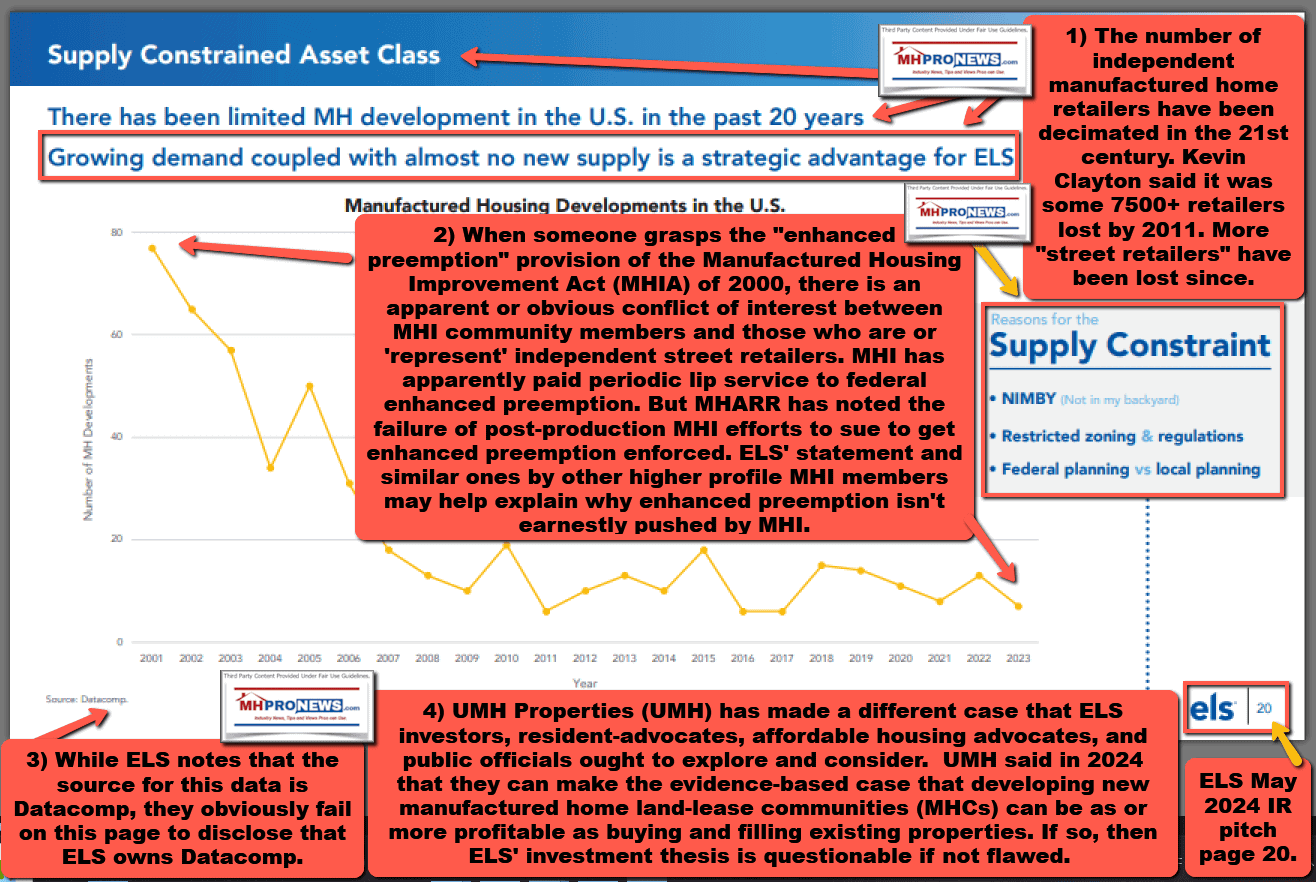


To oversimply. Once someone understands the industry’s dynamics there is an evidence-based argument to be made that either MHI’s leadership is either composed of fools and idiots who despite their degrees and experiences somehow manage to make the same mistakes time and again, OR there is a deliberate set of choices being repeatedly made that are understood through the lens of the consolidation thesis. That oligopoly style consolidation thesis, properly understood, reveals clear evidence of antitrust violating behavioral patterns.


Using the consolidation thesis, MHI pays lip service to seeking the full, routine and robust enforcement by federal agencies of existing laws that if enforced would lead the industry back to and surpassing its historic potential. Call it paltering, “deception and misdirection,” half-truths, bold lies or what have you, but it has been understood and discerned by both human intelligence (HI) and artificial intelligence (AI). Absent the clear understanding of 21st century industry dynamics, the paltering and posturing of key MHI members can work.


By not seeking the rigorous and routine enforcement of existing federal laws (pre-21st Century ROAD to Housing Act), such as “enhanced preemption” and the Duty to Serve/FHA Title I, the almost inevitable conclusion is a steady industry consolidation and surpa-competitive site fees and unit pricing.


See also: https://www.manufacturedhomepronews.com/consolidation-of-key-mh-industry-sectors-ongoing-growing-concern-mhi-hasnt-addressed-because-doing-so-would-implicate-their-own-members-plus-sunday-weekly-mhville-headlines-recap/


Using the consolidation thesis as the interpretive lens, some two decades of industry behavior comes into sharper focus. Part of the beauty of it is that the consolidators themselves have arguably supplied the evidence. Framing that is the quote from Sam Strommen, followed by other quotes and documents by those who shed light on, and/or are a part of, the consolidation thesis behaviorial pattern.

To see the below in a larger size, in most devices or browsers, click here and follow the prompts. Or click the image and follow the prompts.


Market constraints are why lot rents and new manufactured home prices have arguably risen faster than inflation. Those constraints were deliberate choices by corporate leaders routinely involved in MHI and/or MHI linked state associations.


Per economist James Schmitz Jr., “monopolies sabotage and destroy markets.”


Time will tell how the Court will consider the various parties’ pleadings and if it does so in the light of evidence such as is presented or linked herein.
There is always more to know. Until next time…thanks for checking in. ##


With credits, thanks, and contributions to those sources as shown herein.
eFax Number 1-407-604-6427
— —
Invitation for Feedback
MHProNews welcomes evidence‑based feedback from:
- Industry professionals
- Public officials
- Attorneys and antitrust researchers
- Academics and economists
- Affordable housing advocates
- AI researchers
- Any person or organization named in a report
Submit comments or documentation via:
eFax Number 1-407-604-6427


