‘Cracking the Door or Sounding a False Dawn?’ Will New White House Executive Order Boost Affordability via More Manufactured Housing? Plus Sunday Weekly MHVille Headlines Recap. FEA
According to the new White House Executive Order (EO) posted in Part I: “The American Dream of homeownership is a vital pillar of our great country. It is the policy of my Administration to reduce regulatory barriers to mortgage origination and costs impeding homeownership…” According to the document here and posted below in Part II (highlighting added): “Cracking the Door or Sounding a False Dawn?” “The White House executive order titled Decreasing Housing Costs for the American People introduces a complex policy vehicle that touches on transaction expenses, mortgage insurance, appraisal requirements, and the formation of a federal task force dedicated to expanding manufactured housing. From a precise, Facts-Evidence-Analysis (FEA) perspective, the phrasing walks a delicate line. It hints at structural mechanisms capable of opening doors to long-dormant statutory remedies—such as the 2000 Reform Law’s enhanced preemption and Duty to Serve (DTS) mandates for chattel loans under HERA 2008—while remaining cautious enough to skirt direct administrative confrontation with entrenched municipal zoning cartels. Contrasting this current juncture with the previous administration’s stance—typified by HUD Secretary Marcia Fudge’s assertion that the nation would be “perpetually” stuck in a zoning and affordability crisis unless local barriers were addressed—this order represents the closest an administration has come to acknowledging federal levers for factory-built housing since the passage of HERA and the Manufactured Housing Improvement Act of 2000.” The White House Executive Order (EO) dated 1o.22.2026 is provided in Part I so MHProNews readers can have the primary source as well as the MHVillefacts-evidence-analysis (FEA) found in Part II which leads into this Sunday Weekly Headlines in Review provided in Part III.
By the authority vested in me as President by the Constitution and the laws of the United States of America, it is hereby ordered:
Section1. Purpose. The American Dream of homeownership is a vital pillar of our great country. It is the policy of my Administration to reduce regulatory barriers to mortgage origination and costs impeding homeownership; embrace innovative risk and value assessment technologies that incorporate Super Intelligence to drive down mortgage and homeownership costs; and promote competition and innovation throughout the housing and mortgage market.
Sec. 2. Proactive Cancellation of Excessive Mortgage Insurance. (a) The Director of the Federal Housing Finance Agency (Director) shall, if he determines that it is in the best interests of the Federal National Mortgage Association and the Federal Home Loan Mortgage Corporation (Enterprises) or the Federal Housing Finance Agency (FHFA), and the American public, direct the Enterprises to establish a pilot program, applicable only to mortgages made after the establishment of the pilot program, that periodically reviews single-family mortgage loans they own, guarantee, or securitize, using automated valuation models and other available data to assess current market value, and to identify borrowers who appear to satisfy equity and other requirements for cancellation of mortgage insurance.
(b) The Director shall direct the Enterprises to establish procedures for the pilot program, including financial safety and soundness standards and payment-history requirements, under which mortgage insurance is canceled proactively when an Enterprise determines that:
(i) the borrower satisfies applicable equity requirements based on the property’s current market value, as determined through an automated valuation model or other means approved by the Director;
(ii) cancellation is consistent with financial safety and soundness and with the Enterprise’s contractual obligations; and
(iii) the borrower satisfies all other applicable statutory, contractual, regulatory, and Enterprise requirements for cancellation.
(c) The Director shall direct the Enterprises to require servicers, to the extent permitted by law and operationally feasible, to notify borrowers promptly when mortgage insurance may be canceled under the pilot program, and to reduce or eliminate unnecessary documentation requests, appraisal costs, and other administrative barriers to cancellation.
Sec. 3. Standardizing the Permitting of Homes. (a) To increase the quality and lower the cost of building a home, there is hereby established the Task Force on Manufactured Housing Innovation (Task Force), which shall be co-chaired by the Secretary of Housing and Urban Development and the Director of the Federal Housing Finance Agency, or their designees, and shall include the Secretary of Agriculture, the Secretary of Commerce, and the Secretary of Veterans Affairs, or their designees. The co-chairs may invite the heads of other executive departments and agencies (agencies) to participate, as appropriate.
(b) Within 180 days of the date of this order, the Task Force shall submit to the President, through the Assistant to the President for Economic Policy, recommendations to facilitate the use of modern manufacturing methods in the production of manufactured and other factory-built housing eligible for Federal housing programs, including actions to:
(i) promote specifications, certifications, inspections, and approvals across Federal housing and housing-finance programs;
(ii) establish reciprocal recognition among agencies of licenses, certifications, approvals, and inspections, where doing so would avoid unnecessary duplication;
(iii) eliminate Federal requirements and duplicative reviews that unnecessarily impede automation, modularization, standardized production, or other advanced manufacturing techniques, or that increase the time or cost of bringing homes to market;
(iv) use Federal financing, insurance, guarantee, purchasing, and other program authorities to encourage innovation and increased production of affordable manufactured and factory-built homes; and
(v) promote competition among manufacturers and other market participants while maintaining appropriate standards for safety, quality, durability, and consumer protection.
(c) The Task Force shall also evaluate whether, and under what existing statutory authorities, Federal grant funding may be conditioned on, or be used to incentivize, State and local adoption of standardized permitting and licensing for manufactured and other factory-built housing, consistent with the best practices issued under section 4(a) of Executive Order 14394 of March 13, 2026 (Removing Regulatory Barriers to Affordable Home Construction), and shall prepare legislative recommendations to codify the policies set forth in this subsection.
(d) The heads of the agencies represented on the Task Force shall, within their respective authorities, take appropriate action to implement the Task Force’s recommendations.
Sec. 4. Reducing Excessive Title Insurance, Especially in the Refinancing of Americans Homes. (a) The Director shall, if he determines that it is in the best interests of the Enterprises or the FHFA, and the American public, and consistent with financial safety and soundness, the Director’s authorities as regulator and conservator, and applicable law, direct the Enterprises to expand the title acceptance pilot into an ongoing program, available nationwide through both Enterprises, under which an Enterprise may accept an automated title review or other title-risk assessment approved by the FHFA in lieu of a lender’s title insurance policy on eligible refinance transactions.
(b) In expanding the program, the Director shall consider:
(i) extending eligibility to refinance transactions with loan-to-value ratios above the current 80 percent limit where title risk remains low;
(ii) removing geographic limitations and certifying additional title-assessment providers to promote competition;
(iii) waiving appraisals, income re-verification, and other documentation requirements for limited cash-out refinances that reduce the borrower’s monthly payment, where the Enterprise’s existing data support doing so; and
(iv) reducing or eliminating loan-level price adjustments and other Enterprise fees on such refinances.
(c) The Director shall require that cost savings resulting from the program be passed through to borrowers and that lenders inform borrowers of those savings.
Sec. 5. Department of Agriculture and Department of Veterans Affairs Direct Loan Rates. The Secretary of Agriculture and the Secretary of Veterans Affairs shall, consistent with applicable law, including 42 U.S.C. 1490a(a)(1)(B) and 38 U.S.C. 3762(c)(1), and available appropriations, reduce the interest rates charged on single‑family home loans made directly by their respective departments.
Sec. 6. General Provisions. (a) Nothing in this order shall be construed to impair or otherwise affect:
(i) the authority granted by law to an executive department or agency, or the head thereof; or
(ii) the functions of the Director of the Office of Management and Budget relating to budgetary, administrative, or legislative proposals.
(b) This order shall be implemented consistent with applicable law and subject to the availability of appropriations.
(c) This order is not intended to, and does not, create any right or benefit, substantive or procedural, enforceable at law or in equity by any party against the United States, its departments, agencies, or entities, its officers, employees, or agents, or any other person.
(d) The costs for publication of this order shall be borne by the Federal Housing Finance Agency.
Executive Summary: “Cracking the Door or Sounding a False Dawn? An FEA Analysis of the White House Housing Executive Order and Its Manufactured Housing Implications”
The White House executive order titled Decreasing Housing Costs for the American People introduces a complex policy vehicle that touches on transaction expenses, mortgage insurance, appraisal requirements, and the formation of a federal task force dedicated to expanding manufactured housing. From a precise, Facts-Evidence-Analysis (FEA) perspective, the phrasing walks a delicate line. It hints at structural mechanisms capable of opening doors to long-dormant statutory remedies—such as the 2000 Reform Law’s enhanced preemption and Duty to Serve (DTS) mandates for chattel loans under HERA 2008—while remaining cautious enough to skirt direct administrative confrontation with entrenched municipal zoning cartels.
Contrasting this current juncture with the previous administration’s stance—typified by HUD Secretary Marcia Fudge’s assertion that the nation would be “perpetually” stuck in a zoning and affordability crisis unless local barriers were addressed—this order represents the closest an administration has come to acknowledging federal levers for factory-built housing since the passage of HERA and the Manufactured Housing Improvement Act of 2000. However, whether this framework cracks the door open to true reform or serves as another bureaucratic “illusion of motion” depends entirely on aggressive agency execution.
Table 1: Critical FEA Reading of the Executive Order’s Manufactured Housing Provisions
Policy Mechanism in EO
Apparent Surface Intent
FEA Underlying Reality & Structural Implication
Federal Task Force on Manufactured Housing
Directs executive agencies to evaluate and expand factory-built housing contributions.
The Promise vs. Action Gap: While it provides a formal platform, task forces frequently bypass statutory mandates unless coupled with direct enforcement mechanisms like preemption.
Targeting Closing & Refinancing Costs
Lowers burdens related to appraisals, title insurance, and mortgage insurance fees.
Chattel Blindspot: Broad financing relief helps site-built buyers, but unless it specifically tackles personal property (chattel) lending bottlenecks via DTS, it leaves the majority of manufactured home buyers unserved.
Regulatory Barriers Reduction
Seeks to streamline the construction and placement of affordable housing options.
The Preemption Test: True regulatory relief requires invoking the 2000 Reform Law’s enhanced preemption to override local zoning bans—a step requiring executive political will.
Table 2: Historical Contrast: The Biden-Harris HUD Stance vs. Current Executive Action
Administration Era / Official
Core Stated Philosophy on Zoning & Affordability
FEA Evaluation of Systemic Impact
Biden-Harris Administration (HUD Sec. Marcia Fudge)
Declared that the nation would be “perpetually” trapped in a housing crisis regarding zoning until local communities voluntarily address it.
Defeatist Status Quo: Externalized federal responsibility, shielding exclusionary zoning boards and municipal gatekeepers from federal preemption enforcement.
Current Administration Executive Order Framework
Focuses on reducing mortgage, refinancing, and structural housing costs while establishing manufactured housing task forces.
Pragmatic Opening: Closer to invoking statutory tools than any predecessor since 2000/2008, though implementation details will determine its true efficacy.
Table 3: Evaluating Potential Levers: Enhanced Preemption and DTS Chattel
Statutory Instrument
Original Intent & Legislative Power
Current Policy Obstacle & FEA Verdict
Enhanced Preemption (MHIA of 2000)
Empowers HUD to preempt state and local laws that arbitrarily discriminate against HUD-Code manufactured homes.
Under-Enforced Weapon: Despite being on the books for over two decades, administrations routinely sidestep it to avoid political friction with local municipalities.
Duty to Serve (DTS) for Chattel (HERA of 2008)
Mandates that Fannie Mae and Freddie Mac support secondary market liquidity for personal property manufactured home loans.
Gated Access: Enterprise reluctance and conservative underwriting have left chattel borrowers paying inflated interest rates, starving organic industry growth.
Table 4: Key Insights for the Developing MHProNews Weekly Recap
Reporting Angle
Core Focus of the Analysis
Significance for Industry Stakeholders
News Through the Lens of Manufactured Homes
Evaluating mainstream housing executive orders through the specific mechanics of the HUD-Code sector.
Exposes whether federal policies genuinely embrace factory-built solutions or merely pay lip service while prioritizing conventional site-built finance.
The Consolidation Trap vs. Organic Growth
Examining how regulatory burdens and financing gaps disproportionately crush independent builders and retailers while benefiting institutional consolidators.
Highlights the necessity of enforcing federal preemption to break land-lease and zoning monopolies.
Summary and Conclusion
A rigorous, FEA-driven reading of the Decreasing Housing Costs for the American People executive order reveals a dual-natured policy instrument. On one hand, it cracks the door open to federal recognition of manufactured housing as an essential pillar of affordability, marking a noticeable shift away from the passive, defeatist stances of prior leadership like HUD Secretary Marcia Fudge, who resignedly accepted perpetual zoning gridlock. On the other hand, unless the newly formed task forces and federal housing agencies muster the political will to aggressively deploy enhanced preemption under the 2000 Reform Law and enforce robust Duty to Serve chattel financing under HERA, the order risks becoming another high-profile exercise in optical optics rather than structural reform. As independent tracking on MHProNews and MHLivingNews underscores, true affordability will remain elusive until federal authorities stop nibbling at the edges of transaction costs and directly dismantle municipal zoning cartels.
Indeed, the EO’s specific emphasis on zoning and other “outdated … restrictions” on federally-regulated manufactured housing is fully consistent with an April 24, 2019 communication from MHARR to Secretary Carson, calling on HUD to “utilize its resources to research, study and analyze such discriminatory and exclusionary zoning and its local and national impacts on the availability of affordable [manufactured] housing and homeownership in light of relevant national housing policies.” The same communication calls on HUD to exercise its authority under the enhanced federal preemption language of the Manufactured Housing Improvement Act of 2000 to either eliminate or limit such baseless restrictions. And, indeed, in response to an inquiry from MHProNews Publisher L.A. Tony Kovach, it appears that the specific issue of federal preemption will be “on the table” in this process.
Which begs the question. Why hasn’t the Manufactured Housing Institute (MHI) used its much-touted access to key Congressional leaders, public officials, or the White House to press for full and robust enforcement of the “enhanced preemption” provision of the 2000 Reform Law, which successive corporate leaders on behalf of MHI have said they want in Congressional testimony over a period of at least 15 years? Indeed, why is it that when the article below was published, so many of MHI’s own testimonial documents were missing from the public-side of MHI’s own website?
MHProNews Programming Notice. As a result of the contributor relationship developed with HousingWire, MHProNews made a pivot from The Patch previously announced in December 2025. That said, MHProNews can still contribute to The Patchas desired (as the op-ed linked below reflects and can contribute to other publications (an example from WND.com is also shown below). The latest post on HousingWire is immediately below. Don’t miss it the latest via HousingWire.
MHProNews Notice. There is still a potentially developing controversy at HousingWire regarding the article below. See that below and/or archived here. More on this developing topic as the issues are clarified.
While there is an array of roadblocks and what MHARR aptly calls bottlenecks to the sales, placement and thus production of new HUD Code manufactured housing, a quick survey of facts and evidence rapidly leads to a commonsense analysis (FEA).
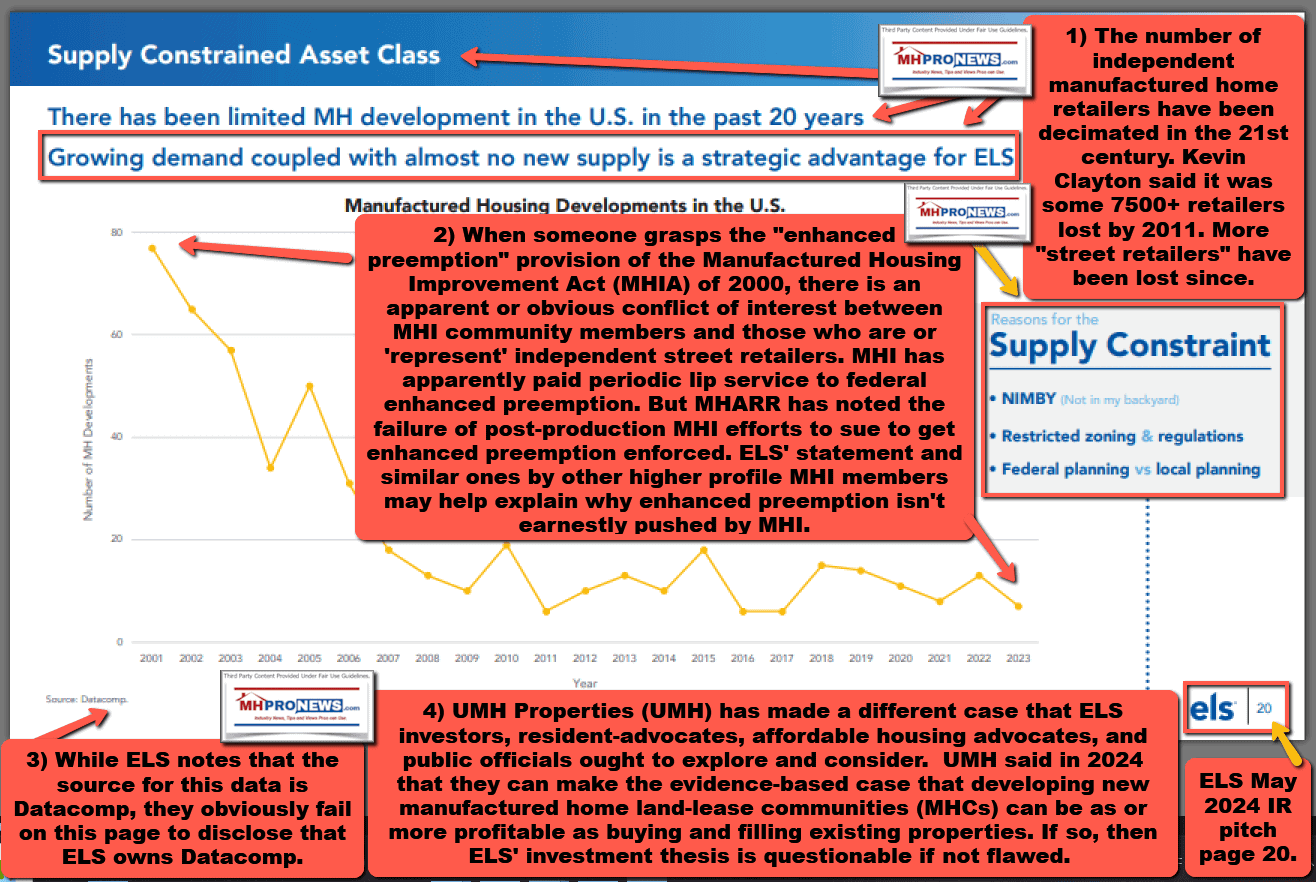
1. As HUD, an array of third-party researchers and Trump Administration of acknowledged, zoning and regulatory barriers have stymied manufactured home production for essentially all of the 21st century. The latest key performance indicators (KPI) demonstrate that point.
2. Financing barriers, as were dramatically illustrated by the Federal Housing Finance Agency (FHFA) release of ‘admissions’ on chattel lending, which revealed that manufactured home loan turndown rates for similar quality credits dwarf those for conventional housing. Gemini calculated in the summer of 2026 that manufactured housing sales could have increased by 125 percent if the approval rates for chattel loans and conventional housing loans were the same.
3. There has been decades of talk about manufactured housing and the industry’s stigma. MHI released a report in 2005 on how that could be addressed and remedied, dubbed the Roper Report which MHI had commissioned. Yet MHI failed to act on its own report. Furthermore, in the years since Roper, Kevin Clayton said the industry was ‘ready’ in 2011 for an image and education campaign. What happened that that Clayton promise?
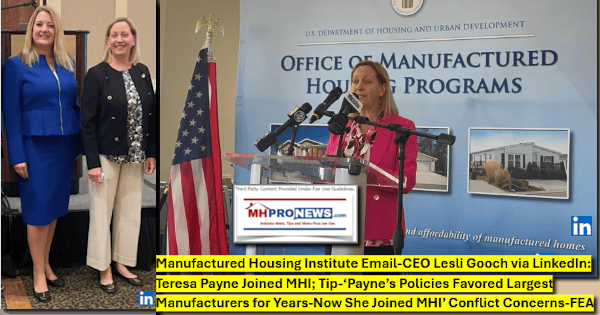
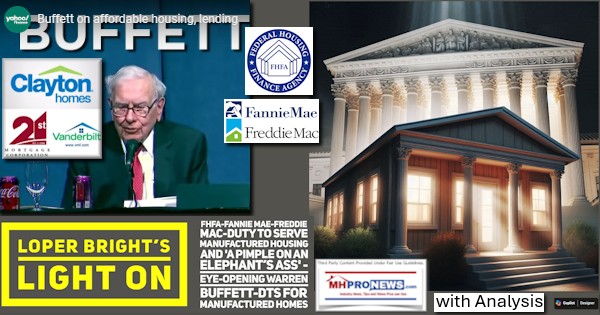
With tens to hundreds of millions of dollars in available cash among individual members of MHI waiting to be deployed, why hasn’t some of that cash been deployed to deal with the image, zoning, and financing parity issues? These are deliberate choices. That’s not speculative, when several of MHI’s own members have repeatedly said that their focus is consolidation and that zoning barriers are a ‘strategic advantage’ to them. The first quote from Lesli Gooch and the second, third and fourth stills from prominent MHI members illustrates the stark divide between posturing and stated corporate priorities.
The ‘mission and goals’ of MHI’s community customers has been further clarified by MHI launching a campaign website dedicated to that cause. So, MHI will launch a ‘campaign’ to burnish the image of communities often accuse of predatory behavior and when several of those MHI member communities are defendants in a national class action antitrust suit? But MHI won’t launch a GoRVing style campaign (see Postscript #3 above) that would essentially be free to producers because consumers that buy the homes pay for them through floor fees?
You simply can’t make this stuff up. It is in your face facts-evidence that practically writes its own analysis.
MHProNews observes that the manufactured home industry should be doing much better than it currently is. To understand the reasons why, there is always more to know. Until next time…thanks as always for checking in. Watch for special reports in the upcoming week, some of which may only be found on MHProNews. ###