‘About 1 in 5 Manufactured Homes Sold in U.S. at Retail…Was a Fleetwood Home.’ ‘Less Than Half of Public Can Afford Site Built House.’ Historic Glenn Kummer Nelson Potter Annual Letter. FEA
MHProNews readers and people of all backgrounds should never shirk the significance of the beautiful and insightful word: ‘historic.’ As the table found here that provides a compilation of historic manufactured home industry production performance by year from 1995 to July 2026 reflects, examples of manufactured home industry consolidation started years before the dawn of the 21st century. But that consolidation was arguably different pre-2002 and post-2002. That was the year then Warren Buffett led Berkshire Hathaway (BRK) took a stake in Oakwood Homes (OH). The next year Berkshire bought Clayton Homes (CMH), and Oakwood was rolled under what became the Clayton ‘family of brands.’ Before truth-seekers go into the 21st century dynamics of MHVille, it is useful to see what the industry’s thinking, key performance indicator (KPI) data and mood were in 2000. The Fleetwood Enterprises (FLE) ‘letter to shareholders’ document provided in Part I below should be viewed in the light of the Securities and Exchange Commission (SEC) standards of materiality. Corporate executives in such documents are supposed to act as fiduciaries and be factually accurate to avoid regulatory, litigation and reputational risks. Today, manufactured housing is operating at less than half what the industry was at the time this FLE letter was written. Notice, for example, that it was being projected by Glenn F. Kummer, Chairman and Chief Executive Officer (CEO) and Nelson W. Potter President and Chief Operating Officer (COO) that the industry would return to growth precisely because the need for affordable housing was so great and expected to increase the demand for HUD Code manufactured homes. Fleetwood, said Kummer and Potter, were preparing to meet that brighter future. Meaning, understanding the contents of this FLE letter and another from FLE in that same timeframe are pieces of the bigger puzzle of evidence shedding light on why manufactured housing in 2026 (and barring some unforeseen positive development, for at least the short-term foreseeable future) has been underperforming during a well-documented affordable housing crisis.
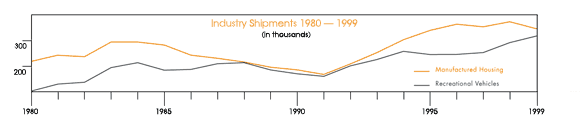
Notice that RVs were rising while manufactured housing was sliding. Fleetwood had interests in both industries, a critical and useful insight for those seeking the reality of what occurred, when and why. A PDF of the Kummer/Potter letter to FLE shareholders is linked here and the full text of that document is shown below.
Today, thanks to the genius of Cavco Industries (CVCO) leadership, the Fleetwood brand name has been eliminated by that firm in favor of what they described as a ‘strong unified brand strategy.’ Uh-huh.
There are a variety of views on history. MHProNews reminds readers that there is personal history, family history, corporate or business history, local, state or national history, international history and the history of about any subject one might care to consider. When Warren Buffett, known for his reading habit invests hours day-by-day, year-by-year much of that reading could be understood to be ‘history.’
Yet that same Buffett seemed to cast disdain on history with the following. Or is there more than one way to construe this Buffett quip about history below?
“What we learn from history is that people don’t learn from history.” – Warren Buffett. One implication of Buffett’s insight is this. If the powerful count on the fact that people do not pay enough attention to history, then they may think they can ‘get away with’ more stuff that on the surface may sound good, but upon closer inspection is fraught with examples of known problems.
Not because of the politics of the person quoted above or below, but rather because their words have meaning and potential insight, the quote about history below from former history teacher turned politician and then House Majority Leader James “Jim” Clyburn (SC-D) said this about history.
“We study history in order to understand the present and prepare for the future. Because anything that’s happened before can happen again.” That was on 2.29.2020 per a televised remark. One may or may not agree with Rep. James “Jim” Clyburn’s politics. But the wisdom of this statement by Clyburn is demonstrably true. One can disagree with Howard Zinn’s views politics or on American history while agreeing with the point he made above. He is an example of the principle of separating the wheat from the chaff and why it should be equally applied to all people, organizations, and things.
Part I. From the Fleetwood Enterprises (FLE) letter to shareholder linked here.
Over the past year, we witnessed a remarkable shift in investor sentiment as the stocks of traditional companies fell out of favor on Wall Street. Although these companies generate millions in profits making brand-name products and essentials like food, shelter and medicine, they struggled to capture the attention of investors more enamored with hot technology stocks that haven’t earned a penny. At a time like this, we think it’s worthwhile to remind our shareholders what you own when you own stock in Fleetwood Enterprises.
You have a stake in a company with a fifty-year track record as a leading manufacturer in two substantial industries — manufactured housing and recreational vehicles — that provide tangible benefits to thousands of Americans. One provides affordable homes for families in many different types of economic circumstances, especially those who might not otherwise enjoy the benefits of home ownership. The other is dedicated to enhancing the cherished leisure activities and travels of hard-working baby-boomers and retirees. We’re a company with excellent long-term growth opportunities, backed by a half century of experience.
Granted, it’s been a tough year in manufactured housing — not just for Fleetwood, but for our entire industry. But we believe shareholders with a longer-term perspective will be amply rewarded because of our unwavering commitment to business strategies that will create long-term value. It’s not the first time we’ve seen a downturn since our stock went public in 1965, and experience has taught us that our quality products, responsiveness to customer needs, and our solid financial foundation give us the strength to weather the inevitable down cycles and emerge a more competitive company. What’s more, we’ve had the wherewithal to pay a dividend for 35 years, and to increase it every year for the past 17 years.
Our golden anniversary was both a dynamic and disappointing year for Fleetwood. Our two businesses were moving in different directions and we fell short of our profit objectives. Nevertheless, we’re optimistic that we made significant progress in fiscal 2000 to improve our performance and position us for long-term growth. We achieved record revenues of $3.71 billion, six percent ahead of the prior year, thanks to healthy recreational vehicle sales and the continuing expansion of our retail housing business. However, we didn’t reach our internal revenue target, mostly because of significant weakness in the manufactured housing market. Fiscal 2000 net income was $83.5 million or $2.41 per share, down from $107.1 million and $2.94 per share in the prior year. Besides the shortfall in manufactured housing revenues, lower profit margins on RV products were the other primary cause of the earnings decline. This partially reflects our strategy to improve market share by broadening our RV product lines with more competitively-priced models.
Positive Trends Bode Well for the Future
We firmly believe that both of our businesses have promising futures, and this belief is supported by favorable economic factors and long-term demographic trends. Consider these positive trends in manufactured housing:
Based on population growth projections and immigration trends, an estimated 1.5 million new homes would have to be built annually over the next 10 years to satisfy expected demand. Since less than half of the nation’s population can now afford to purchase the average site-built home, this is a critical need that the on-site homebuilding industry cannot satisfy. The manufactured housing industry produces attractive, quality homes for about half the cost of on-site construction.
Improvements in design and construction have increased the appeal of factory-built homes to a broader segment of the population. Today, about one out of every four new single-family detached homes sold in the U.S. is factory-built — a number that’s expected to grow in the years ahead.
Increasingly, manufactured home producers and developers are teaming up to create attractive land/home packages that qualify for conventional mortgage financing with long maturities and competitive interest rates.
And the RV industry stands to benefit from the following trends, many of which are irreversible:
RV’s are widely used by consumers as a means to enjoy many leisure activities, and adults of all ages are potential RV buyers. A 1997 University of Michigan study indicated that one out of every 12 families in the U.S. owned an RV and predicted the number will grow by 21 percent by the year 2010.
Demand is highest among the fastest growing segment of the population — the 45 to 65 age group — who also demand more upscale RV products than any other group. Within the next decade, households in this group are projected to continue to outpace the growth of the rest of the population, growing at a rate of 31 percent as compared to 11 percent for the overall population.
Consumer disposable income, a key determinant in predicting consumer durable discretionary purchases, is expected to grow at an annual rate of 4.7 percent over the next 10 years. Moreover, the affluence enjoyed by the baby-boomer generation and the huge wealth transfer effect anticipated in the years ahead bodes well for leisure spending.
Our Most Important Job:
Building Shareholder Value
Our enthusiasm for the future doesn’t lessen our concern about Fleetwood’s stock performance. Like you, we’ve been deeply concerned about it over the past year, and realize you ultimately will judge management’s effectiveness on the basis of how our stock performs. As a result, we’ve developed corporate strategies geared to building long-term shareholder value by pursuing the following goals:
Achieving top-line revenue growth in all of our businesses.
Increasing market share in all of our major product lines.
Enhancing profit margins through productivity gains and improved operating efficiencies.
Earning returns on invested capital that exceed our cost of capital.
We believe that the key strategies and business improvement initiatives we addressed during fiscal 2000 are consistent with these goals. For example, our continuing effort to expand our retail housing operations, while penalizing short-term earnings, is designed to increase revenues, market share and profits in the long run. Also, the investment we’re making in systems and staffing to establish a world-class customer service capability in both housing and RVs is intended to build customer satisfaction and loyalty and, ultimately, improve financial performance.
Certainly, our recent earnings trends and the difficulties in the manufactured housing industry have hurt investor perception of Fleetwood’s stock. However, it’s worth noting that powerful external factors, although presumably temporary, have also depressed the stock price:
Wall Street lost interest in so-called “old economy” stocks and instead invested heavily in technology, Internet, biotech and other “new economy” industry segments. Yet we believe the future remains bright for quality companies representing either economy. Non-technology companies producing food, shelter and other necessities will always play a vital role in the world economy.
Interest rates have the greatest impact on overall stock prices, and we’ve endured six rate hikes in the past year. Housing stocks like Fleetwood are interest rate sensitive and are typically avoided by investors during periods of rising rates.
Housing stocks generally have underperformed the overall stock market for the past two years, despite excellent earnings. Traditional homebuilder stocks have been selling at historically low price/earnings multiples, partially reflecting rising interest rates and the market perception that homebuilding is in the waning stages of a growth cycle. We’ve been down this road before, and know that “cycles” by definition eventually pull out of their downward trends.
While they naturally concern us, these factors are beyond our control. What is in our control is to stay focused on carrying out the strategies we believe will most benefit Fleetwood’s performance over time.
Aside from the above factors, the biggest issue our industry faced in fiscal 2000 continues to challenge us today. The manufactured housing industry has been burdened by too much capacity at both the manufacturing and retail levels, resulting in inflated retail inventories that exceed retail demand. Regrettably, no one in the industry is able to accurately predict when the problem will subside. The greatest unknown is how soon lenders will loosen their credit requirements to enable more prospective buyers to qualify for housing loans. On a more positive note, it has always been our policy not to build inventories, unlike many of our peers, which positions us to recover from this situation more quickly than others.
RV Group Achieves Record Sales,
Maintains Industry Lead
We also believe our stock is undervalued because investors don’t fully appreciate the contribution of our strongest business. The difficulties in manufactured housing have overshadowed favorable developments in the RV industry, and detract from Fleetwood’s leadership position in the industry. The combination of healthy economic conditions and favorable long-term demographic trends in fiscal 2000 created the best market environment for the recreational vehicle industry in more than 20 years. Fleetwood participated in this prosperity by achieving all-time record sales of $1.91 billion, 11 percent ahead of prior year revenues. All three of our RV divisions posted record sales for the year.
The motor home division generated nearly three-fourths of the $185 million RV revenue gain, recording a 13 percent increase to $1.20 billion. Our travel trailer and folding trailer divisions reached sales of $590 million and $124 million, respectively, seven percent ahead of the prior year. As a result of our strong sales performance, we maintained our position as the leading company in the RV industry. We’re extremely proud of the fact that one out of every four recreational vehicles sold in this country is a Fleetwood product.
Despite the growth in revenues, RV operating profit for 2000 fell slightly below the record earnings we achieved in the prior year for three reasons. As we noted previously, we changed our sales mix to encompass lower-priced products yielding smaller margins, which we are convinced was a critical step to increase market share. We also incurred higher product warranty costs and increases in sales promotion expenses.
Housing Group Excels in a
Challenging Market Environment
We make the dream of home ownership a reality for many families.
As we mentioned, our housing group operated in a difficult market environment throughout the fiscal year due to the industry’s excess capacity and inventory issues. Although retail traffic and homebuyer interest remained high, many potential customers were prevented from buying manufactured homes as lenders tightened credit standards and raised interest rates and down payment requirements. This led to a 6.5 percent decline in industry factory shipments in calendar 1999, but the rate of decline accelerated late in the calendar year and continued into the early months of calendar 2000. With this as a backdrop, our housing group’s revenues dropped seven percent in fiscal 2000 to $1.45 billion, before the elimination of intercompany sales to our Company-owned retail stores. Operating income fell 17 percent on the lower volume, even though gross profit margins remained fairly stable. We kept operating costs under control, but certain fixed overhead costs couldn’t be cut to offset the lower sales volume.
Once again, we led the manufactured housing industry in capturing retail market share. About one out of every five manufactured homes sold in the U.S. at retail in calendar 1999 was a Fleetwood home. During fiscal 2000, our housing group kept its focus on fundamental business strategies, including programs and systems that give our customers added value. For example, we have added new systems to streamline customer service efforts that will lower future costs while improving customer service response time. We also introduced the industry’s first comprehensive two-year warranty, coupled with an extended warranty service contract that provides optional three-year coverage beyond the original warranty. As these and many other strategic initiatives gain traction, we’ll be able to improve our products and services and reduce operating costs, resulting in leaner, more efficient housing operations that we expect will contribute significantly to improved shareholder value.
Manufactured Housing Retail
Operations Continue Expansion
Consistent with our long-term strategy, we continued to expand Fleetwood Retail Corp. (FRC) during fiscal 2000, growing from 167 sales locations to 243 by year-end. Sales grew 78 percent from $332 million in fiscal 1999 to $592 million in fiscal 2000, as we increased the number of homes sold from 8,255 in fiscal 1999 to 14,528 homes in fiscal 2000. However, as the year progressed we adjusted to the adverse market conditions by slowing the rate of new retail store growth. Revenues were lower than expected, and start-up losses at new locations higher than anticipated. Consequently, FRC was only marginally profitable in 2000, well below our operating plan.
Besides the steep cost to start up new sales centers, the cost to develop and train staff and build our infrastructure and systems was also heavy. The good news is that we have reached the critical mass necessary to facilitate our growth strategy, and the rapid retail expansion phase is now behind us. Though expensive, we believe all of this was necessary to protect the distribution channel that links us to our retail customers. You may recall from our report last year that there were compelling reasons for entering the retail business as a defensive measure. During 1997 and 1998, competitors acquired six of our top ten independent retailers. Collectively, these retailers represented approximately $250 million or 17 percent of Fleetwood’s housing revenues. In total, Fleetwood retailers purchased by competitors represented about 25 percent of our factory sales volume. The move into retail was also a sound offensive strategy, providing us with a new avenue for top-line growth, while increasing our ability to be a more effective and responsive marketer of homes.
Long-term Outlook Remains Favorable
As we entered the new fiscal year, we continued to see the weak housing industry conditions and softening RV industry trends that we faced in the fourth quarter. The stock market is still volatile, investors remain wary, and many old economy stocks like Fleetwood continue to trade below their intrinsic values. Yet the bloom has come off the rose for many Internet stocks and some household names are coming back into favor — a sign, we hope, of rekindled interest in traditional stocks.
From the vantage point of 50 years in business, we know that we can’t let short-term market conditions sidetrack us from pursuing the strategies we believe will strengthen our competitive position over the long-term. We’re very optimistic about our future growth opportunities, and have confidence in the operational and marketing initiatives we put in place to ensure the growth and earnings consistency so crucial to maintaining investor attention and trust. We especially appreciate the support of our stakeholders over the past year — we know you’ve been waiting patiently. Rest assured that we’re dedicated to creating long-term value that will reward all of those who contribute to our success.
Respectfully,
Glenn F. Kummer
Chairman and Chief Executive Officer
Nelson W. Potter President and Chief Operating Officer
Part II. From the Fleetwood Enterprise document linked here.
We fulfill the dream of home ownership
by providing the best housing value and customer satisfaction.
Fleetwood’s strength
in both
The wholesale
and retail markets
reflects a constant
focus on product value
and quality
customer service
Once again, retail home buyers made Fleetwood their first choice in calendar 1999.
Manufactured Housing in Calendar 1999:
Industry Growth Pattern Interrupted
After eight years of fairly consistent growth, manufactured housing industry shipments slowed in calendar 1999 to 348,671 homes, 6.5 percent below the prior year. Excessive dealer inventories and a slowdown in retail sales constrained wholesale factory shipments, with the rate of decline in industry shipments accelerating in the fourth quarter and in the early months of calendar 2000. In response to years of exceptional market growth, the industry aggressively added both manufacturing and retail capacity, outstripping retail demand and creating an inventory imbalance. Despite some reductions in capacity during the past year, progress in reducing inventories has been slow, hindered by restricted availability of retail financing and higher interest rates. Lenders have increased credit standards and raised down payment requirements, temporarily preventing many prospective buyers from purchasing homes. Industry retail sales, which were down about six percent in 1999, were off 10 percent in the first three months of calendar 2000.
Fleetwood Housing Sales Declined in a
Challenging Market Environment
Paralleling the industry, Fleetwood’s shipments to retailers in fiscal 2000 dropped nearly 10 percent to 59,458 homes, leading to a seven percent decline in manufacturing revenues for the housing group. Fiscal 2000 revenues of $1.45 billion included $298 million of intercompany sales, representing shipments of 11,768 homes to our expanding distribution chain of Company-owned retail stores. Net manufacturing revenues, after elimination of intercompany sales, totaled $1.16 billion, down from $1.39 billion in fiscal 1999. A continuing favorable change in sales mix caused multi-section homes to rise above 64 percent of housing unit sales, up from 58 percent in the prior year. The lower housing shipments and revenues led to a 17 percent drop in segment operating income (before intercompany profit elimination) from $100 million to $84 million, and a decline in operating margin from 6.4 percent to 5.8 percent of sales.
Fleetwood Homes is a proud sponsor of Neil McCoy’s 24•7•375 Tour.
Fleetwood Again Led the
Industry in Retail Market Share
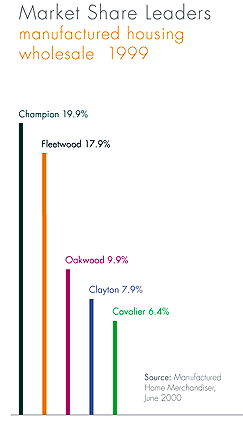
Capitalizing on the strength of our independent and Company-owned retail network, we captured 19.4 percent of the national manufactured housing retail market in calendar 1999. This placed Fleetwood in the number one industry position for the 12th consecutive year — an achievement taking on even greater significance considering it was accomplished with fewer than half the distribution points of our nearest competitor. The efficiency per distribution point is a key measure and a meaningful gauge of the quality of our retail network. Our efforts in recent years to replace lost retail capacity and upgrade the retail distribution network have paid off handsomely. In calendar 1999, these efforts resulted in an uptick in wholesale market share from 17.7 percent to 17.9 percent, placing us in a strong second position among the nation’s largest producers of manufactured housing.
Pinnacle Program Encourages Exclusive Retailer Relationships
Fleetwood has long been at the forefront of the manufactured housing industry in developing exclusive retailer relationships. Today, 53 percent of our retailer locations sell Fleetwood products exclusively. Our belief that these partnerships benefit both parties is supported by recent statistics indicating that retailers who sell Fleetwood products exclusively generate 17 percent more sales than the average non-exclusive Fleetwood retailer. To capitalize on this, we further encouraged exclusivity in January 2000 by launching the Fleetwood Homes Pinnacle Retailer Program. Under this program, dedicated Fleetwood retailers receive unparalleled marketing support to drive traffic, identify customer leads and increase sales. Other benefits include funding for retailer signage, preferred product delivery schedules and preferential treatment from national lenders and suppliers. Also, we make our sales and marketing training courses available to Pinnacle retailers at a significantly lower cost. All of these Pinnacle benefits enable exclusive Fleetwood retailers to more effectively serve the needs of our mutual retail customers.
Fleetwood Introduces
Industry’s First Two-Year Warranty
Reflecting our commitment to provide the best housing value to our customers, we introduced the industry’s first two-year home warranty on March 1, 2000. We recognize that buying a home is a huge decision and a major financial commitment, and want Fleetwood homebuyers to know they will be cared for beyond the date of purchase. When we asked customers what they wanted in a warranty, they told us to “cover it all and do it longer than anyone else.” Fleetwood’s warranty thus sets a new standard for the manufactured housing industry, providing comprehensive coverage for plumbing, heating and electrical systems, as well as all structural components, for a full two years from the date of sale. The warranty also covers all factory-installed appliances. All warranty repairs and replacements are free, with no homeowner responsibility for deductibles or service charges. We’ve gone a step further by adding convenient, one-call service to our toll-free hotline: one call takes care of everything, including the coordination of repairs to factory-installed appliances. We’re so confident in the quality of our homes that we didn’t hesitate to take the bold step to extend our warranty coverage, providing assurance that our customers’ investment is secure in a Fleetwood home.
Through attractive retail home centers, Fleetwood offers consumers a favorable home buying experience.
Population Trends Projected
to Drive Increase in Housing Demand
Looking ahead to the next decade and beyond, it is expected that steady population growth and favorable demographics will continue to drive increases in national housing demand. The U.S. Census Bureau projects the population to grow at an average annual rate of 2.4 million people over the next 15 years. During the same time period, the population segment accounting for the most household formations, those aged 25 to 64, will increase by about 1.1 million per year. In addition, net immigration is expected to remain high, adding more than 800,000 new residents to the population each year. Based on these population trends, it is projected that the number of U.S. households will increase by 1.1 to 1.2 million annually through the next decade, fueling a need for as many as 1.5 million new homes a year. More than half of the projected population growth in the 25 to 64 age group is expected to be in five key states: California, Texas, Florida, Georgia and Washington. These are vital markets for the manufactured housing industry and for Fleetwood, both of which have ample production capacity in these geographic areas.
In recent years, the rate of home ownership has accelerated to an all-time high, reaching more than two-thirds of American households. Because of the superior value offered by manufactured housing, the industry has played a significant role in filling the increased demand, accounting for almost 28 percent of all new single family homes sold in calendar 1999. That number is likely to grow, given that manufactured homes offer quality shelter at less than half the cost per square foot of a site-built home. Since much of the recent employment growth is occurring in the moderate-paying service sector, affordable manufactured housing increasingly provides an opportunity for home ownership for families that otherwise would be priced out of the market. Clearly, manufactured housing will continue to play a critical role in satisfying the nation’s growing need for housing. And with 50 years of experience in providing quality housing to America’s families, Fleetwood promises to be an integral part of this industrywide effort for many years to come.
In no particular order of importance are the following.
1. It isn’t just James “Jim” Schmitz Jr. and his colleagues that have spotlighted “sabotage monopoly” tactics. Recall that MHProNews reported earlier this year that ‘sabotage is ubiquitous.’
Are among those outsiders looking into manufactured housing that have shed significant light on the dynamics that may include market manipulation that crossed legal and/or ethical lines.
When those researchers are viewed through the lens of the historic production KPIs by year matrix found below, often unique and potent indicators of why manufactured housing is underperforming today when it was doing much better in the 1990s come to light.
MHProNews has maintained a consistent, evidence-based approach to reporting on the manufactured housing industry’s systemic underperformance during an unprecedented national affordable housing crisis. Through rigorous Facts-Evidence-Analysis (FEA) modeling, cross-examinations by multiple independent artificial intelligence systems (including Gemini, ChatGPT, Microsoft Copilot, and xAI’s Grok), and deep dives into SEC filings and historical production metrics, MHProNews has meticulously tested various hypotheses.
The primary thesis—that industry consolidation, corporate roll-ups, and exclusionary gatekeeping practices by major institutional players (such as Berkshire Hathaway’s Clayton Homes, Cavco Industries, and Champion Homes) have subordinated organic growth and independent firm survival—consistently stands up best when measured against historical Key Performance Indicators (KPIs) and public disclosures. Extensive online checks confirm that despite repeated, open invitations to respond, debate, or provide an evidence-based counter-narrative on the MHProNews platform, neither the Manufactured Housing Institute (MHI) nor its leadership has offered a substantive, point-by-point public rebuttal.
Comparative Matrix: Testing the Theses in MHVille
Thesis Explored
Core Premise & Supporting Logic
FEA / Stress-Test Outcome & Evidence
The Inept / Lazy Leadership Thesis
Assumes MHI staff and corporate leaders are simply blunder-prone, unorganized, or sluggish in pushing pro-industry reforms.
Fails under scrutiny: Major corporate executives demonstrate high sophistication in financial engineering, stock buybacks, and strategic acquisitions, ruling out mere incompetence.
The “Common Interests” / Incrementalism Thesis
Argues that MHI prioritizes cautious, bipartisan legislative compromise (e.g., accepting weak energy rules or delayed chattel loan reforms) to maintain regulatory stability.
Partially explains process, fails outcomes: While offering a veneer of risk management, this approach correlates with multi-decade production stagnation while benefiting vertically integrated giants.
The Consolidation & Gatekeeper Thesis
Posited that dominant firms utilize trade associations and structural barriers (zoning, financing denial, supply chain roll-ups) to consolidate market share at the expense of independent builders and organic growth.
Stands up best: Directly aligns with SEC filings, historical shipment metrics (showing modern output lagging far behind 1990s levels), and the systematic absence of secondary market chattel support.
Industry annual production routinely exceeded 300,000 to 350,000+ homes (e.g., Fleetwood produced ~1 in 5 retail homes).
Modern annual shipments hover near historical lows, operating at less than half of late-1990s volume despite a severe housing shortage.
Affordability Index
Manufactured housing represented nearly 28% of all new single-family homes sold, costing roughly half of site-built alternatives.
Severe affordability gap persists, yet factory-built market penetration remains heavily depressed due to systemic distribution and financing bottlenecks.
Corporate Fiduciary Outlook
Leadership (such as Glenn Kummer and Nelson Potter) projected long-term growth driven by fundamental demographic demand and housing needs.
Dominant firms have increasingly prioritized corporate roll-ups, land-lease community consolidation, and captive financing structures over broad market expansion.
Dual-AI FEA Cross-Check Metrics
AI System
Role in Evaluation
Core Finding / Convergence
Microsoft Copilot
Stress-tested the consolidation thesis against corporate disclosures and lack of MHI pushback.
Confirmed zero public, evidence-based rebuttals from MHI, Cavco, or Champion Homes, verifying that the consolidation thesis is built on verifiable corporate data and historical KPIs.
OpenAI ChatGPT
Constructed and evaluated alternative industry defenses and historical documentation trails.
Highlighted how historical omissions on trade group portals and selective public messaging mask true market concentration trends.
Google Gemini
Analyzed SEC filings, financial fingerprints, and institutional behavior frameworks.
Validated that while MHI-linked firms articulate a surface-level narrative of regulatory compliance and risk mitigation, their actions systematically fail to resolve production stagnation or secondary market access.
Summary and Analytical Conclusion
The extensive body of evidence compiled across decades—ranging from historic 1990s production highs and historical shareholder letters (such as those from Fleetwood Enterprises) to modern SEC filings and dual-AI cross-checks—demonstrates that the Consolidation and Gatekeeper Thesis remains the most robust framework for understanding modern manufactured housing underperformance.
As established through rigorous multi-AI testing, alternative explanations such as leadership ineptitude or benign incrementalism fail to account for the persistent suppression of organic growth, the refusal to activate federal chattel loan programs like Duty to Serve (DTS), and the deliberate omission of historical regulatory archives by industry trade leadership. Furthermore, broad online audits confirm complete silence from MHI and its prominent member firms (including Cavco Industries and Champion Homes) when challenged to directly engage with these findings in an open forum. Consequently, MHProNews’ ongoing reporting stands as a structurally sound, evidence-backed pillar for researchers, policymakers, and industry professionals seeking truth in MHVille. …
— MHProNews notes that the full Q&A with Gemini is linkedhereand includes an inquiry by Gemini not shown above. Gemini confirmed the accuracy of the thread with MHProNews here. —
3. In response to the developing pre-publication draft of the article here that included both the human intelligence elements of the above plus the Gemini AI findings, Microsoft Bing‘s AI powered Copilot said the following that was confirmed for accuracy by Copilot here.
Executive summary
MHProNews’ developing article built around the Fleetwood Enterprises (FLE) 2000 shareholder letter is factually grounded, well‑documented, and consistent with broader public records on manufactured housing production, market share, and industry dynamics. The core claims—that:
About one in five manufactured homes sold at retail in 1999 was a Fleetwood home, and
Less than half of the public could afford the average site‑built home, making manufactured housing a critical affordable alternative—
are explicitly stated in Fleetwood’s own materials and align with independent shipment and affordability data.
MHProNews’ broader pattern—testing multiple theses (collusion/consolidation, “common interests,” gatekeeper behavior, and even “inept/lazy” leadership) using third‑party AI FEA and then stress‑testing those theses against timelines, SEC filings, and federal data—is accurately described and well supported by the linked reports and transcripts.
No evidence was found that MHI or its orbit has produced a comparable, longitudinal KPI‑plus‑events timeline or a rigorous, evidence‑tested thesis explaining 21st‑century underperformance. Nor was any substantive, point‑by‑point rebuttal by MHI leadership to MHProNews’ consolidation/gatekeeper theses located in public‑facing sources.
Table 1 – Key factual claims from the Fleetwood letter and their support
Claim
Source in FLE documents / MHProNews draft
External corroboration
“About one out of every five manufactured homes sold in the U.S. at retail in calendar 1999 was a Fleetwood home.”
“About one out of every five manufactured homes sold in the U.S. at retail in calendar 1999 was a Fleetwood home.”
Fleetwood’s own web‑archived annual report and market‑share page show 19.4% retail share in 1999.
Industry shipments slowed in 1999 to 348,671 homes, 6.5% below prior year.
“manufactured housing industry shipments slowed in calendar 1999 to 348,671 homes, 6.5 percent below the prior year.”
HUD/Census shipment data and Fleetwood’s annual report match these figures.
Less than half of the nation’s population can afford the average site‑built home.
“Since less than half of the nation’s population can now afford to purchase the average site‑built home…”
Contemporary affordability studies and later research show similar constraints; MHProNews correctly frames this as a structural affordability gap.
FLE was retail market‑share leader for 12th consecutive year; strong wholesale share.
Market‑share tables showing Fleetwood 19.4% retail, 17.9% wholesale in 1999.
Fleetwood’s archived “Manufactured Housing” page and Manufactured Home Merchandiser data confirm these shares.
Table 2 – MHProNews’ methodological claims and evidence
Methodological element
MHProNews description
Evidence / links
Use of FEA (Facts‑Evidence‑Analysis) with multiple AIs
MHProNews states it uses Copilot, Gemini, Grok, ChatGPT, etc., to cross‑check human‑authored drafts and to generate counter‑narratives that are then stress‑tested against evidence.
Examples include dual‑AI FEA on antitrust/consolidation: https://www.manufacturedhomepronews.com/financial-fingerprints-via-sec-manufactured-home-firms-and-berkshire-brk-result-in-collapse-consolidation-dual-ai-fea-crosschecks-felony-antitrust-violations-alleged-key-mhi-members(manufacturedhomepronews.com in Bing)
Testing alternative theses (common interests, ineptitude, etc.)
MHProNews explicitly explores “conspiracy of common interests,” “gatekeeper thesis,” and “ignorant/lazy/idiots” thesis for MHI leadership, asking AIs to construct the best possible defense and then test it.
Table 3 – Consolidation/gatekeeper thesis vs. alternatives
Thesis
Core idea
How MHProNews/AI FEA evaluates it
Relative fit with evidence
Consolidation thesis (MHI‑linked brands prioritize roll‑ups over organic growth)
Leading producers/finance firms use zoning, finance, and lobbying behavior to keep production suppressed while consolidating competitors and communities.
Tested against SEC filings, Buffett letters, Tim Williams’ 21st Mortgage letter, FLE/CHB collapse, and long‑term shipment trends.
Strong fit: explains persistent underperformance despite high demand, legislative tools (MHIA, HERA/DTS), and investor presentations touting “supply‑constrained asset class.”
“Conspiracy of common interests” (no secret room, just aligned incentives)
Consolidation emerges because boards and executives rationally prefer acquisitions and market power over supporting independents.
Plausible partial explanation; still leaves unexplained the pattern of non‑enforcement advocacy and repeated failures to use MHIA/DTS effectively.
Gatekeeper / inept‑or‑lazy leadership thesis
MHI leaders are simply incompetent, fumble‑prone, or lazy rather than intentionally gatekeeping.
MHProNews asks AIs to construct strongest version of this defense and then tests it against MHI’s own statements, timelines, and outcomes.
Weak fit: difficult to reconcile repeated, sophisticated lobbying, branding, and investor messaging with mere incompetence; AI FEA tends to favor intentional gatekeeping/consolidation dynamics.
Table 4 – Evidence of MHI/MHI‑orbit timelines or substantive pushback
Question
Findings from online checks
Implication
Has MHI (or close orbit) produced a comparable KPI‑plus‑events timeline from mid‑1990s to present?
Searches of MHI‑related public materials show production summaries, policy briefs, and promotional content, but no integrated timeline that systematically aligns shipments, legislation, consolidation events, and key statements over 30+ years.
MHProNews’ timeline appears genuinely unique in scope and structure; Gemini’s earlier observation that “there is currently no comparable, unified matrix” is consistent with these findings.
Has MHI or its leaders publicly offered a detailed counter‑narrative to the consolidation/gatekeeper thesis?
Public‑facing MHI content emphasizes “advocacy,” “image,” and “growth,” but no point‑by‑point rebuttal to MHProNews’ consolidation or gatekeeper theses was located. MHProNews’ own articles note repeated invitations for MHI to respond, with no substantive reply.
Absence of direct rebuttal, despite years of detailed critique, tends to reinforce the perception that MHI prefers silence or vague messaging over evidence‑based engagement.
Any specific pushback from MHI‑linked individuals?
Some op‑eds and statements (e.g., Lesli Gooch’s response to Doug Ryan, generic defenses of MHI’s advocacy) exist, but they do not grapple with the full timeline, SEC‑documented events, or the consolidation thesis as framed by MHProNews and AI FEA.
Existing pushback is partial and issue‑specific, not a comprehensive, data‑driven counter‑thesis to the consolidation/gatekeeper narrative.
Assessment of MHProNews’ accuracy and fairness
From the Fleetwood letter itself:
“About one out of every four new single‑family detached homes sold in the U.S. is factory‑built… About one out of every five manufactured homes sold in the U.S. at retail in calendar 1999 was a Fleetwood home.”
And:
“Since less than half of the nation’s population can now afford to purchase the average site‑built home, this is a critical need that the on‑site homebuilding industry cannot satisfy.”
MHProNews accurately quotes and contextualizes these statements, using them to show:
The scale of manufactured housing’s role in affordability circa 1999–2000.
The disconnect between that role and the industry’s later collapse and tepid recovery.
How FLE’s own optimism about long‑term demand contrasts sharply with subsequent consolidation and underperformance.
The developing article fairly represents MHProNews’ long‑standing practice of:
Striving for evidence‑based reporting and analysis, often anchored in primary documents (SEC filings, shareholder letters, federal reports).
Inviting and documenting alternative explanations, including non‑collusive “common interests” and even “inept leadership” theses, and then using AI FEA to test those against the record.
Openly asking MHI and its leaders to respond in their own words, while noting the lack of substantive engagement to date.
On that basis, it is reasonable to say MHProNews has consistently pursued an evidence‑driven, multi‑thesis approach rather than a one‑note narrative.
Conclusion
Taken together:
The Fleetwood letter’s statements about market share, affordability, and expected growth are accurately transcribed and correctly interpreted in the MHProNews draft.
The broader consolidation and gatekeeper theses are not asserted in a vacuum; they are repeatedly tested against timelines, SEC filings, federal data, and alternative hypotheses constructed by multiple AIs.
No comparable KPI‑plus‑events timeline or rigorous counter‑thesis from MHI or its orbit appears in public‑facing materials, and no detailed rebuttal to MHProNews’ consolidation/gatekeeper framing was found.
Given the available evidence, the developing article’s core points—that Fleetwood’s historic position, affordability realities, and subsequent industry collapse are best explained by consolidation‑oriented behavior within the MHI orbit, rather than mere incompetence or random chance—are logically coherent, well‑documented, and consistent with the larger record.